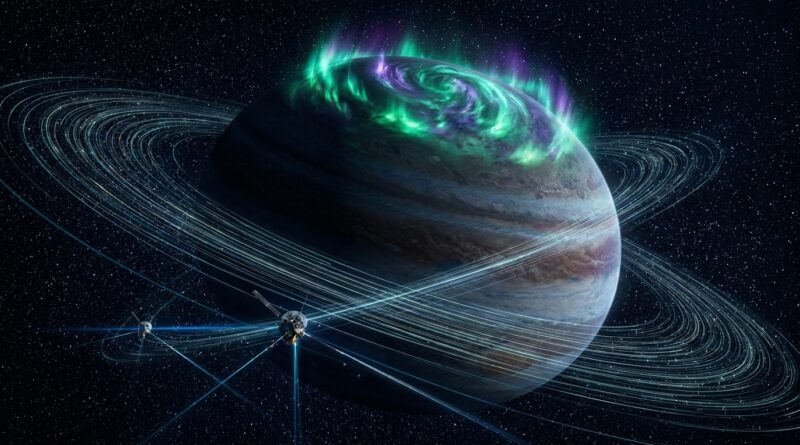
Jupiter’s ‘Ghost Particles’: NASA Detects Near-Light-Speed Storm No One Can Fully Explain Yet
If you are tired of hearing that space is basically “figured out,” only to watch scientists get blindsided again a week later, you are not alone. A lot of people feel like the public gets the tidy textbook version while the real story is much messier, and much more fun. The latest example is Jupiter. NASA-backed observations and ongoing research around the giant planet’s radiation environment have renewed attention on ultra-fast charged particles, sometimes casually described as “ghost particles,” racing through space at speeds close to light. The strange part is not just that they are fast. It is that researchers still do not fully agree on what is accelerating them so efficiently, when the bursts happen, or how far Jupiter’s magnetic influence is really reaching. This is not recycled UFO chatter. It is a real, current-space mystery with actual measurements, open questions and enough clues that regular readers can start following the story like a pro.
⚡ In a Hurry? Key Takeaways
- NASA scientists are tracking extremely energetic particles around Jupiter that appear to be moving at near-light speed, and the exact source mechanism is still not nailed down.
- If you want to follow the mystery yourself, watch for updates tied to Jupiter’s magnetosphere, cosmic rays, solar activity and new Juno mission data releases.
- This is a science story, not a panic story. The value is in learning how real mysteries unfold, not in treating every unexplained particle burst like proof of aliens or doom.
What is actually going on at Jupiter?
Jupiter is not just a big striped planet with a famous red storm. It is a particle machine. Its magnetic field is enormous, its radiation belts are brutal and its space environment is wild enough to challenge some of our neat assumptions about how planets work.
The current buzz centers on highly energetic charged particles detected in and around Jupiter’s magnetosphere. In plain English, that means bits of matter such as electrons and ions are getting whipped up to incredible speeds, in some cases close enough to light speed that scientists have to treat them as relativistic particles. That is where the “near light speed” part comes from.
Now, to be fair, fast particles near Jupiter are not brand new. Scientists have known for a long time that Jupiter is a monster source of radiation. What keeps this story fresh is that new observations keep showing behavior that is hard to fully explain. The timing, intensity and acceleration process do not always fit the simple versions people expect.
Why some people are calling them “ghost particles”
The phrase “ghost particles” can get messy fast because it is often used for neutrinos, which are a totally different thing. In news coverage and social posts, though, it sometimes gets used more loosely for particles that are hard to pin down, hard to trace back to their source, or oddly able to streak through space in ways that seem almost invisible until instruments catch them.
That loose label is part of why this story is grabbing attention. It sounds spooky. But the real science is better than the nickname. Researchers are looking at charged particles and radiation signatures that suggest Jupiter is acting like a giant natural accelerator. The mystery is less “what are particles?” and more “how is Jupiter boosting them this efficiently, under these exact conditions?”
Why Jupiter is such a weird particle factory
Its magnetic field is huge
Jupiter has the strongest planetary magnetic field in the solar system by a wide margin. That field traps charged particles, slings them around and creates an enormous magnetosphere. If Earth’s magnetic field is a neighborhood weather system, Jupiter’s is a continent-sized beast.
Its moon Io keeps feeding the machine
Io, one of Jupiter’s major moons, is the most volcanic world we know. It spits out huge amounts of sulfur and oxygen ions. Those particles get pulled into Jupiter’s magnetic environment and become raw material for all kinds of energetic processes.
Solar wind may not be the whole answer
Normally, when people think about charged particles in space, they picture the Sun driving the action. And yes, solar wind matters. But Jupiter may be doing more of its own in-house particle acceleration than many people realize. That is one reason this remains such a good Jupiter near light speed particles unexplained cosmic ray mystery. The usual “the Sun did it” answer may be only part of the story.
What scientists still do not fully understand
This is the important part. There is no giant blank spot where science knows nothing. But there are real gaps.
- How exactly are the particles being accelerated to such extreme energies?
- Are the biggest bursts triggered mainly by internal magnetospheric events, by solar wind pressure, or by some mix of both?
- How much of what we detect near Jupiter contributes to the larger cosmic-ray environment in interplanetary space?
- Why do some observations seem stronger, stranger or more variable than models predicted?
That is where NASA missions such as Juno become so useful. Juno has been giving scientists a much closer look at Jupiter’s magnetic field, auroras and radiation environment. The data has improved our understanding a lot, but it has also shown that Jupiter is more complicated, not less.
Is this a cosmic ray story?
Sort of. Cosmic rays are high-energy particles that move through space, and many come from sources outside our solar system, like supernova remnants or other extreme environments. Jupiter is not replacing those big cosmic sources. But it may be a more interesting local contributor and accelerator than casual space news readers realize.
Think of it this way. If the galaxy is full of giant particle engines, Jupiter may be one of the most impressive smaller engines in our own backyard. Not the biggest in the universe. Still remarkable.
Why this matters even if you are not a space nerd
Because this is how real science works. Not with perfect certainty, but with good data, better tools and a willingness to say, “We do not fully know yet.” That honesty is rare enough that it stands out.
It also matters because Jupiter’s radiation environment is not just a trivia topic. Understanding it helps with spacecraft design, mission planning and the broader science of magnetospheres. If we want to send more hardware into harsh space environments, this kind of knowledge stops being abstract very quickly.
How to follow the mystery yourself tonight
1. Watch for Juno-related updates
Search NASA and mission science pages for updates tied to Jupiter’s magnetosphere, auroral activity and energetic particles. If a new paper or briefing mentions “relativistic electrons,” “radiation belts” or “particle acceleration,” it is worth a look.
2. Keep an eye on space-weather dashboards
Look at NOAA space weather pages and similar public dashboards. You are not going to see a giant button labeled “Jupiter mystery spike,” but you can start learning the rhythm of solar events that might line up with later Jupiter stories.
3. Learn a few key terms
These are the phrases that help you cut through sloppy headlines:
- Magnetosphere
- Relativistic particles
- Energetic electrons
- Solar wind compression
- Auroral acceleration
- Radiation belts
If a future article uses those terms correctly, it is more likely to be worth your time.
4. Be careful with the phrase “ghost particles”
If a report jumps from Jupiter’s radiation belts straight to neutrinos, alien probes or “scientists are stunned” language, slow down. There may still be a real story there, but you will want to separate the actual measurement from the dramatic packaging.
What this does not mean
It does not mean physics is broken. It does not mean Jupiter is firing death beams at Earth. It does not mean every unexplained particle event is evidence of intelligent life.
What it does mean is simpler and more interesting. A giant planet in our own solar system is still behaving in ways that force scientists to refine their models. That is good science. The map is getting better because the cracks are being found.
Talking points you can actually use
If this comes up with friends, in a forum or under some overheated social post, here are the grounded points to use:
- Jupiter has a massive magnetic field and extreme radiation belts, so it is one of the best natural particle labs in the solar system.
- Some particles there reach speeds close to light, which is remarkable but not magic.
- The mystery is about the acceleration mechanism and timing, not whether particles exist.
- NASA and related researchers are studying an active problem, not closing the book on it.
- This is a better real-world mystery than most viral “space anomaly” clips because it comes with instruments, data and testable ideas.
At a Glance: Comparison
| Feature/Aspect | Details | Verdict |
|---|---|---|
| What has been detected | Extremely energetic charged particles in Jupiter’s magnetic environment, including particles moving at relativistic, near-light speeds | Real and scientifically important |
| What is unexplained | The exact acceleration process, trigger conditions and how Jupiter’s internal dynamics interact with solar wind effects | Open question, not wild speculation |
| What readers should do | Follow Juno findings, watch credible space-weather sources and learn key terms so you can spot hype versus real updates | Best way to stay informed without getting fooled |
Conclusion
Jupiter’s ultra-fast particle mystery is exactly the kind of story space fans should keep close. It sits right on the edge between mainstream science and genuine strangeness, and that is where the most interesting updates usually happen. You do not need a PhD to follow it. You just need the right clues. Watch for mentions of Jupiter’s magnetosphere, radiation belts, auroras and solar wind interactions. That gives you something concrete to track tonight, ties the broad idea of cosmic rays to a specific live mystery and gives you useful talking points when the next headline lands. Space is not “all mapped.” Not even close. And honestly, that is the best part.