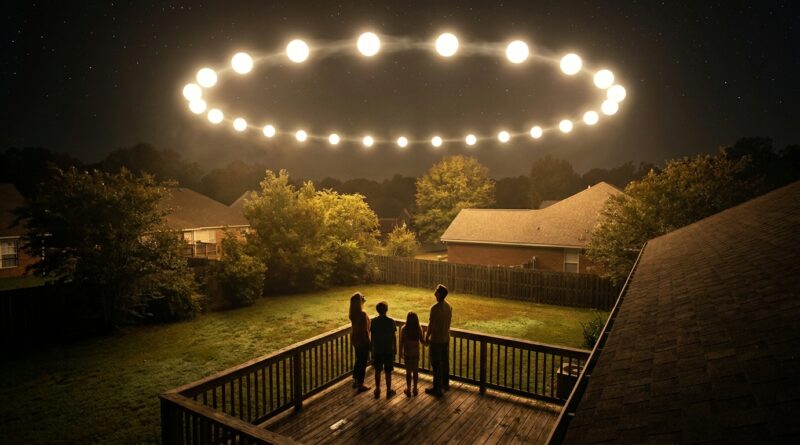
The Lights That Drew A Perfect Circle: Did A Mysterious Orb Ring Just Rewrite One Family’s Night Sky?
If you have ever watched a strange sky video get dismissed in ten seconds as “probably a drone,” you already know the frustration. People want real questions asked before the eye-roll starts. That is exactly why the mysterious ring of lights over Tuscaloosa sky has caught so much attention. A family recording from an Alabama backyard appears to show a near-perfect circle of lights hanging in the night, not moving like a normal aircraft, not stretching like a satellite train, and not matching the sloppy blinking pattern most of us expect from consumer drones. Even more interesting, when local TV brought in an astronomy professor to weigh in, he did not offer the usual easy answer. He admitted he could not confidently identify it. That does not prove anything supernatural. But it does make this a case worth watching carefully, and worth documenting better than the usual shaky, zoomed-in clip.
⚡ In a Hurry? Key Takeaways
- The mysterious ring of lights over Tuscaloosa sky has no confirmed explanation yet, and even an expert on local TV did not pin it on a planet, plane, or known sky event.
- If you see something similar, record wide shots first, note the time and direction, and try to capture nearby stars, rooftops, or trees for scale.
- Interesting does not mean dangerous, but good documentation is what separates a shrug-off from a case people can actually analyze.
What People Say They Saw
The basic claim is simple. A family in Tuscaloosa recorded a ring-shaped pattern of lights in the night sky from their backyard. Not a line. Not a triangle. A circle, or close to it.
That shape is what makes people stop scrolling. Most sky sightings get explained away because they match a familiar pattern. Planes blink and move on a track. Starlink satellites form a chain. Lens flare often creates ghostly dots or arcs that shift with the camera. This one is getting attention because viewers say it does not fit those usual buckets very neatly.
Now, that does not mean the footage is proof of anything exotic. It means the footage is unusual enough to deserve a slower, more careful look.
Why This Clip Feels Different
The shape is unusually clean
A rough cluster of lights is one thing. A ring is another. Human eyes are very good at spotting patterns, and sometimes too good. But a clean circular arrangement tends to stand out because it is less common in everyday sky traffic.
The behavior does not scream “normal aircraft”
Reports around the clip suggest the lights were not traveling in a straightforward way you would expect from a plane or helicopter. There was no obvious red-green navigation light pattern, and no clear body shape visible between the lights.
An easy expert answer never arrived
This part matters. A veteran astronomy professor appearing on local TV reportedly said he did not have a solid explanation. That is rare enough to keep the story alive. Usually, the expert segment ends the mystery in two sentences. Here, it did not.
What It Probably Was Not
It helps to narrow the field before anyone jumps to big conclusions.
Probably not a planet or bright star
Planets do not appear as multiple evenly spaced lights in a ring. Phones can distort bright objects, sure, but a single planet turning into a tidy circle of separate lights would be a stretch without other signs of camera artifact.
Probably not a satellite train
Satellite trains, especially Starlink, usually show up as a line or a gently curving chain moving steadily across the sky. A stationary or nearly stationary ring does not fit that look.
Not an obvious commercial aircraft pattern
Commercial planes have specific lighting setups. You usually see motion, blinking cadence, and a predictable path. A circular arrangement without those clues makes a normal aircraft explanation less convincing.
Not a standard flare pattern, at least at first glance
Lens flare is still worth testing. It is one of the first things investigators should check. But flare usually shifts in relation to the camera movement and a bright source in frame. If the ring stayed put in a way that did not track with camera angle, then flare gets weaker as an explanation.
What It Could Be
There are still several grounded possibilities.
Drone formation
This is the most obvious non-exotic option. Coordinated drones can create precise shapes, including circles. But there are questions. Was there sound? How high did the lights appear? Was there any local event, halftime show, promotion, or private drone hobby group operating nearby? Drone displays usually happen with a reason and often near a venue, not quietly over a neighborhood.
Optical illusion plus camera limitations
Phone cameras are notorious for making distant lights look stranger than they are. Digital zoom, autofocus hunting, stabilization, and low-light noise can all make separate points of light merge into weird geometry. If multiple witnesses saw the same shape with the naked eye, though, that lowers the odds that this was purely a camera trick.
Military or private test activity
People often jump here too fast, but it is still fair to ask. Unusual formations can come from testing, training, or specialized equipment. The problem is that “classified tech” becomes a catch-all when no one has evidence. It should stay on the list, not become the automatic answer.
How To Judge A Sky Video Without Fooling Yourself
This is where the Anomal community can really help. A good sighting is not just about what appears in the frame. It is about the context around it.
Start with the boring questions
Those are often the most useful.
- What time was it, exactly?
- Which direction was the camera facing?
- How long did the sighting last?
- Did anyone else nearby record it from another angle?
- Was there sound, especially the buzz of drones or rotors?
- Did the witness see the same shape with the naked eye, or only through the phone screen?
Look for reference points
Trees, rooftops, utility poles, and visible stars help a lot. They give investigators a way to estimate height, movement, and whether the lights are drifting or actually staying fixed.
Do not zoom in too soon
This is the big one. Phone zoom ruins more UFO videos than skeptics do. Record a wide shot first for at least 20 to 30 seconds. Then slowly zoom if you must. A wide shot preserves context and makes it much easier to rule things in or out.
If You Ever See Something Like This, Do These 7 Things
If the mysterious ring of lights over Tuscaloosa sky inspires one useful habit, let it be this list.
1. Record wide, then close
Get the whole sky area and horizon first. Context beats magnification.
2. Say the time and place out loud
It sounds silly, but it helps. “It is 9:14 p.m. in Tuscaloosa, facing west.” That single sentence can save a lot of guesswork later.
3. Capture the surroundings
Pan briefly to nearby houses, trees, and the street. That helps with scale and direction.
4. Check for sound
Stay quiet for a few seconds while recording. Drone noise, traffic, and aircraft sound matter.
5. Use a sky map app after filming
Do not interrupt the recording. But once the object is gone, apps like Sky Guide, SkySafari, or Stellarium can help check whether a bright planet or star was in that direction.
6. Ask neighbors fast
Another angle is gold. Two videos from different spots can tell you more than one perfect clip.
7. Save the original file
Do not just upload a compressed version to social media. The original video keeps metadata and image detail that analysts may need.
Why TikTok and Reddit Matter Here
Normally, social platforms make these stories messier. They spread bad guesses fast. But they also create something local news often cannot. A crowd of people comparing weather data, flight paths, satellite passes, neighborhood event schedules, and frame-by-frame video details in real time.
That kind of crowd analysis is not perfect. Sometimes it turns into a circus. But when it works, it can rule out obvious explanations quickly and pressure official voices to give more than a shrug.
What Would Move This From “Interesting” To “Strong Case”
Right now, this looks like a genuinely odd clip. To become a strong case, it would need more.
- A second or third independent video from a different location
- Confirmed timestamp and compass direction
- Witness statements that match on key details
- Weather and flight data for that time window
- Evidence ruling out a local drone event
That is how a story stops being internet fuel and starts becoming a case file people can work with.
At a Glance: Comparison
| Feature/Aspect | Details | Verdict |
|---|---|---|
| Shape | Witness video appears to show a near-perfect ring rather than a line or single light source. | Unusual enough to justify closer review. |
| Common explanations | Does not neatly match planets, standard aircraft lighting, or a typical satellite train. | No easy match yet. |
| Best next step | Gather original footage, witness details, exact time, direction, and possible second-angle videos. | Strongest path to a serious answer. |
Conclusion
The smartest response to the mysterious ring of lights over Tuscaloosa sky is not blind belief and not lazy dismissal. It is careful attention. Right now a fresh home-video from an Alabama backyard is rippling through TikTok, Reddit and local TV because the lights it caught do not behave like satellites, aircraft or the usual flare patterns, and even a veteran astronomy professor on air had to admit he had no solid answer. That makes this exactly the kind of live case worth following. It gives the Anomal community a chance to crowd-analyze something current, learn how to document sightings so they are taken seriously, and push back against the tired habit of calling every weird light a drone or a glitch before the facts are even on the table. If more witnesses come forward with better footage, this could go from viral curiosity to one of the more useful recent sky cases to study.