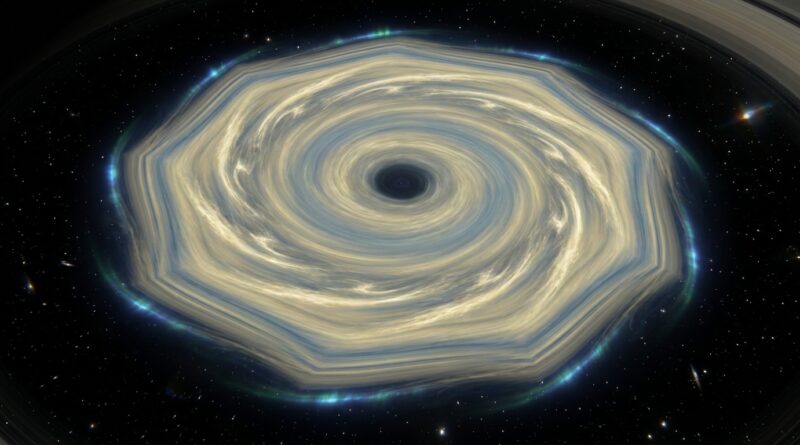
The Decagon At The End Of The World: What Is Sculpting Saturn’s Newly Found Ten‑Sided Storm?
If you are tired of every strange space headline ending with “camera trick,” “old archive image,” or “scientists meant something else,” you are not alone. That is exactly why this Saturn story is grabbing attention so fast. Astronomers appear to have spotted a new ten-sided pattern, a decagon-like wave, forming around Saturn’s south pole. Not the famous hexagon at the north pole. Something different. Something recent. And at least right now, no one has a neat, polished answer for what is shaping it. That makes this one rare. It is not just a recycled mystery from the Cassini years. It looks like a live one, unfolding in front of us. For regular readers, that is the fun part. You can follow the images as they arrive, compare what professionals and skywatchers are seeing, and watch a real scientific argument take shape instead of getting the cleaned-up version six months later.
⚡ In a Hurry? Key Takeaways
- A newly reported ten-sided atmospheric pattern near Saturn’s south pole appears to be a real and recent feature, not the long-known north-polar hexagon.
- If you want to track it yourself, watch for fresh Hubble releases, observatory updates, and side-by-side image comparisons over the next few weeks.
- The smart takeaway is caution with excitement. The shape looks unusual, but scientists still need repeat observations to confirm how stable, sharp, and long-lived it really is.
What exactly has been found?
The short version is simple. Saturn may be showing a ten-sided wave structure near its south pole. Think of it less like a solid shape stamped onto the planet and more like a repeating edge pattern in fast-moving clouds and winds.
That distinction matters. Gas giants do not have a surface in the way Earth does. What we are seeing is weather, motion, temperature contrast, chemistry, and light all mixed together. So when astronomers say “decagon,” they usually mean a polygon-like atmospheric boundary or wave pattern, not a literal geometric object hanging in space.
Still, the precision is the eyebrow-raiser. Saturn is already famous for the north-polar hexagon, one of the strangest and most stubborn jet-stream features in the Solar System. A fresh ten-sided structure at the opposite pole would be a big deal because it suggests Saturn’s atmosphere may be able to lock into more than one stable polygonal pattern.
Why this is different from the usual “weird space” story
A lot of people have learned to be skeptical, and honestly, that is healthy. Many dramatic space stories fade because they are based on low-quality images, old data recast as new, or a misunderstanding that gets corrected a day later.
This case feels different for three reasons.
1. It appears to be recent
The value here is timing. If this south-pole feature is truly new, then we are not looking at a museum piece. We are catching an atmosphere in transition.
2. It has a specific shape
“Odd storm on Saturn” is vague. “Potential ten-sided polar wave” is testable. Scientists can count edges, track drift, measure angles, and compare images over time.
3. Saturn already has form in this area
The north-polar hexagon proved long ago that Saturn can do geometry in the sky. That makes a south-pole decagon less absurd than it first sounds, but no less interesting.
So what could be sculpting Saturn’s mysterious ten sided storm?
This is the part where a lot of coverage goes off the rails with “scientists baffled.” The better answer is that scientists have a few serious ideas, but none are confirmed yet.
Jet streams and standing waves
The leading idea is some version of atmospheric wave behavior inside or along a fast jet stream. Picture traffic on a ring road. Cars move forward, but jams and patterns can stay in place or repeat. Saturn’s atmosphere can do something similar with wind and pressure. A standing wave can form a repeating shape that looks surprisingly crisp.
That is the basic explanation for the north-polar hexagon. A south-polar decagon could be another version of the same kind of physics, but under different wind speeds, temperatures, or depths.
Seasonal changes on Saturn
Saturn has seasons, just much longer ones than ours. Sunlight changes over time, and that can alter haze, temperature layers, and circulation at the poles. If the southern atmosphere recently crossed some threshold, a new pattern might have emerged from conditions that were already close to unstable.
Different layers moving at different speeds
Gas giant atmospheres are stacked. One layer can move differently from the one above or below it. If a storm boundary or polar vortex interacts with those layers just right, sharp edges can appear. The “decagon” may be the visible top of a much deeper circulation pattern.
It may not be permanent
This is important. The shape could be real and still turn out to be temporary. It might sharpen, blur, rotate, split, or vanish. That does not make the finding less interesting. In some ways it makes it better, because a changing feature gives scientists more clues about the forces behind it.
How this compares with Saturn’s famous north-pole hexagon
The north-pole hexagon is one of those rare space oddities that survived scrutiny. It has been observed for decades and remains one of the best examples of a stable planetary wave pattern.
The reported south-pole feature is not just “the same thing but lower.” At least from the early descriptions, it differs in location, number of sides, and likely atmospheric setting. That is what makes the comparison useful. If two poles on the same planet can settle into different polygonal forms, researchers may be able to learn which ingredients control the number of edges.
That would be huge for planetary weather models. It might help explain not only Saturn, but how fast-rotating atmospheres organize themselves more broadly.
How to follow this story without getting fooled
You do not need a PhD to track this well. You just need a good filter.
Look for repeat observations
One image is a curiosity. Several images taken days or weeks apart are a pattern. If the decagon keeps showing up from different instruments and viewing angles, confidence goes up fast.
Watch for raw image comparisons
The best updates will include side-by-side frames, annotations, and dates. You want to see whether the ten edges remain consistent or if they depend on contrast settings and image processing choices.
Pay attention to who is saying what
Astronomers are usually careful with wording. “Candidate feature,” “possible wave,” and “likely polygonal boundary” all mean slightly different things. Those details matter more than a dramatic social post.
Check whether amateurs can spot it too
This is one of the fun parts of planetary observing. Skilled amateur astrophotographers often produce useful Saturn images. If the same broad structure starts appearing outside major observatories, that adds another layer of confidence.
Why ordinary readers should care
Because this is science in motion, not science turned into a souvenir.
Most of us encounter discoveries after the messy part is over. By then, the odd bits are trimmed away and the uncertainty is gone. Here, the uncertainty is the story. We may be watching a planet-sized weather system settle into a shape no one predicted, or at least no one expected to see right now.
That gives readers something rare. You can build your own timeline. You can compare claims against fresh evidence. You can watch whether the early excitement holds up. That is a much better experience than passively reading “experts stunned” and moving on.
What to expect next
Over the next stretch, expect three kinds of updates.
Better images
Higher-quality observations should tell us whether the edges are truly sharp, evenly spaced, and stable.
Early modeling papers or notes
Researchers will likely start testing whether known Saturn wind profiles can produce a ten-sided standing wave near the south pole.
Pushback, which is normal
Some scientists may argue the pattern is being overread. That is not bad news. It is how good science works. If the decagon is real, it should survive skepticism.
At a Glance: Comparison
| Feature/Aspect | Details | Verdict |
|---|---|---|
| Location | Reported near Saturn’s south pole, separate from the long-known north-polar hexagon. | Potentially a distinct new atmospheric feature. |
| Best current explanation | Likely tied to jet streams, standing waves, polar vortex behavior, or seasonal atmospheric shifts. | Plausible physics exist, but no single answer is confirmed. |
| What readers should do | Follow repeat observations, compare raw and processed images, and treat early claims carefully. | Worth watching closely from day one. |
Conclusion
The Saturn south pole mysterious ten sided storm matters because it gives us something we almost never get anymore. A real-time space mystery that has not been sanded down into a tidy summary. Maybe this decagon will turn out to be a stable new member of Saturn’s strange weather family. Maybe it will prove to be a short-lived wave pattern that teaches us even more by changing fast. Either way, this is exactly the kind of story worth tracking now, not later. The community does not need another empty “scientists baffled” headline. It needs a living anomaly with fresh data, open questions, and room for serious ideas. If this ten-sided structure holds up, readers who start following today will have the full timeline from the beginning, and that is a much better seat than getting the flattened version after everyone else has already decided what it means.