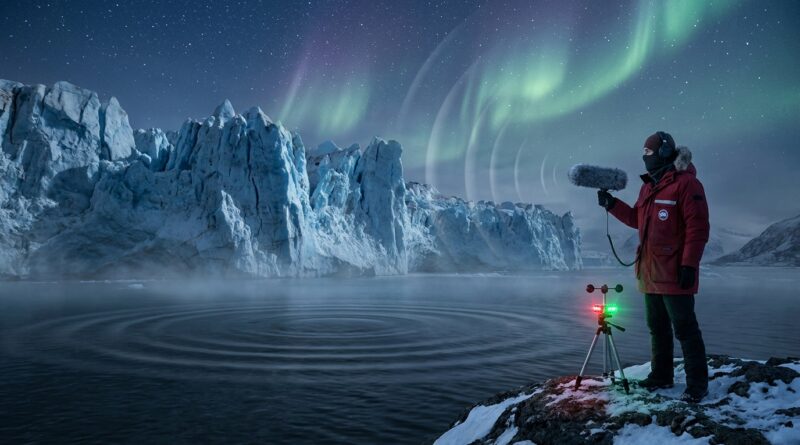
The Glacier That Growls At Night: What Is Hiding Behind Earth’s Newest ‘Skyquake’ Mystery?
You hear a boom at 2 a.m. The windows twitch. Your chest feels it. Then you check the weather, the flight map, maybe even local earthquake feeds, and nothing fits. That is the maddening part with mysterious skyquakes and unexplained booming sounds near glacier regions. Most writeups either dump every old “mystery boom” into one pile or jump straight to aliens, secret weapons, or the end times. Neither helps if you want to know what is actually new.
What is new is this. In some cold coastal and polar areas, researchers are paying closer attention to low-frequency sounds tied to moving, cracking, and melting ice. Some glaciers do not just calve with a splash. They grind, resonate, vent trapped air, shift under stress, and sometimes produce signals people hear as growls, cannon-like booms, or rolling sky noise. Not every report is a glacier. Some are aircraft, quarry blasts, frost quakes, surf, or meteors. But in a warming world, changing ice may be adding a real and poorly mapped piece to the puzzle.
⚡ In a Hurry? Key Takeaways
- Some recent “skyquake” reports in cold regions may be linked to glacier movement, ice fracturing, calving, or air and water pressure changes, not just folklore.
- If you hear one, save a timestamp, location, weather notes, and any recording, then compare it with local seismic, infrasound, flight, and marine data.
- Do not approach unstable ice, cliffs, or shorelines to investigate. Useful data can be collected safely from a distance.
What is the actual mystery here?
The mystery is not that Earth makes strange sounds. It always has. The mystery is why some people hear deep, body-shaking booms that sound huge, while nearby seismographs often show little or nothing.
That mismatch matters. If the ground did not shake much, then the source may be more acoustic than seismic. In plain English, the air may be carrying the drama more than the soil under your feet. That opens the door to things like atmospheric ducting, ocean wave interactions, meteors, military activity, and, in icy regions, glacier processes that send sound efficiently over long distances.
So when people talk about mysterious skyquakes unexplained booming sounds glacier links, they are really asking a narrower question. Can moving and melting ice create noises that travel like sky-borne booms, confuse listeners, and slip past normal earthquake detection?
Short answer. Yes, in some cases, that is plausible. Proven in every case? No.
Why glaciers are suddenly getting more attention
Glaciers are not silent blocks of frozen rock. They are active systems under stress. They crack. They bend. Meltwater drills through them. Air gets trapped. Ice rubs against bedrock. Whole fronts collapse into water. Each of those can make sound.
Some of the main sound-making suspects
Ice fracturing. When internal stress crosses a limit, ice can crack fast and loudly. Think of a giant frozen pane snapping, except the geometry is messy and the sound can echo through valleys and over water.
Calving events. When a chunk breaks off into the sea or a lake, you can get a mix of sharp cracks, low booms, splash impact, and underwater pressure pulses.
Subglacial water flow. Meltwater moving through channels under pressure can create rumbling or droning sounds, especially when pathways open or collapse.
Air release. Ancient air bubbles trapped in dense ice can be released during breakage. On a small scale this makes ice “sizzle.” On a giant scale, it may add to the acoustic mess.
Iceberg resonance and shoreline effects. Floating ice and coastal terrain can bounce and shape sound in odd ways. A local crack can seem like a faraway boom from the sky.
Why people say “the sky did it” when the glacier did not look dramatic
Because sound is sneaky. Temperature layers in the atmosphere can bend low-frequency sound over long distances. Water and ice can also move energy efficiently. Add mountains, fjords, sea ice, or a coastal inversion layer, and the listener may hear something that seems detached from the ground source.
This is one reason eyewitness reports often sound contradictory. One person hears a single explosion. Another hears rolling thunder. Someone else feels a pressure thump indoors. All can be talking about the same event filtered through different terrain and air conditions.
What is folklore, and what is hard data?
Folklore is the giant bucket of “mystery booms” stories with no timestamp, no location precision, no weather notes, and no instrument check. Those stories can still be sincere. They just are not enough to solve anything.
Hard data starts with synchronized observations. Time to the minute. Exact place. Direction of the sound. Weather. Audio. Was there visible icefall, surf, lightning, aircraft, or blasting? Then you compare that report with public records.
The four data sources that matter most
Seismic logs. If there was a local quake, landslide, or strong ice fracture coupled into the ground, a nearby station might catch it.
Infrasound data. Some booms live more in the air than the ground. Infrasound networks are useful here, though public access varies by region.
Flight and maritime traffic. Supersonic-like reports, military training, ship shock noise, and industrial activity can muddy the picture fast.
Weather and satellite context. Temperature inversions, storm fronts beyond the horizon, wave conditions, and visible glacier change all help sort signal from noise.
Why seismographs can stay quiet
This trips people up. “If it was that loud, why no quake?” Because loud to your ears is not the same thing as strong in the ground.
A glacier boom may produce a weak seismic signal but a strong acoustic one. Or the nearest station may be too far away, too noisy, or simply not aimed at that kind of event. Consumer apps can also lag or miss small local signals. No reading does not mean nothing happened. It means the event may not have coupled well into the instruments you checked.
The best non-sensational explanation right now
The best working answer is not one single cause. It is a stack of causes. In glacier and cold-coast settings, the most serious current candidate is a mix of ice fracture, calving, meltwater pressure change, and acoustic channeling through air and terrain.
That is less flashy than “mystery from the sky,” but it is more interesting because it is testable. It also fits the timing. Climate-driven ice loss is changing how often ice breaks, where meltwater travels, and how unstable some coastal frozen systems have become.
How to investigate a boom without turning it into a ghost story
If you hear one, start simple and write things down right away. Your memory gets fuzzy within minutes.
Make a clean field note
Include:
- Date and exact local time
- Your location, as precise as you can safely share
- How many booms you heard
- How long it lasted
- Did windows rattle or the floor vibrate?
- Clear sky, cloud cover, wind, temperature, rain, snow
- Nearby coast, glacier, quarry, airbase, rail line, or highway
- Any visible flash, plume, avalanche, or icefall
Grab supporting evidence
If safe, record 30 to 60 seconds of ambient audio after the event. A phone recording is fine. What matters most is the timestamp and the background context. If neighbors heard it, ask them what time and what direction it seemed to come from before you tell them your own guess. That avoids accidental story-mixing.
Check the obvious public sources
Look at local earthquake pages, volcanic observatories if relevant, weather radar, lightning maps, flight trackers, marine traffic maps, and community alert channels. If you are near glaciers, also check park or research station notices for calving, icefall, or access warnings.
How to compare recordings like a calm amateur investigator
You do not need a lab to do useful first-pass comparisons.
Listen for the shape of the sound
Sharp crack, then rumble. Often points toward fracture plus echo.
Single deep thump. Could be a distant blast, meteor, pressure wave, or a compact calving event.
Rolling growl. More consistent with long resonance, moving ice, surf-ice interaction, or terrain echo.
Check duration and repeats
One event can mean one break. A series every few minutes can suggest ongoing calving, repeated ice settling, industrial blasting, or even frost quake clusters in the right weather.
Use a simple spectrogram app
Many free apps will show whether the sound had strong low-frequency content. You do not need to become an audio engineer. You are just looking for patterns. A low, broad band with little high-end snap can be different from a close gunshot or construction blast.
What else could it be, besides a glacier?
Quite a few things.
Frost quakes
These happen when water-saturated ground freezes rapidly and cracks. They can sound explosive and often happen in very cold snaps.
Meteors and bolides
A bright meteor can produce delayed booms. If people saw a flash first, pay attention.
Surf and coastal wave impacts
Large wave sets slamming sea caves, cliffs, or frozen shorelines can create cannon-like reports.
Human activity
Quarries, mines, construction blasting, military flights, artillery practice, and shipping can all fool listeners, especially at night.
Small landslides or rockfall
In thawing terrain, rocks can let go suddenly and produce a crack-boom-rumble sequence that travels farther than expected.
Why this matters beyond curiosity
If glacier-linked booming is increasing in some regions, it may be more than an odd sound. It could be a clue about changing stress in ice, unstable meltwater routing, or shifting coastal hazards. That does not mean every boom is a warning siren from nature. It means repeated, well-documented reports might add one more useful layer to how we watch a changing planet.
That is where communities can help. Not by panicking. By collecting better observations.
How to report it in a way researchers can actually use
Send a structured report, not just “huge boom lol.” Include your notes, any audio file, the device used, and whether the file time is accurate. If there are multiple witnesses, list them separately with their own locations. If you post online, add a map pin area, not just the town name, and say whether you are near ice, coast, hills, or industry.
The best reports are boring on the surface. That is a compliment. Boring reports solve mysteries.
Safety first, always
Do not chase the sound toward a glacier front, frozen shoreline, sea cliff, or avalanche path. Calving zones can throw waves and ice farther than people expect. Unstable thaw ground can fail underfoot. If your first thought is “I should go get closer,” the answer is probably no.
At a Glance: Comparison
| Feature/Aspect | Details | Verdict |
|---|---|---|
| Glacier-linked boom | Often near coasts, fjords, icefields, or cold regions. May include crack, growl, rumble, or delayed echoes. Seismic signal can be weak or absent. | Strong candidate in icy areas, especially during melt, calving, or rapid stress change. |
| Frost quake or ground crack | More likely during sudden deep freezes. Short, explosive sound. Very local. Sometimes felt indoors. | Good fit in inland cold snaps, less tied to glacier zones. |
| Human or atmospheric source | Aircraft, blasting, surf impact, meteors, or temperature-layer sound bending can mimic “skyquakes.” | Always rule out first with flight, weather, marine, and local industry checks. |
Conclusion
The smart answer to this newest skyquake mystery is not “nothing to see here,” and it is not “the apocalypse is loud now.” It is that some unexplained booming sounds in glacier country may come from real, changing ice dynamics that we still do not map well enough. The Anomal community has been tracking strange sounds for years, but too much coverage turns them into jokes or instant doom. A better approach is simpler. Save the time. Save the recording. Check the seismic and weather logs. Compare notes with other listeners. Report what happened in a clean, structured way. That turns vague dread into something useful. And if these growls and booms really are part of how a warming world is reshaping coasts, ice, and even the sounds we hear at night, then paying attention together is not weird. It is responsible.