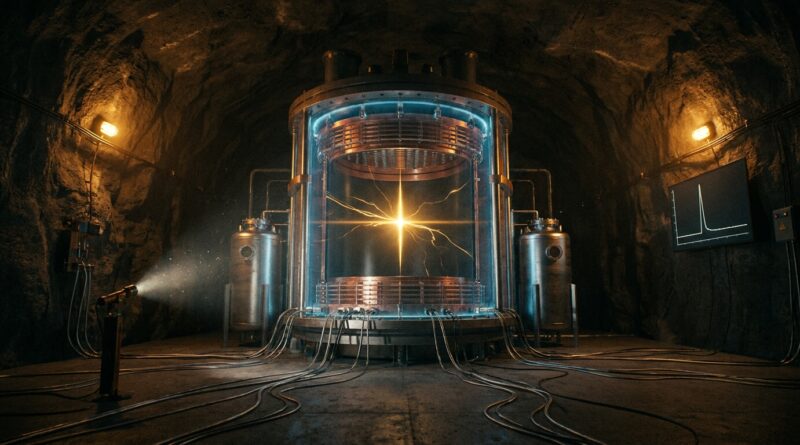
The Dark Matter Signal That Shouldn’t Be There: Why One Underground Detector Just Got Spooked
If you follow dark matter news, you already know the routine. A detector blips, headlines scream, and six months later the exciting “maybe” quietly turns into calibration noise, a stray neutron, or plain bad luck. So when a major underground experiment says it saw a strange event that has only about a half-percent chance of being ordinary background, it is fair to feel two things at once. Curious, and tired. This latest mysterious dark matter detector signal 2026 story matters because the team itself is not brushing it off, but it is also refusing to oversell it. That is exactly the zone where good science gets hard to read from the outside. The signal is unusual enough to deserve attention, not celebration. And if you understand how scientists talk about these early anomalies, you are much less likely to get fooled by hype, doom, or somebody on social media shouting that physics is broken before lunch.
⚡ In a Hurry? Key Takeaways
- This was a real odd event in a dark matter detector, but it is not a discovery of dark matter.
- When you read early anomaly news, check three things first: how rare the event is, what backgrounds could fake it, and whether another detector can confirm it.
- A half-percent chance of random background is interesting, but still far below the standard scientists use before claiming new physics.
What actually happened
A leading underground dark matter experiment reported a single event that does not fit comfortably into its expected background models. In plain English, something bumped the detector in a way that was rare enough to make the team stop and say, “Hang on, that should not be there so often.”
The detector sits deep underground for a reason. Rock overhead helps block cosmic rays and other junk from space that would otherwise swamp the instrument. These experiments are built to sit in the dark, in the quiet, waiting for incredibly faint interactions. Most of the time, they see either nothing useful or things they can explain.
This time, they saw one event that appears unusual enough that the chance of it being just normal background noise is around 0.5 percent. That sounds dramatic, and it is worth paying attention to. But it is not the same thing as saying there is a 99.5 percent chance they found dark matter. That leap is where a lot of bad science coverage starts.
Why physicists are interested, but not popping champagne
Science has a pretty unforgiving standard for discovery claims. In particle physics, researchers usually want something near the famous “5 sigma” level before they start talking about a real discovery. This event is nowhere near that level.
Think of it like hearing a strange noise in your attic once. It might be important. It might be a raccoon. It might be the house settling. One weird sound does not prove you have discovered a hidden room.
That is the place we are in now. The event is odd. It stands out. It may point to something new. But there are still more ordinary explanations on the table, and scientists are trained to be suspicious of exciting one-off results.
What “background” means here
Background does not mean “nothing happened.” It means something happened that the detector can see, but it is not the thing researchers are hunting for. Backgrounds can come from trace radioactivity in materials, neutrons, tiny detector quirks, and even rare combinations of ordinary effects that pile up into something that looks exotic.
So when the collaboration says this event has about a half-percent chance of being mundane background, they are saying, “Our usual explanations do not fit this comfortably.” That is interesting. It is not final.
Why one event can still matter
One event sounds flimsy, and often it is. But in rare-event physics, one clean, weird signal can still get people’s attention because these detectors are designed to be incredibly quiet. If something pokes through all that shielding, cleaning, screening, and modeling, it earns a second look.
The key word is “second.” Not “victory lap.” Not “rewrite the textbooks.” Just “second look.”
This is why the collaboration is talking about it publicly at all. If the event were obviously junk, it would likely stay buried in technical notes while they fixed the issue. The fact that they are acknowledging it means they think the anomaly deserves scrutiny from both the team and the wider community.
What it could be, besides dark matter
Before anybody reaches for alternate universes or new cosmic forces, the boring list gets first priority. And honestly, the boring list wins a lot.
1. A rare background event
The simplest answer is still that the detector got hit by something ordinary but uncommon. Rare things happen if you watch long enough.
2. An imperfect model
Scientists rely on background models to estimate what “normal” looks like. Those models are good, but not magic. Sometimes the event is real and the surprise comes from the model being incomplete.
3. Detector behavior nobody noticed before
Ultra-sensitive instruments can have odd edge cases. A strange interaction with hardware, software filtering, or reconstruction code can make an event look more mysterious than it really is.
4. New physics
Yes, this is on the list. It could be some kind of dark matter interaction, or another particle process that current models do not capture well. But this option comes last, not first. Good scientists are conservative because nature has a long history of making fools out of people who fall in love with the exciting answer too early.
How to read this kind of headline without getting played
If you want to be smarter than the average viral post, use this quick filter whenever a detector “sees something weird.”
Ask: Is it one event, a cluster, or a pattern?
One event can be interesting. A repeated pattern is much stronger. Scientists get much more excited when multiple events line up in a consistent way.
Ask: Can another experiment check it?
This is huge. A result gets real weight when another detector, with different hardware and different noise sources, sees something similar. Independent confirmation is the gold standard.
Ask: Are researchers sounding excited or careful?
If the actual scientists are using phrases like “anomalous,” “under study,” and “not a claim of discovery,” believe their caution. Usually the press release is the loud part. The paper is the honest part.
Ask: Does the number sound impressive, but stop short of proof?
A half-percent background probability sounds tiny. In everyday life, it is. In frontier physics, it is notable but not enough. Context matters.
Why the underground part matters so much
Dark matter detectors are often buried deep underground because the universe is noisy. Cosmic rays constantly slam through Earth’s atmosphere and create showers of particles. If you are trying to detect something almost ghostly, you need to get away from as much interference as possible.
Then the experimenters go further. They use ultra-pure materials. They shield the detector. They monitor temperature, electronics, and trace contamination. They spend years trimming away anything that could fake the signal they want.
So when one of these machines still gets “spooked,” it catches attention. It means the event either slipped through a serious gauntlet of defenses, or the gauntlet missed something important.
What happens next
This is the part many news stories skip, even though it is the most useful bit.
More data
The first step is simple. Keep watching. If the signal was a fluke, it may never happen again. If it points to a real process, more events may slowly build a pattern.
More background checks
The team will revisit every known source of noise they can think of. They will test assumptions, rerun analysis pipelines, and try to break their own result before anyone else does.
Cross-checks from other experiments
This is where things get interesting for the rest of the field. Other dark matter experiments will want to know whether their own data contain anything remotely similar. If another detector twitches in the same way, the story changes fast.
What this does not mean
It does not mean dark matter has been found.
It does not mean the Standard Model is dead.
It does not mean a portal to another universe is opening under a mountain.
It means a serious experiment saw something odd enough that trained skeptics do not want to ignore it. That alone is valuable.
Why this story is worth your attention right now
This is not one of those recycled “scientists baffled” stories from ten years ago dressed up with spooky stock art. This is a live case. The evidence is limited, the language is cautious, and the outcome is unknown. That makes it more useful, not less.
You get to watch science in its awkward middle stage, where the answer is not ready and nobody honest can promise where it will land. That is rare. It is also where the public usually loses the plot, because uncertainty is harder to package than certainty.
If you can read this moment clearly, you will be in much better shape the next time a neutrino detector, gravitational wave observatory, or dark matter tank reports something strange from the dark.
At a Glance: Comparison
| Feature/Aspect | Details | Verdict |
|---|---|---|
| How unusual was the signal? | Roughly a 0.5 percent chance of being ordinary background, based on current modeling. | Interesting enough to study closely, not strong enough to call proof. |
| What is the most likely explanation today? | A rare background event, an incomplete model, or a detector-related effect are still very much in play. | Stay cautious. The boring explanations have not been ruled out. |
| What would change the story? | More similar events in the same detector, or independent confirmation from another experiment. | Confirmation is everything. |
Conclusion
This helps the Anomal community right now because it is a live mystery at the edge of known physics, not another reheated spooky anecdote. A major dark matter experiment has logged an event unusual enough that the team says it should not be ignored, even while refusing to call it a discovery. That is exactly the kind of moment where people get misled by either overhype or lazy cynicism. If you understand the stakes, the caution, and the method, you are in a much better position to judge the next strange claim that comes out of a detector buried deep underground. For now, the best response is simple. Stay curious. Stay skeptical. And keep an eye on whether this lonely signal stays lonely.