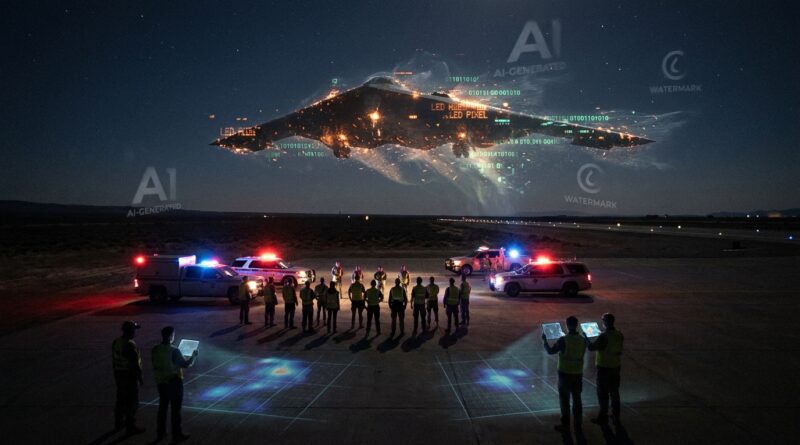
The California ‘Ghost Craft’: Debunked Bomber Crash Photos And The Real Mystery They Accidentally Exposed
If your feed suddenly looked like a sci-fi movie, you are not imagining it. Over the last day, real reporting about a California B-52 tragedy got buried under dramatic fake images showing a glowing “ghost craft” over an air base and in the nearby mountains. That is frustrating for two reasons. First, a real incident involving real people deserves facts, not recycled UFO bait. Second, the fakes were good enough to fool plenty of smart, normal readers scrolling fast on their phones. The short version is this: the viral “mystery craft crash” photos do not appear to be authentic incident imagery. They carry several signs of AI generation or heavy manipulation, and no credible source has verified them. The real mystery is not a hidden alien cover-up. It is how quickly fabricated visuals can hijack a breaking story, especially when fear, grief, and curiosity are already running high.
⚡ In a Hurry? Key Takeaways
- The viral California “ghost craft” crash photos are not confirmed evidence of a UFO and show multiple signs of AI-generated or manipulated imagery.
- Check the source, reverse-search the image, inspect lighting and edges, and look for confirmation from local officials or established news outlets before sharing.
- This matters because a real aviation tragedy can get distorted fast when fake visuals spread faster than verified reporting.
What actually happened, and what did not
The first thing to separate is the human event from the internet noise. There was genuine public attention around a reported B-52-related incident in California. That is the serious part. Then came the social media pile-on. Glowing objects. Burn marks in impossible shapes. “Leaked” night shots with cinematic fog and orange-blue lighting that looked more like a movie poster than emergency response photography.
That second layer is where things went off the rails.
As of now, there is no credible evidence that a “mysterious craft” crashed alongside or near a B-52. No official statement, no trustworthy local reporting, and no verified on-scene documentation backs up the most viral images. In plain English, the UFO part was added by the internet.
Why so many people believed the images
This is the part that catches even careful readers. The fake images did not look like the old clumsy hoaxes with blurry pixels and obvious cut-and-paste jobs. They looked polished. Atmospheric. Weirdly emotional. That is exactly why they spread.
AI image tools are now very good at making “plausible drama.” They can produce realistic smoke, emergency lights, military silhouettes, and mountain backdrops in seconds. If you are already primed by a scary headline, your brain fills in the rest.
That does not make people gullible. It makes them human.
The biggest signs these California B-52 crash fake UFO photos were AI generated
1. Lighting that looks cinematic, not situational
Real crash or emergency photos are usually ugly and uneven. You get harsh glare, blown-out highlights, deep shadows, random flashlight spill, and poor angles. The viral “ghost craft” images had a suspiciously balanced glow, with dramatic color contrast and smooth haze. Great for engagement. Not great for authenticity.
2. Details that fall apart when you zoom in
AI often gets the big scene right and the small stuff wrong. In several circulating images, edges around vehicles and fencing looked soft or inconsistent. Some shapes appeared to blend into the background. Warning lights and reflective surfaces repeated in odd ways. Those are classic clues.
3. Missing photo chain of custody
This sounds technical, but the idea is simple. Where did the image come from first? A real witness photo usually has a trackable path. A local account posts it. A reporter contacts the source. More angles appear. Time and place get pinned down. With these images, many versions appeared all at once on repost accounts with dramatic captions and no original photographer attached.
4. Captions doing all the heavy lifting
When a post needs a giant paragraph in all caps to explain why the image is shocking, that is a clue. Real evidence tends to stand on its own. Fake evidence often arrives wrapped in instructions about what you are supposed to feel.
The real mystery this story exposed
The accidental lesson here is bigger than one viral hoax. We are entering a messy phase where breaking-news events can be visually rewritten in real time by strangers with image tools and a taste for attention. That means the question is no longer just “Is that a UFO?”
Now the question is also, “Was that image even taken by a camera?”
That is a real shift, and it changes how anyone interested in UAP stories, aviation incidents, or emergency footage has to think.
A simple 5-step checklist for vetting future “glowing object” claims
Check the original source
Do not stop at the repost. Tap backward until you find the first account that shared it. If the trail ends at a meme page, an anonymous aggregator, or a brand-new account, slow down.
Look for local confirmation
If something supposedly happened near a California base, there should be local chatter that is more boring and more useful. Traffic closures. scanner talk. weather context. official warnings. Local journalists are often less dramatic and more reliable in the first hours.
Run a reverse image search
This catches a lot of nonsense. Sometimes the “new” photo is actually months old, or it started life as concept art, game footage, or a previous hoax with a new caption.
Zoom in on the weird parts
Hands, text, insignia, fences, wheels, shadows, and reflections are where AI often slips. If the image feels striking but somehow mushy around the important details, trust that feeling.
Ask what the image is not showing
No bystanders. No alternate angles. No emergency crews in realistic positions. No debris pattern. No metadata. One perfect frame and nothing else. That is often the giveaway.
How AI forensics helps, and where it still falls short
There are now tools that try to detect AI-generated imagery by looking for pattern inconsistencies, compression artifacts, and synthetic textures. They can be useful, especially when several clues line up. But they are not magic lie detectors.
A smart approach is to use AI forensics as one piece of the puzzle, not the final word. Think of it like checking the weather before a road trip. Helpful, yes. Enough on its own, no.
The best results come from combining tool-based checks with old-fashioned reporting habits. Who posted it? When? From where? Is there independent confirmation? Do physical details make sense?
Why this matters for UAP coverage
People interested in unexplained aerial events already deal with enough bad evidence. Fake crash photos make that worse. They do not just muddy one story. They train everyone to either believe everything or dismiss everything. Neither reaction helps.
The healthier middle ground is skepticism without cynicism. Some claims deserve real attention. Some images are misidentified aircraft, drones, flares, or weather effects. And some are simply manufactured for clicks. The job is telling those apart.
What to do if you already shared one
No shame spiral needed. Just correct it. Delete the post, or add a note saying the image appears unverified or likely AI-generated. That actually helps. Quiet corrections matter because bad images live a long time once they get attached to a tragic event.
It is also a good reminder to pause when a photo seems almost too perfect for the story attached to it.
At a Glance: Comparison
| Feature/Aspect | Details | Verdict |
|---|---|---|
| Source credibility | Viral reposts, weak origin trail, no solid attribution to a verified witness or outlet | Major red flag |
| Visual consistency | Overly dramatic lighting, soft edges, odd blending, detail breakdown on zoom | Consistent with AI or manipulation |
| Real-world confirmation | No verified official evidence supporting a parallel “ghost craft” crash narrative | Claim not supported |
Conclusion
This is one of those stories where the internet made a hard situation even harder to understand. A real aviation tragedy was quickly wrapped in fake “ghost craft” imagery, and that mix made it tougher for normal readers to know what was true. The good news is that this is also a useful test case. It gives us a chance to separate a genuine breaking event from opportunistic hoaxing, see how AI forensics can help flag fabricated anomalous images, and build a repeatable habit for checking the next “glowing object over the mountains” claim before it hardens into folklore. That is the real value here. Not just debunking one batch of California B-52 crash fake UFO photos said to be AI generated, but getting better at spotting the next wave. A sharper eye, a calmer checklist, and a little patience still go a long way.