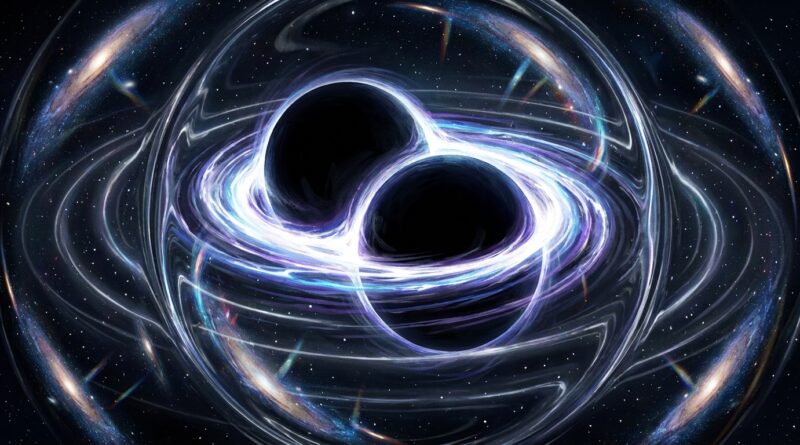
The Black Hole Collision That Shouldn’t Exist: Why Einstein’s Math Just Opened A Bigger Cosmic Mystery
Space headlines can be maddening. One week a black hole discovery “breaks physics,” and the next week someone says it is all explained. If you felt whiplash over the impossible black hole merger mystery, that reaction is fair. The event looked like two black holes so massive that, under the usual story of how stars live and die, they should not have existed in the first place. Now astronomers think the merger may not have been truly impossible after all. Their fix is both clever and unsettling. Using Einstein’s relativity, they argue that a heavy object sitting between us and the collision may have bent and amplified the signal, making the black holes appear larger and weirder than they really were. That helps with one problem. It creates another. If this is right, the universe may be full of hidden, ultra-dense objects quietly warping our view like cosmic funhouse mirrors.
⚡ In a Hurry? Key Takeaways
- The simplest answer is that the “impossible” merger may have looked bigger than it really was because gravity from an unseen object magnified the signal on its way to Earth.
- When you see future black hole headlines, check whether scientists are talking about the source itself or about lensing, which can distort what detectors think they saw.
- This is not a full closure story. It solves one black hole puzzle but points to a possible hidden population of dense objects we still do not understand.
Why this merger caused such a headache
Black holes formed from dead stars usually fit within a rough mass range. There is a known awkward zone where standard stellar physics says black holes should be rare or absent, because the star blows itself apart in a way that prevents that kind of leftover core from forming.
So when gravitational-wave detectors picked up an enormous merger, astronomers had a problem. The signal suggested black holes so heavy that they did not fit the usual script. That is why people started calling it impossible, or at least deeply suspicious under standard models.
The impossible black hole merger mystery was not that black holes collided. They do that. The weird part was the apparent size of the objects involved.
The new idea, in plain English
The proposed fix uses gravitational lensing. That is the same basic effect that can make distant galaxies look stretched, brightened, or multiplied when a massive object sits in the line of sight.
In this case, the idea is that something massive sat between Earth and the black hole merger. Its gravity warped spacetime enough to amplify the gravitational-wave signal. If that happened, our detectors would read the event as louder than it really was.
And here is the trick. For gravitational waves, a louder signal can fool us into thinking the merging black holes were more massive and perhaps closer than they actually were.
Think of it like this
If someone speaks through a microphone hidden behind a wall, you might think they are naturally shouting. But maybe they are not. Maybe the sound was boosted before it reached you.
The new argument says something similar may have happened here. The merger itself could have been more ordinary. The universe just turned up the volume.
Why Einstein matters here
This is not a case of Einstein being wrong. It is almost the opposite. Researchers are using general relativity, Einstein’s description of gravity as warped spacetime, to rescue the observation from looking impossible.
That is why this story is so good. The math that helps explain the event also opens a bigger mystery. If lensing is the answer, then what exactly did the lensing?
It was not necessarily a normal galaxy we can easily point to in a telescope image. It may have been a compact, dark, hard-to-see object, or a dense structure that does not announce itself in obvious ways.
The bigger mystery hiding behind the fix
This is where the story gets interesting fast. If one unseen object can distort a gravitational-wave event enough to make it look impossible, how many other events have been misread in the same way?
That would mean some part of our black hole census could be skewed. We may think we are seeing giant, exotic mergers more often than we really are. Or we may be undercounting the hidden masses doing the lensing.
In other words, fixing the impossible black hole merger mystery may force astronomers to investigate a second mystery. What is this hidden population of dense objects scattered through the cosmos?
If that angle grabs you, it fits neatly with another recent anomaly story, The Invisible Weight In The Sky: Did Astronomers Just Stumble On A Million-Sun ‘Ghost Object’ Warping Our Universe?. Different case, same unsettling theme. Something massive may be out there, bending what we see while staying mostly out of sight.
What this does and does not solve
What it solves
It offers a realistic way around the formation problem. If the black holes were smaller than first estimated, they no longer need such extreme origin stories. Standard stellar evolution looks less broken.
What it does not solve
It does not prove every weird black hole merger is just a lensing illusion. It does not identify the hidden lens with certainty. And it does not remove the need for more data.
This is an explanation, not a final verdict.
How astronomers can test this
The good news is that this is not vague hand-waving. It gives scientists something concrete to look for.
1. Repeated or patterned signals
Strong lensing can sometimes produce multiple versions of the same event arriving at different times. If detectors catch matching waveforms with a delay, that would be a huge clue.
2. Better sky mapping
As gravitational-wave detectors improve, researchers can narrow down where signals come from and check whether likely lensing structures sit along that path.
3. Population studies
If too many black hole mergers seem uncomfortably massive, lensing becomes more attractive as part of the answer. Patterns across many events matter here, not just one headline grabber.
4. Cross-checking with telescopes
Scientists can also search for galaxies, dark clumps, or other compact structures that might be acting as the gravitational lens.
Why this matters beyond one event
Gravitational-wave astronomy is still young. We are basically learning how to hear the universe while also realizing the room has echoes, filters, and strange acoustics.
That is exciting, but it also means caution matters. A signal is not always a clean readout of the source. Sometimes the trip matters as much as the thing making the noise.
For non-specialists, that is the big takeaway. Science did not “mess up” by first calling the event strange and then proposing lensing. This is the process working as it should. Detect something odd. Stress-test the explanation. Then see what new weirdness falls out.
At a Glance: Comparison
| Feature/Aspect | Details | Verdict |
|---|---|---|
| Original merger claim | Black holes appeared so massive that standard formation models struggled to explain them. | Good reason for skepticism and follow-up study. |
| New relativity-based explanation | A hidden mass may have gravitationally lensed the signal, making the merger look larger and stranger. | Plausible and testable, but not yet the final word. |
| Bigger implication | The universe may contain many unseen dense objects that distort both light and gravitational waves. | Potentially the more important mystery of the two. |
Conclusion
The best part of this story is that it sits right on the line between “headline solved” and “hold on, this just got stranger.” The new explanation for the impossible black hole merger mystery uses Einstein’s relativity in a smart, grounded way. It suggests the record-breaking event may have been magnified and distorted by hidden warped spacetime in between us and the source, making the black holes look bigger than they really were. That eases one long-running problem about how such huge black holes could form so fast. But it also hints at a more unsettling possibility: an unseen population of ultra-dense objects may be scattered across the universe, quietly bending what we detect. For Anomal readers, that is the sweet spot. This is fresh, peer-reviewed, genuinely testable, and a lot more useful than another vague “space is weird” claim. Keep an eye on what comes next, because this fix may turn out to be the doorway to a much bigger cosmic secret.