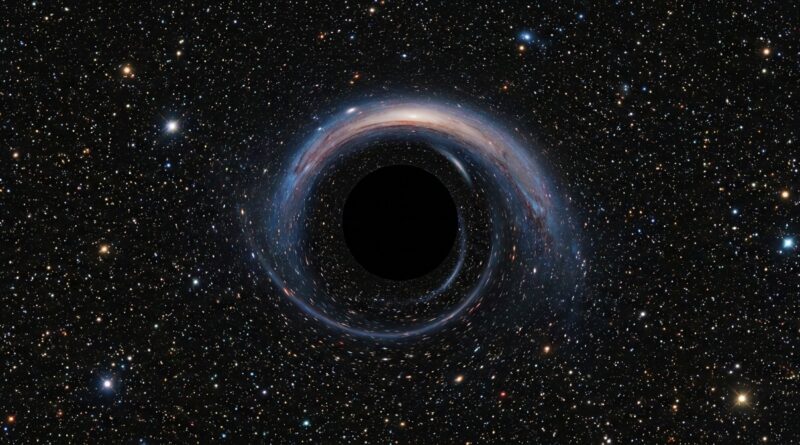
The Invisible Weight In The Sky: Did Astronomers Just Stumble On A Million-Sun ‘Ghost Object’ Warping Our Universe?
Most “space mystery” stories are exhausting for a reason. They promise a world-shaking reveal, then hand you a blurry clip, a lot of yelling, and no real evidence. This one is different. Astronomers appear to have spotted a genuinely mysterious dark object through gravitational lensing, which is a fancy way of saying its gravity gave it away even though the object itself stayed invisible. And not just a little invisible. We are talking about something with roughly the mass of a million Suns that seems to be warping light, yet refuses to show up in visible light, infrared, X-rays, or other usual checks. That is why researchers are paying attention. The data suggest a heavy object is out there, but the obvious explanation is still missing. It could be a rogue black hole, a dense clump of dark matter, or something stranger that does not fit neatly into the categories astronomers like to use. That is a real mystery, not a recycled one.
⚡ In a Hurry? Key Takeaways
- This mysterious dark object gravitational lensing signal suggests something about a million times the Sun’s mass is bending light while staying invisible.
- If you want to judge the story sensibly, focus on the lensing data and follow-up observations, not dramatic artwork or UFO-style headlines.
- The big value here is that the mystery is anchored to real measurements, but it is still early and no single explanation has won yet.
What actually happened
The short version is simple. Astronomers were studying light from a much more distant source and found signs that something in the foreground bent and distorted that light on the way to Earth.
That effect is called gravitational lensing. Einstein’s general relativity says mass curves space. Light follows those curves. So if a heavy object sits between us and a distant galaxy or quasar, it can act a bit like a cosmic magnifying glass.
Usually, when astronomers find a lens, they can also find the thing doing the lensing. It might be a galaxy, a cluster of galaxies, or a black hole in a place that makes sense. Here, the strange part is that the lens seems to have a lot of mass, but no one can clearly see the object responsible.
That is why this story has people leaning in. The gravity appears to be real. The “thing” creating it is the part that is missing.
What gravitational lensing looks like in plain English
If the term sounds abstract, think of looking through the bottom of a thick glass bottle. The image behind it can stretch, split, or brighten depending on the shape of the glass. Space does something similar when a very massive object sits in the way.
In astronomy, lensing can show up as:
- Multiple copies of the same distant object
- Stretched arcs of light
- Unexpected brightening
- Tiny positional shifts that should not be there otherwise
That matters because lensing does not care whether the mass is glowing. A black hole can lens light. Dark matter can help lens light. A dim cluster of dead stars could, in principle, lens light too. Gravity leaves fingerprints even when the source stays hidden.
Why this case stands out
A lot of lensing discoveries are exciting but not shocking. You find the distortion, then you match it to a visible galaxy or cluster and move on. In this case, researchers seem to be dealing with a mass estimate on the order of a million Suns with no easy visual counterpart.
That creates a weird menu of possibilities.
Option 1: A wandering black hole
Black holes do not need to glow. If one is not actively feeding on gas or dust, it can be very hard to detect directly. A very large black hole roaming outside the center of a galaxy would be unusual, but not impossible. It could be the remnant of a galaxy merger or some other violent event.
Option 2: A dark star cluster or compact mass clump
Maybe it is not one object at all. It could be a tight swarm of faint remnants, things like neutron stars, black holes, or burned-out stars packed closely enough to create a lensing effect. The challenge is that such a cluster may still be expected to reveal itself in some wavelength or through its environment.
Option 3: A dense concentration of dark matter
This is the option that really gets people talking. Dark matter is the invisible stuff astronomers believe makes up most of the matter in the universe, based on its gravitational effects. We do not see it directly, but we infer it constantly. If this lens comes from an especially dense dark matter clump with little or no normal matter mixed in, that would be a big deal.
Option 4: The data are real, but the interpretation changes
This is the least flashy answer and often the most important one. The lensing may be genuine, while the mass, distance, or structure of the object gets revised as better observations come in. Science does this all the time. A mystery can stay real even if the first explanation does not survive.
Why astronomers cannot just point a telescope at it and solve it
People hear “million-sun object” and reasonably ask, “How can you miss something that huge?” Because in astronomy, huge does not always mean bright.
Brightness depends on what the object is doing, not just how much mass it has. A black hole can sit quietly. Dark matter, by definition, does not emit light the way stars do. A cold, compact collection of dead objects may also be extremely faint.
So astronomers check across many wavelengths. Visible. Infrared. Radio. X-ray. Sometimes gamma-ray. If the object stays dark across the board, the puzzle gets more interesting, not less.
What “ghost object” really means
It does not mean paranormal. It means an object inferred from effects rather than directly imaged.
That is normal in modern astronomy, by the way. Planets are often found from tiny wobbles in stars before anyone gets a direct image. Black holes were accepted long before we had the famous Event Horizon Telescope picture. Dark matter itself is one giant argument from effects.
So when people call this a “ghost object,” the serious version of that phrase is: something massive is making itself known through gravity, but not through light.
How big is a million-sun mass, really?
Very big. Too big to shrug off. But also not automatically “monster galaxy” big.
For context, stellar black holes are often a few to a few dozen solar masses. Supermassive black holes in galaxy centers can run from millions to billions of solar masses. A million-solar-mass object sits in an intriguing middle ground if it is a single black hole. That would put it in the category often called an intermediate-mass black hole, which is one of the most debated missing links in astronomy.
That is part of why this story matters. Intermediate-mass black holes have been suspected for years, but clear, clean examples are hard to lock down.
Why the dark matter angle is so tempting
Dark matter is one of those subjects that sounds like science fiction until you realize how much of modern cosmology rests on it. Galaxies rotate too fast for visible matter alone to hold them together. Galaxy clusters bend light more than their visible mass should allow. Large-scale structure in the universe also makes more sense if a lot of unseen mass is out there.
So if astronomers have found a mysterious dark object gravitational lensing signal that points to a compact dark clump, that could help test ideas about what dark matter is made of and how it gathers.
That said, this is where caution matters. “Could be dark matter” does not mean “we found dark matter at last.” It means one plausible explanation fits the fact that gravity is visible while the object is not.
What should smart readers watch for next?
If you want to follow this without getting dragged into hype, keep an eye on a few practical things.
More observations from different telescopes
One team’s result gets stronger if other instruments confirm it. Astronomers will want sharper imaging, better lens models, and deeper searches in wavelengths that might reveal a hidden host.
Whether a host galaxy turns up
If a very faint galaxy appears near the lensing signal, the mystery may shift from “ghost object” to “extremely dim system.” That would still be interesting, just less dramatic.
Mass estimate revisions
Early mass calculations can move around as researchers refine the geometry. A million solar masses is the kind of number that grabs headlines, but science often trims or adjusts those first estimates.
Competing papers
The healthy version of science is disagreement backed by data. If other researchers publish alternate models that explain the same lensing with less exotic ingredients, pay attention.
Why this is more satisfying than the usual mystery bait
Because this one starts with evidence, not vibes.
No shaky cockpit video. No “expert” with a YouTube channel and a fog machine. No claim that the truth is being hidden because someone saw a light over a hill. Instead, you get a real astrophysical effect that scientists use every day, then one case that refuses to behave normally.
That is the good stuff. A solid method. A weird result. Honest uncertainty.
At a Glance: Comparison
| Feature/Aspect | Details | Verdict |
|---|---|---|
| Evidence type | Based on gravitational lensing, which is a well-tested tool for detecting mass through light distortion. | Strong starting point |
| Main mystery | Estimated mass is huge, but the lensing object has no clear visible, infrared, or X-ray counterpart. | Genuinely unusual |
| Best explanations so far | Rogue intermediate-mass black hole, dense dark cluster, compact dark matter clump, or a later revision to the lens model. | Open case, not solved |
Conclusion
This is the kind of cosmic mystery people say they want and rarely get. It is strange, but not silly. It is dramatic, but tied to real telescope data. Right now, the most honest answer is that astronomers may be looking at a massive invisible object revealed only by the way it bends light. That puts it in the sweet spot between rigorous science and high strangeness. Maybe it turns into one of the cleaner cases for an intermediate-mass black hole. Maybe it points to a dark matter structure we do not fully understand yet. Maybe follow-up work turns the whole thing in a less exotic direction. Any of those outcomes would still be worth watching. The fun here is not pretending the mystery is solved. It is getting to watch smart people argue from actual evidence while the picture is still forming.