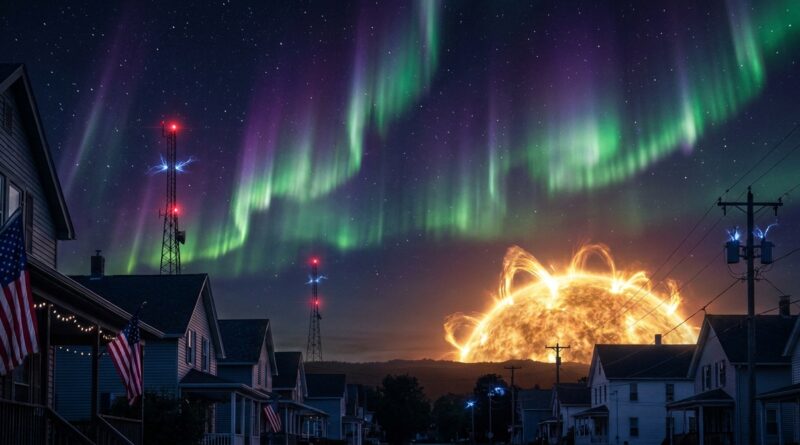
‘Machine-Gun Sun’ Is Firing Repeating Blasts At Earth. Scientists Say The Pattern Makes No Sense
If you feel like every solar storm story is talking down to you, you are not imagining it. Most coverage boils this down to “pretty northern lights” and “nothing to worry about,” while quietly slipping in the part that matters most. The Sun has been firing off repeated bursts in quick succession, and some scientists are openly saying this pattern does not fit neatly into the calm, predictable picture many of us learned in school. That is the real story behind the so-called machine gun sun mysterious solar storm aurora anomaly. It is not proof of doom. It is not proof of aliens either. But it is a reminder that even our own star can still surprise the people who study it for a living. If you have been wondering whether something deeper is going on than a simple holiday light show, the honest answer is yes. Not apocalyptic. Just genuinely unusual, and worth paying attention to.
⚡ In a Hurry? Key Takeaways
- The Sun really has been producing repeated eruptions in a pattern that scientists do not fully understand yet.
- If auroras are forecast in your area, use a dark-sky app, check NOAA space weather updates, and look north after local sunset for your best shot.
- This is mostly a power-grid and satellite concern, not a personal safety crisis on the ground, but it is a useful reminder that space weather can affect real-world tech.
What people mean by the “machine-gun Sun”
This nickname is not a formal science term. It is shorthand for a Sun that seems to be spitting out blast after blast, with less downtime than people expect.
Normally, solar activity comes in waves. Sunspots form. Magnetic fields twist. A flare pops. Sometimes a coronal mass ejection, or CME, follows. That part is familiar. What has people paying closer attention now is the rapid-fire feel of it all. Multiple eruptions. Strong auroras. Repeated impacts. And timing that makes the whole thing feel less tidy than the classroom version.
That does not mean physics has broken. It means the simple version of solar behavior, the one most of us hear in headlines, leaves out how messy the real system can be.
Why scientists say the pattern “makes no sense”
That phrase needs a little translating. Scientists usually do not mean “we have no clue what the Sun is.” They mean the exact combination of events is not lining up cleanly with the models or expectations they would normally use.
Think of it like your car starting every morning, except one week it begins coughing, revving, then running perfectly fine, then coughing again in a rhythm your mechanic cannot easily explain. The engine still exists. The parts still make sense. But the pattern is odd.
With the Sun, the trouble comes from magnetic complexity. Solar eruptions are driven by magnetic field lines that get stretched, tangled, and snapped into new shapes. Scientists can track a lot of this. What they cannot always do is predict exactly when one eruption will trigger another, or why some active regions become repeat performers.
Three reasons this feels strange right now
1. Repetition. One big flare is interesting. Several in sequence gets attention.
2. Strong auroras tied to those blasts. Beautiful sky color is the public-facing result, but it also tells us charged particles are hitting Earth’s magnetic environment hard enough to stir things up.
3. Public messaging is too neat. Headlines often present this as routine “space weather,” while experts in interviews admit parts of the behavior are still being sorted out.
So is this dangerous, or just weird?
For most people on the ground, it is mostly weird and interesting.
The atmosphere and Earth’s magnetic field do a lot of heavy lifting for us. You are not going to walk outside and get fried by a solar flare. That is not how this works. The bigger risks are to systems, not skin. Satellites can have trouble. Radio communication can get noisy. GPS accuracy can wobble. Power grid operators have to pay attention when geomagnetic storms ramp up.
That is why I wish more outlets would stop treating this like a pure skywatching story. It is both a beautiful natural show and a real technology issue. If you rely on navigation, aviation systems, radio, weather satellites, or even just the quiet assumption that infrastructure always behaves, space weather matters.
Why auroras are the clue everyone can actually see
Auroras happen when charged particles from the Sun get funneled by Earth’s magnetic field toward the poles, where they collide with gases in the upper atmosphere. That part is well understood.
What is less settled in moments like this is why the upstream solar activity arrives in bursts that seem to stack on top of each other so effectively. A single CME can cause a storm. Several arriving in close sequence can stir up stronger, longer-lasting effects, especially if magnetic orientation lines up in just the wrong, or right, way depending on whether you want a warning or a light show.
So when you see reports of “ultra-charged auroras,” that is the visible symptom. The hidden story is the chain of solar events that fed them.
What the textbooks get right, and what they smooth over
The textbook story says the Sun follows an approximately 11-year solar cycle. Activity rises and falls. More sunspots generally mean more flares and ejections. That is true as far as it goes.
But nature loves rough edges. Real cycles are not clockwork. Some active regions become unusually productive. Magnetic structures interact in ways that are hard to forecast. A pattern can be broadly expected and still feel surprising in the details.
That is the part many readers pick up on instinctively. You hear “this is normal,” then five minutes later hear “we have not seen this exact setup before.” Both can be true. The broad category is familiar. The exact sequence can still be an anomaly.
What you should actually do with this information
You do not need a bunker. You do need better filters for science news.
If you want to watch the skies
Check NOAA’s Space Weather Prediction Center, local weather, and cloud cover maps. If auroras are possible where you live, get away from city lights, face north, and give your eyes time to adjust. Phone cameras often pick up color before your eyes do.
If you are worried about your tech
Do the same boring smart stuff that helps in any infrastructure hiccup. Keep your phone charged. Download maps before a trip. Do not assume GPS, cell service, or radio will always be perfect during strong geomagnetic activity. Most of the time, consumer effects are minor. But “minor” is not the same as “nothing.”
If you care about the science
Pay attention to how experts phrase uncertainty. “Unexpected.” “Unusual.” “Not fully understood.” Those are not red flags for panic. They are green lights for curiosity.
The honest middle ground between panic and dismissal
This is where a lot of reporting falls apart. One side screams that the sky is falling. The other side pats you on the head and says it is just a nice aurora weekend.
The truth sits in the middle. The machine gun sun mysterious solar storm aurora anomaly is real in the sense that the Sun’s recent behavior has raised eyebrows. It is mysterious in the normal scientific sense, where experts are still working out the exact mechanics. And it matters because our civilization now depends on fragile layers of electronics and orbital hardware that older generations did not.
That is not fearmongering. That is basic modern life.
Why this story matters more than the holiday-weekend framing
A lot of coverage is selling this as bonus fireworks. Nice photos. Maybe some dramatic language. Then everyone moves on.
But for people who like to watch the edges of accepted explanations, this is more interesting than that. We are looking at a live example of science doing what science actually does. Not issuing perfect answers from a mountaintop, but revising, comparing, arguing, and trying to make sense of a messy reality in real time.
And honestly, there is something refreshing about that. The Sun is the best-studied object in our cosmic neighborhood, yet it can still throw us a sequence that makes experts stop and say, “Hold on.”
At a Glance: Comparison
| Feature/Aspect | Details | Verdict |
|---|---|---|
| What is happening | Repeated solar eruptions and strong auroral activity arriving in a pattern that is more complicated than the simple “one storm, one effect” story. | Genuinely unusual, but not unprecedented in the broad sense of active solar behavior. |
| Risk to ordinary people | Little direct bodily danger on the ground. Main concerns are satellites, radio, GPS, aviation, and power systems. | Low personal danger, moderate infrastructure relevance. |
| Why it matters | It shows the gap between the simplified schoolbook model of the Sun and the messier reality scientists are still trying to map. | Worth watching, especially if you care about science, anomalies, or tech resilience. |
Conclusion
Today’s solar story is being sold everywhere as a fun fireworks bonus for the holiday weekend, but buried in the coverage is something far more interesting for a community like ours. We are watching a star behave in a way that strains the limits of the models we teach in school. That does not mean all bets are off. It does mean the neat, reassuring version of “space weather” leaves out the most human part of science, which is admitting when reality gets weird. Framed that way, the machine gun sun is more than a pretty aurora generator. It is a live anomaly in our own backyard. A reminder that our explanations are useful, but never complete. If you want to take part, step outside, watch the sky, compare notes, and pay attention to where confidence ends and real mystery begins.