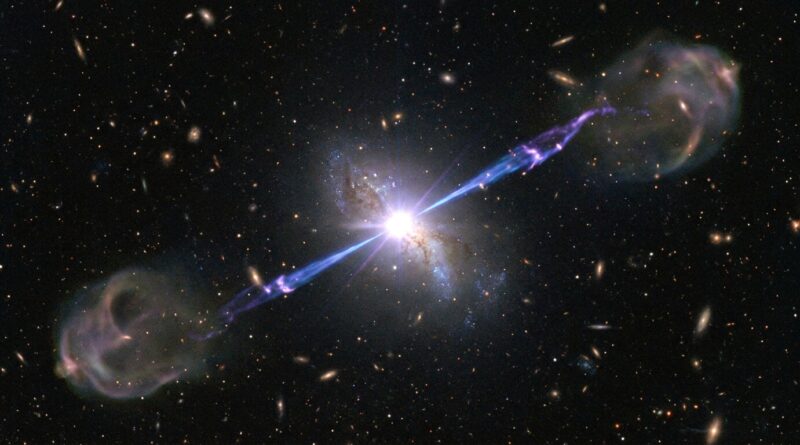
This Black Hole Just Switched On Like A Cosmic Lighthouse. Astronomers Say It Shouldn’t Be Possible
If you are tired of every “space mystery” turning into something ordinary with a dramatic headline, this one may finally earn the hype. Astronomers are watching a nearby galaxy called SDSS J110546.07+145202.4, where a supermassive black hole seems to have switched from quiet to loud, blasting out radio energy in a way that does not fit the usual script. That matters because black holes are not supposed to flip on like a porch light, especially not in a galaxy this close by, and especially not with radio behavior that looks more like what we expect from the early universe. The result is a genuinely odd case. Not internet odd. Professional-astronomers-going-back-to-the-data odd. The big question is simple to ask and hard to answer. Are we catching a black hole in a rare stage of waking up, or are our models for how these giants ignite missing a whole chapter?
⚡ In a Hurry? Key Takeaways
- This mysterious long-lived radio outburst from black hole galaxy 2026 may be the first clear example of a new kind of changing-look radio galaxy.
- When you see claims like “black hole switched on,” focus on what changed: radio brightness, duration, and how fast the galaxy went from quiet to active.
- The value here is real. This is a current astrophysics puzzle, not recycled clickbait, and scientists do not yet agree on the cause.
What actually happened?
A galaxy with the not-exactly-memorable name SDSS J110546.07+145202.4 appears to have gone through a dramatic change. For years, it looked fairly ordinary in the ways astronomers track black hole activity. Then it started producing a strong, long-lasting radio signal.
That radio outburst is the key. Black holes themselves do not emit light because, well, they are black. What we see is the chaos around them. Gas falls inward. Magnetic fields twist. Jets can shoot outward at huge speeds. Those jets, and the particles in them, can produce bright radio emission.
What makes this case weird is not just that the black hole became active. It is how it did it, how long the outburst has lasted, and how closely it resembles radio-loud systems more common in the younger universe than in our local cosmic neighborhood.
Why astronomers are calling it “impossible” or close to it
“Impossible” in astronomy usually means, “our current best model does not explain this cleanly.” That is a lot less dramatic than movie dialogue, but it is more interesting.
The standard picture says supermassive black holes can spend long periods quiet, then become active when enough material starts falling in. Fine. No problem there. The trouble is that radio-loud activity, especially the kind linked to powerful jets, tends to fit certain patterns. It often shows up in galaxies with a long history of active feeding, mergers, or environments that make jet production easier to sustain.
This object seems to have skipped part of that expected story. It looks like a system that went from relatively subdued to radio-bright on a timescale and in a way that pushes against the neat categories astronomers like to use.
Think of it like this
Imagine a quiet lighthouse on a calm shore. No lamp, no beam, nothing unusual. Then one night it starts sweeping a powerful light across the sea, and when you inspect the building, it does not seem to have the fuel system or wiring you would expect for that kind of output. You would not just ask, “Why is the light on?” You would ask, “How is this thing powered at all?”
What is a “changing-look” radio galaxy?
You may have heard of changing-look active galaxies before. Usually that phrase refers to galaxies whose bright central regions seem to shift categories over time. They might show stronger or weaker signatures in visible light, X-rays, or other wavelengths as the black hole feeding process changes.
This case may be different enough that some researchers are treating it as the prototype of a changing-look radio galaxy. In plain English, that means a galaxy whose black hole did not just brighten a little. It appears to have changed its radio personality.
That matters because radio emission often points to jets, and jets are one of the hardest parts of black hole physics to fully explain. You need matter falling in, yes. But you also need the right geometry, magnetic field structure, black hole spin, and timing. A system that suddenly lights up in radio waves can reveal where our assumptions are too simple.
Why the long duration matters
A brief flare is exciting, but it can sometimes be explained away. Maybe a star got shredded. Maybe a clump of gas fell in. Maybe there was a one-off burst tied to a temporary event.
A long-lived radio outburst is tougher. It suggests a more sustained engine. Something kept feeding or maintaining the process. That pushes scientists toward ideas involving a real change in the black hole’s accretion state, the start of a jet, or a major restructuring of the environment near the galactic core.
And that is where the mystery gets sharper. If this is a sustained switch-on event, we may be seeing the birth, restart, or reconfiguration of an active galactic nucleus in near real time.
So what could be causing it?
Right now, there are a few main possibilities. None is fully satisfying yet.
1. The black hole recently started feeding harder
This is the most straightforward idea. More gas falls toward the central black hole. The inner disk heats up. Magnetic fields become more organized. A jet turns on. That sounds reasonable, but the details matter. The radio properties may still be stronger or stranger than expected for such a simple reboot.
2. A jet was born or reawakened
Some black holes are better at launching jets than others. If conditions near the event horizon changed just enough, a previously weak or hidden jet might have become powerful and visible. This would help explain the radio brightness, but researchers still have to show why the transition happened now, and why it looks so unusual.
3. We are seeing the aftermath of a disruption event
Sometimes a star wanders too close and gets torn apart. That can trigger a flare across several wavelengths. But tidal disruption events usually have signatures that astronomers can compare with past examples. If this event does not match those patterns well, that explanation weakens.
4. Our categories are too neat
This may be the uncomfortable answer. Nature does not care about our labels. “Quiet galaxy,” “active galaxy,” “radio loud,” “radio quiet.” Those are useful bins, but the universe may be full of transitional states we have simply missed because we have not been watching often enough or with the right instruments.
Why this sounds like the early universe
One of the most intriguing parts of the story is that the radio behavior feels out of place locally. Similar powerful radio phenomena are more commonly discussed in connection with the younger universe, when galaxies were messier, black holes were feeding more aggressively, and cosmic structures were still settling down.
Seeing something with that flavor nearby is a bit like finding a machine from a factory’s wild startup years still behaving like the company never matured. It suggests either a rare local environment, a hidden trigger, or a process that can happen much later in cosmic history than expected.
Why this is not just another dressed-up “space mystery” story
The honest answer is that astronomers have data, but not closure. That is a good sign.
When a science story gets overhyped, it often follows a pattern. Strange signal. Breathless coverage. Then a dull answer appears two days later. Satellite glitch. Dust. Instrument noise. Statistical fluke.
This case has held interest because the weirdness survives first contact with expert skepticism. Researchers are not saying, “Look, aliens.” They are saying, “This object may not fit our usual picture of how black holes become radio-loud.” That is a serious and useful kind of mystery.
What non-experts should pay attention to
You do not need a PhD to follow the important part. Ask three simple questions whenever a story like this pops up.
Did the object really change, or did we just notice it?
Sometimes better telescopes or wider surveys reveal things that were already there. In this case, the central issue appears to be genuine change over time, which is much more interesting.
Is the signal short-lived or sustained?
Short flashes can come from many one-off causes. Sustained activity usually points to a more fundamental process in the black hole system.
Does it break a model, or just stretch it?
Most discoveries do not destroy physics. They expose where a model is incomplete. That is still a big deal. Science often moves forward by finding the awkward cases that refuse to behave.
What happens next?
Astronomers will keep tracking this galaxy across multiple wavelengths, not just radio. They will want X-ray data, optical spectra, and time-series observations to see whether the source keeps brightening, fades, or changes character again.
If they can map the environment around the black hole more clearly, they may be able to tell whether a jet is expanding, whether fresh material is still falling in, and whether this event belongs to a known family or really is the first of a new class.
The most exciting outcome is not necessarily a dramatic answer. It is a useful one. If this object becomes a benchmark case, future surveys may uncover more galaxies doing the same thing. Then a one-off mystery turns into a population, and a population turns into a new chapter in black hole physics.
At a Glance: Comparison
| Feature/Aspect | Details | Verdict |
|---|---|---|
| Type of event | A long-lived radio outburst from a supermassive black hole in nearby galaxy SDSS J110546.07+145202.4 | Genuinely unusual |
| Why scientists care | It may represent a changing-look radio galaxy, meaning the black hole’s radio behavior changed dramatically over time | Potentially a new class |
| Best current explanation | Some mix of fresh accretion, jet activation, or a black hole state change, but no single model explains everything cleanly yet | Still an open puzzle |
Conclusion
This is the kind of story space fans keep hoping for and rarely get. Not a recycled “scientists baffled” headline. A real, current puzzle with enough data to be credible and enough missing pieces to stay interesting. SDSS J110546.07+145202.4 seems to host a supermassive black hole that flipped from quiet to roaring, creating a mysterious long-lived radio outburst from black hole galaxy 2026 that looks oddly out of time, more at home in the early universe than in our local one. That is why some astronomers are framing it as the first example of a changing-look radio galaxy. Maybe we are catching black holes in the act of evolving. Maybe our timeline for how they light up is incomplete. Either way, this gives readers something valuable: a live scientific mystery where the jargon matters, the data matter, and the answer is not settled yet.