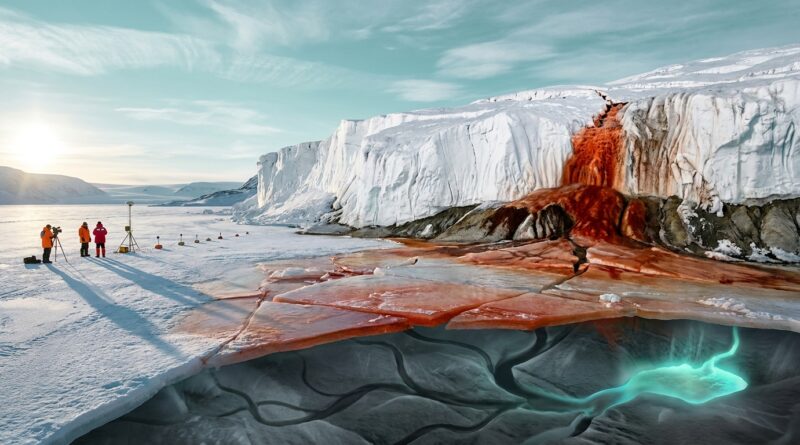
Antarctica’s ‘Waterfall of Blood’ Just Got Weirder: The Hidden World Beneath Blood Falls
You have probably seen the same shallow take by now. Antarctica’s Blood Falls looks wild, scientists solved it, case closed, it is rusty water. That answer is not wrong, but it is incomplete, and honestly a little annoying if you want the real story. The fresh twist in the Antarctica Blood Falls mystery is that researchers did not just confirm what makes the water red. They caught hints that the glacier itself subtly rises and sinks as super-salty brine moves through hidden channels below the ice. In plain English, the falls may be connected to an active underground plumbing system that pulses, shifts, and possibly supports life in brutal conditions. That matters because Blood Falls is no longer just a pretty oddity for social media. It is turning into a live test case for how strange ecosystems can survive in sealed, dark, freezing places, including spots on Mars or icy moons like Europa.
⚡ In a Hurry? Key Takeaways
- The direct answer is that Blood Falls is red because iron-rich brine hits air and oxidizes, but new work suggests the source is part of a moving underground brine network, not a simple static pool.
- If you see “mystery solved” posts, look for the deeper evidence: GPS drift, timelapse images, and temperature sensors all pointed to the glacier sagging as brine pulsed outward.
- The big value is scientific, not just visual. Blood Falls may help researchers understand hidden ecosystems on Earth and guide the search for life in icy worlds beyond Earth.
Why Blood Falls still matters
Blood Falls spills out of Taylor Glacier in Antarctica’s McMurdo Dry Valleys, one of the harshest places on Earth. The scene looks unreal. Red liquid stains white ice like a horror movie prop.
For years, the quick explanation has been simple. The water is packed with iron. When that iron-rich brine reaches oxygen in the air, it rusts and turns red. That part is true.
But the newer research pushes the story much further. Instead of a one-off leak from a trapped pocket, scientists are seeing signs of a connected subsurface system. Think less “frozen stain” and more “hidden plumbing under a giant block of ice.”
What scientists actually noticed
The really interesting part is how this came together. Not from one flashy gadget. From several boring-sounding tools lining up at just the right time.
GPS showed the glacier moving in a subtle way
Researchers tracking the glacier saw small vertical shifts. Parts of the ice appeared to sag and then recover. That may sound minor, but glaciers do not do that randomly without a reason.
One likely explanation is pressure changing below the ice as brine moves through sediments or channels. If fluid builds up, drains, or shifts, the overlying ice can respond.
Timelapse cameras caught the surface changes
Images taken over time backed up those motion readings. This matters because one instrument can glitch. Multiple lines of evidence are much harder to dismiss.
When the camera record and GPS record point in the same direction, scientists get more confidence that they are seeing a real physical process and not noise.
Temperature strings added another clue
Sensors placed in and around the ice tracked temperature changes that fit the same broad picture. Super-cold freshwater would behave differently from concentrated brine. Brine stays liquid at much lower temperatures because of its salt content.
That helps explain how fluid can still move in a place that looks locked solid.
So what is under Blood Falls?
The best current picture is a buried network of extremely salty water, ice, and sediment beneath Taylor Glacier. This brine may be ancient. It may also be more connected and dynamic than scientists once thought.
That word matters. Dynamic. It suggests the glacier is not simply sitting on top of a sealed red reservoir. Instead, there may be a shifting system that stores pressure, releases it, reroutes flow, and occasionally pushes brine to the surface.
That is why the Antarctica Blood Falls mystery has gotten weirder, not simpler. The color may be explained, but the underground world feeding it is starting to look alive in a geological sense.
Why the water does not freeze solid
This is one of the easiest parts to miss. Normal water freezes. Brine does not behave normally.
The hidden fluid beneath Blood Falls is so salty that its freezing point drops far below that of freshwater. Add pressure, trapped sediments, and a cold but not perfectly uniform environment, and you get a system where liquid can persist and move in conditions that seem impossible at first glance.
If you have ever used salt on an icy sidewalk, you already know the basic idea. Blood Falls is that principle taken to an extreme.
What this says about life in extreme places
This is where the story gets bigger than one red waterfall.
Microbes have already been linked to the Blood Falls environment. They are not sun-loving organisms hanging out in open water. They survive in darkness, in cold, in salty conditions, and with very limited resources.
That makes Blood Falls a natural test site for one of science’s biggest questions. Could life exist in hidden pockets where sunlight never reaches?
On Earth, the answer looks increasingly like yes.
Why space scientists care
Icy moons such as Europa and Enceladus are famous because they may hide oceans or salty water beneath frozen shells. Mars, too, has long raised questions about buried brines and past water activity.
Blood Falls gives researchers a real place to study how chemistry, salt, pressure, and microbes interact under ice. It is not a perfect copy of another world, but it is a useful analog. In science, that is gold.
Why this was missed for so long
Partly because Antarctica is hard. It is remote, brutal, expensive, and unforgiving. You cannot just pop over with a shovel and a test kit.
Partly because the first answer was satisfying enough. Red water. Iron. Oxidation. Mystery solved.
And partly because good science often moves this way. A broad explanation comes first. Then better tools reveal the messy details underneath. That does not mean the earlier scientists were wrong. It means nature was more complicated than the summary version.
What people get wrong when they share Blood Falls online
The most common mistake is treating the falls like a visual trick with a tidy label attached. “It’s just rust.”
That is like saying a smartphone is “just glass and metal.” Technically true. Not very helpful.
The real interest is in the system. Where the brine sits. How it moves. Why the glacier appears to react. What chemistry lets liquid survive there. And whether microbes are using that environment in ways that hint at how life might persist elsewhere.
What to watch for next
If this line of research keeps moving, expect more focus on mapping the subsurface network without disturbing it too much. Scientists will want better models of how pressure builds, how channels connect, and how often brine pulses outward.
They will also keep studying the chemistry and microbiology. If the underground network is truly shifting and exchanging material, that has big implications for how hidden ecosystems stay supplied over time.
In other words, the next headline probably should not be “Blood Falls explained.” It should be “Blood Falls keeps explaining how little we know about what lives under ice.”
At a Glance: Comparison
| Feature/Aspect | Details | Verdict |
|---|---|---|
| Why it is red | Iron-rich brine reaches oxygen and oxidizes, creating the blood-red color. | Solved, but only the surface-level part. |
| What is new | GPS, timelapse cameras, and temperature strings suggest the glacier subtly sags as brine pulses through hidden pathways. | Strong clue that the source is an active underground network. |
| Why it matters | Shows how liquid water and possibly microbial life can persist under ice in extreme conditions. | Important for Earth science and the search for life beyond Earth. |
Conclusion
That is the deeper layer missing from most viral posts about the Antarctica Blood Falls mystery. Yes, the red color comes from rusty, iron-rich brine. But the stranger and more useful finding is that the glacier seems to respond as that brine moves, pointing to a hidden system below that is active, pressurized, and still full of surprises. For the Anomal community, that is the real payoff. Blood Falls is not just a century-old mystery with a neat label slapped on it. It is a reminder that “solved” stories can reopen when better evidence shows up, and sometimes they come back bigger than before. GPS drift, timelapse cameras, and temperature strings together turned a famous photo-op into a clue about buried ecosystems, moving brine, and maybe even how life could hang on under alien ice. That is science-first weirdness at its best, and it is exactly why this story deserves more than a shrug.