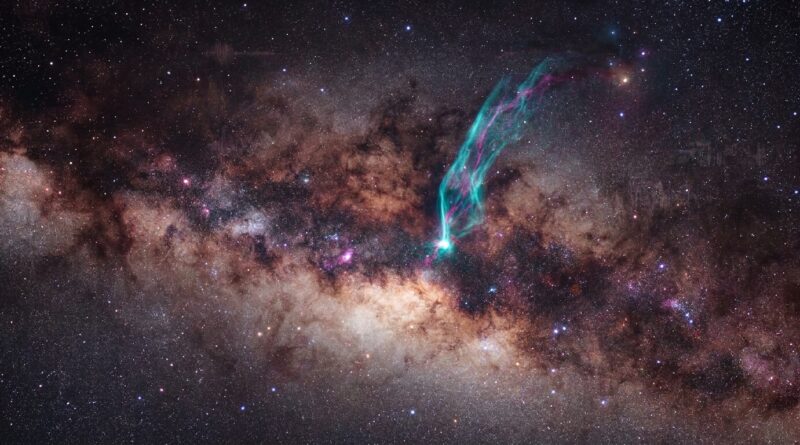
The Milky Way’s Heart Just Whispered A New Mystery Signal. No One Knows What’s Talking
If you are worn out by breathless UFO posts and recycled “astronomers heard a weird signal” headlines, you are not alone. Most of these stories get stretched far beyond the facts. This one is different. Astronomers have reported a genuinely new and oddly behaving radio source coming from the crowded central region of the Milky Way, and the easy answers are not fitting neatly. That does not mean aliens. It also does not mean “nothing to see here.” It means researchers may have caught a real, fresh puzzle in one of the busiest and messiest parts of our galaxy. Right now, the most useful thing is to separate what has actually been detected from the guesses piling up around it. The signal appears to be transient, unusual in behavior, and hard to match cleanly with familiar sources like ordinary pulsars, known stellar flares, or simple human-made interference. That makes the next round of observations the real story.
⚡ In a Hurry? Key Takeaways
- A mysterious radio signal from the center of the Milky Way 2026 appears to be a real new astronomical source, but scientists do not yet know what object is producing it.
- The smart way to follow this story is to watch for repeat detections, frequency data, X-ray follow-up, and whether other telescopes confirm the same behavior.
- This is a science story, not proof of aliens. The value is in seeing how astronomers test strange signals before jumping to big claims.
What happened
A radio source near the heart of our galaxy has turned up with behavior that is not lining up cleanly with the usual suspects. In plain English, telescopes picked up radio emission from a spot in the galactic center region, and that emission seems odd enough that astronomers have flagged it as hard to classify.
The center of the Milky Way is a rough neighborhood for this kind of work. It is packed with stars, dust, magnetic activity, and exotic objects. That means two things at once. First, weird signals can happen there for perfectly natural reasons. Second, it is harder to sort out exactly which object is making the noise.
So the headline here is not “space is talking to us.” The headline is that astronomers may have found another member of a growing class of strange radio transients that do not fit the old tidy categories very well.
What scientists know so far
It seems to be a real source, not just random static
The first basic question with any mystery signal is boring but important. Is it real? Researchers usually check whether the detection shows up in the right place, with the right instrument behavior, and whether it survives the first pass of data cleaning. If it does, then attention shifts from “is this noise?” to “what kind of object does this?”
It is coming from a crowded part of the sky
Because this source appears near the galactic center, pinning down its identity is harder than it would be in a quieter patch of sky. A crowded field can hide counterparts at other wavelengths. One radio source may sit close to stars, nebulae, X-ray emitters, or compact objects that muddy the picture.
Its behavior does not match the simplest explanations
A normal pulsar has a fairly well-understood signature. Human interference often has telltale signs too. Stellar flares, black hole activity, and magnetars each leave patterns that astronomers know how to look for. The reason this case is getting attention is that the source is not dropping neatly into one of those boxes yet.
What it could be, and why each idea has problems
A pulsar
This is one of the first guesses whenever radio astronomy turns up a repeating or bright signal. Pulsars are spinning neutron stars, and they can act like cosmic lighthouses. But if the timing, spectrum, or fading pattern is off, the pulsar label starts to wobble.
If this source lacks the usual stable rhythm, or if it switches on and off in an unusual way, then a standard pulsar explanation may not hold up.
A magnetar
Magnetars are neutron stars with extremely strong magnetic fields, and they can do wild things in radio and X-rays. The Milky Way’s center has already given us unusual magnetar behavior before, so this is not a crazy option.
The trouble is that magnetars often have partner clues. Astronomers would want to see whether the radio behavior lines up with expected bursts, polarization, or X-ray activity. If those extra clues are missing, the fit gets weaker.
A stellar flare or binary system
Some stars and star systems can produce dramatic bursts of radio waves. A close binary system, where two objects orbit each other tightly, can also create strange repeating signals.
But if the brightness changes too sharply, the frequencies look wrong, or the position does not match a likely visible star, then that explanation starts looking less convincing.
Human-made interference
This is always checked first because radio telescopes live in a world packed with satellites, aircraft signals, and ground-based electronics. But when astronomers say a source looks interesting, it usually means they have already done early checks to make sure it does not behave like ordinary radio pollution.
That still does not settle everything. Independent confirmation from more than one telescope is what really helps.
Why the galactic center matters so much
The mysterious radio signal from the center of the Milky Way 2026 is extra interesting because the galactic center is one of the richest laboratories in the sky. It holds dense star populations, strong gravitational effects, and unusual magnetic environments. If you are going to discover a weird radio source that rewrites the rulebook a little, this is exactly the kind of place where it might show up.
That is also why astronomers are careful. Busy regions create both opportunity and confusion. A flashy headline can make it sound like one object has been nailed down, when the truth is often that researchers are still sorting through overlapping sources and follow-up data.
What tests come next
Repeat observations
The biggest question is whether the source comes back, and if it does, whether it follows any schedule. A repeat pattern can reveal a spinning object, an orbiting system, or a source that switches between active and quiet states.
Multi-frequency radio checks
Radio signals are not just about “it made a sound.” Astronomers look at how bright the source is across different frequencies. That spectrum can hint at the physical process behind it. Some objects get brighter at lower frequencies. Others do the opposite.
Polarization measurements
This is one of those technical terms that matters. Polarization tells scientists about the orientation and behavior of electromagnetic waves, and it can reveal strong magnetic fields or turbulent material between us and the source. If the polarization is unusual, it could point toward a magnetar-like environment or something similarly extreme.
X-ray and infrared follow-up
Radio alone may not solve the case. If an X-ray telescope or infrared survey finds a matching source in the same spot, that can narrow the list fast. No counterpart is also useful information. It tells astronomers what the source probably is not.
What this does not mean
It does not mean extraterrestrials have been detected. That is the leap that always rushes in when “mystery signal” hits social media. In real astronomy, “mystery” usually means the data does not fit the first few known templates yet.
It also does not mean the signal is fake or overhyped. Sometimes the most exciting discoveries start exactly this way, as an annoying mismatch between fresh data and old categories.
Why this story is worth your attention
There is a bigger trend here. Radio astronomers keep finding more transient and oddly timed events than they used to. Better instruments, wider surveys, and constant sky monitoring are showing us that the galaxy is more active and more varied than the old textbooks suggested.
That matters because each new object helps map the Milky Way’s real “soundscape.” We are learning that space is not just filled with neat, repeating clockwork signals. It also has bursts, one-offs, weird repeaters, and edge cases that blur the lines between known classes of objects.
For readers, this is where healthy skepticism helps. Ignore anyone claiming certainty too early. The best updates will be the least dramatic ones. They will mention confirmation, timing behavior, frequency range, and follow-up from other observatories.
How to follow the story without getting fooled
If you want the useful version of this news instead of the clickbait version, keep an eye out for four things.
1. Has another telescope confirmed it?
One instrument can find something important. Several instruments can make the case much stronger.
2. Does it repeat?
A repeat schedule can change everything. It may point to spin, orbit, or some regular physical trigger.
3. Is there a match in X-ray, infrared, or optical data?
A counterpart can turn a mystery into a category very quickly.
4. Are astronomers arguing over a few plausible models, or still at square one?
There is a big difference between “we have three decent candidates” and “we barely know what family this belongs to.”
At a Glance: Comparison
| Feature/Aspect | Details | Verdict |
|---|---|---|
| What is confirmed | A new radio source near the Milky Way’s center appears unusual enough that standard labels are not fitting cleanly yet. | Interesting and real enough to study closely |
| Most likely explanations | Possibilities include an odd pulsar, magnetar, flaring star system, or another compact object with unusual radio behavior. | Natural source is still far more likely than exotic claims |
| What happens next | Repeat monitoring, frequency analysis, polarization checks, and X-ray or infrared follow-up will decide which models survive. | Wait for more data before trusting strong conclusions |
Conclusion
This is the kind of space story that deserves patience. A brand new, hard-to-classify radio source has appeared in almost real time, and it is exactly the sort of case that will be buried under loud speculation within days. The useful approach is simpler. Stick to what is known, note what remains unexplained, and watch the next tests carefully. That way, you get the science without the circus. It also fits a bigger pattern in radio astronomy right now. We keep finding more transient, one-off, and repeating signals that do not behave like simple pulsars or obvious interference. In other words, we are still mapping the basic soundscape of our own galaxy. And sometimes the most exciting part is not having the answer yet, but getting to watch how the answer is built.