The Wow! Signal Isn’t Done With Us Yet: New Study Rekindles Astronomy’s Strangest ‘Maybe’
If you have ever felt whiplash from Wow! signal headlines, you are not alone. One year it is “probably a comet,” the next it is “definitely not a comet,” and now the new wow signal study 2026 unexplained radio signal debate is alive again. That is frustrating, especially if you just want a clean answer to a mystery that started back in 1977. But this is also what real science looks like when the evidence is thin and the stakes are weirdly huge. A fresh study has pushed the argument back into the spotlight, not by proving aliens, but by challenging older “case closed” claims and forcing astronomers to re-check what that famous 72-second burst could have been. The result is not certainty. It is something more interesting. The Wow! signal is still standing in that uncomfortable middle ground between solved and unsolved, and that is exactly why people cannot stop talking about it.
⚡ In a Hurry? Key Takeaways
- The new study does not solve the Wow! signal, but it does weaken the idea that the mystery is fully explained.
- If you follow space anomalies, pay attention to what the paper actually rules out, not just the dramatic headlines.
- This is a good reminder that one strange data point can stay unsettled for decades without being proof of aliens or proof of a boring answer.
Why the Wow! signal still gets under people’s skin
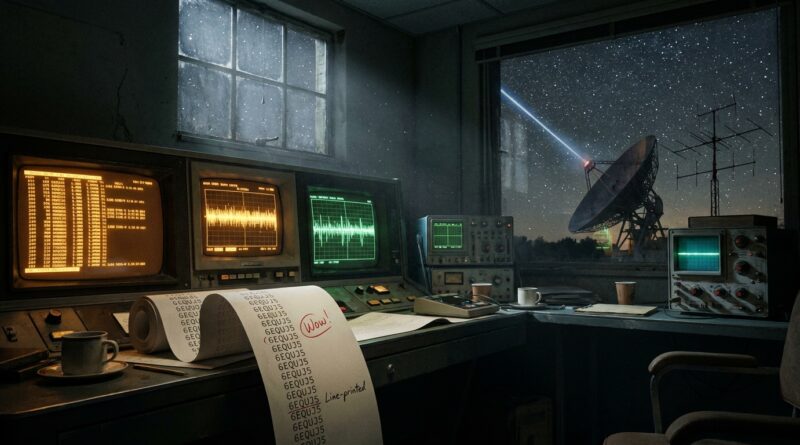
The Wow! signal is famous because it was simple, sharp, and brief. In August 1977, Ohio State University’s Big Ear radio telescope picked up a strong narrowband radio signal that appeared to come from the direction of Sagittarius. It lasted 72 seconds, which matched how long a fixed telescope could “see” a source as Earth rotated.
Astronomer Jerry Ehman circled the printout and wrote “Wow!” in the margin. The name stuck.
What made it so strange was not just the strength of the signal. It was the combination of things people hunting for artificial transmissions would expect to care about. It was narrow in frequency, unusually intense compared with background noise, and never convincingly repeated. That last part matters a lot. If it had repeated, scientists would have had a much easier time pinning down what made it.
What the new study is saying
The new wow signal study 2026 unexplained radio signal argument focuses on whether previous natural explanations really hold up. Over the years, several ideas have been floated. Some were ordinary radio interference. Some involved hydrogen clouds. One of the best-known attempts pointed to comets and their hydrogen envelopes passing through the right region of sky.
This fresh work does not hand us a neat replacement answer. Instead, it re-examines assumptions behind those older explanations and asks a blunt question: do they actually match the original observation closely enough?
That matters because “possible” and “fits the data” are not the same thing. In anomaly research, people often confuse those two.
The big issue: matching the original signal
For an explanation to stick, it has to account for several awkward details at once:
- Why the signal was so narrowband.
- Why it appeared in the frequency neighborhood people associate with neutral hydrogen.
- Why it lasted the amount of time it did.
- Why it was strong enough to stand out so clearly.
- Why it did not show up again in the same convincing way.
The new paper argues that some older explanations have been treated as more complete than they really are. In plain English, the study is saying, “Hold on. You may have explained a piece of the puzzle, but not the whole thing.”
Why the comet explanation keeps getting dragged back into court
The comet idea got a lot of attention because it sounded satisfyingly natural. Comets can carry huge hydrogen clouds. Hydrogen emits radio waves at a famous frequency. On paper, that gives you a way to connect a space object with a radio event.
The problem is that the Wow! signal was not just any blob of radio noise. It was unusually clean and intense.
Critics of the comet explanation have long argued that a diffuse hydrogen cloud should not produce a signal with the same narrow, standout character. Supporters have replied that the sky is messy, old observations were limited, and rare geometry can fool us. The new study appears to side more with the critics, or at least to say the comet story should not be treated as a finished answer.
That is why this mystery keeps reopening. Not because astronomers love drama, but because each proposed explanation fixes one problem and leaves two more behind.
What this does not mean
It does not mean aliens just moved back to the top of the list.
That is the part worth saying clearly. A weak explanation for a natural cause is not the same thing as strong evidence for an artificial cause. Those are very different standards.
The Wow! signal remains a “maybe” in the most literal sense. Maybe it was a rare natural radio event we still do not understand well. Maybe it was terrestrial interference that looked more convincing than anyone realized. Maybe it was something genuinely unusual in the sky. Science, annoyingly but honestly, is allowed to stop there until better evidence appears.
Why this old mystery still matters in 2026
You might wonder why anyone still cares about one lonely burst from nearly fifty years ago. Fair question.
The reason is that the Wow! signal sits right at the intersection of astronomy, data quality, and human bias. It is a perfect case study in how scientists handle anomalies. Some rush to explain them away. Some become too attached to the mystery. The useful work happens in the middle, where people keep testing each claim against the original evidence.
That is also why this story is so useful for readers. You get to watch science as an argument, not as a polished movie ending. That can be messy, but it is more honest.
It is a lesson in reading science headlines
If you see a headline claiming the Wow! signal is “finally solved,” slow down. Ask three simple questions:
- Does the study explain all the main features of the 1977 signal, or just one of them?
- Has the explanation been independently tested or repeated?
- Are experts saying “this is one plausible idea,” or are they saying “the evidence is now overwhelming”?
Most of the time, the real answer is more modest than the headline.
What scientists are really arguing about
At the center of the new wow signal study 2026 unexplained radio signal debate is not just one burst of radio energy. It is standards of proof.
One camp says a natural explanation does not have to be perfect to be the best available answer. Another camp says that if the fit is poor, then calling it solved is misleading. Both views have some logic behind them.
That tension is healthy. It stops weird signals from turning into mythology, but it also stops weak explanations from hardening into fake certainty.
The hard truth about one-off events
Single events are a nightmare in astronomy. If something happens once and never repeats, you cannot point a telescope back at it and run the test again in the same way. You are stuck with old logs, instrument limits, sky maps, and probabilities.
That is one reason the Wow! signal keeps surviving every attempt to bury it. The original data point is both intriguing and lonely.
So where does the mystery stand now?
Right now, the honest status is this: still unresolved, still debated, still interesting.
The new study rekindles the mystery because it tells readers and researchers not to be too quick about placing the Wow! signal in the solved drawer. It does not blow up radio astronomy. It does not rewrite SETI. But it does remind everyone that some old cases remain open because the evidence never quite lines up cleanly.
That is a small but important difference.
What to watch next
If this paper gets traction, expect a few things to happen next:
- Other astronomers will check the study’s assumptions and math.
- Writers will oversimplify the result into either “aliens” or “nothingburger.”
- Researchers may compare the Wow! signal again with more modern transient radio events.
- The debate over whether older comet-based explanations were overstated will heat up again.
For non-specialists, the smart move is simple. Follow the rebuttals, not just the first splashy paper. In science, the second and third rounds are usually where the real value shows up.
At a Glance: Comparison
| Feature/Aspect | Details | Verdict |
|---|---|---|
| What the new study does | Re-checks whether past explanations, especially natural ones, really fit the original 1977 data well enough. | Useful challenge, not a final answer. |
| Does it solve the Wow! signal? | No. It weakens confidence in “case closed” stories more than it presents a complete new solution. | Still unresolved. |
| What readers should take from it | The mystery remains open because the evidence is limited and every explanation has rough edges. | Worth following with cautious curiosity. |
Conclusion
The best thing about covering the Wow! signal now is not that we are finally getting a clean ending. We are not. The value is that we get a live look at how a decades-old mystery gets reopened in real time. You can see how scientists argue over strange data, where the new explanation still breaks down, and why this signal keeps refusing to slide neatly into the solved pile. For the Anomal community, that is the good stuff. Not blind belief, not lazy debunking, but thoughtful, evidence-driven weirdness. And for a mystery this old, still being able to say “we need to look again” is pretty remarkable.