Did We Just Find a Crack in the Cosmic Rulebook? New Study Says the Universe May Be ‘Lopsided’ After All
It is oddly frustrating when science tells us the universe is settled, neat, and basically figured out, then a new paper comes along and whispers, “Maybe not.” That is the feeling around a fresh deep-sky analysis suggesting the universe may not be as even and directionless as the standard picture says. In plain English, one broad side of the cosmos may look like it is expanding or evolving a little differently than the other. If that holds up, it matters. A lot. The idea that the universe is roughly the same in every direction is one of the quiet rules holding modern cosmology together. This new result does not blow that rule up yet. But it does poke at it hard enough to get attention. And for anyone who loves real scientific mysteries, this is one of those rare moments when the data itself seems to be asking whether the cosmic rulebook is missing a page.
⚡ In a Hurry? Key Takeaways
- The new result hints that the universe may not be perfectly uniform in all directions, which would challenge a core idea in standard cosmology.
- Take the claim seriously, but not as settled fact yet. Watch for follow-up studies using different telescopes, sky surveys, and methods.
- This is not fringe hype. If confirmed, it could affect how scientists think about dark energy, cosmic expansion, and the basic structure of the universe.
What the new study is actually saying
At the heart of this story is a simple assumption with a fancy name: cosmic isotropy. That is the idea that, on the very largest scales, the universe should look broadly the same no matter which direction you look.
Not identical galaxy by galaxy, of course. Space is messy up close. Clusters, voids, filaments, collisions. But zoom way out and the standard model says it should average into something smooth and fair. No preferred direction. No cosmic “left side” behaving differently from the “right side.”
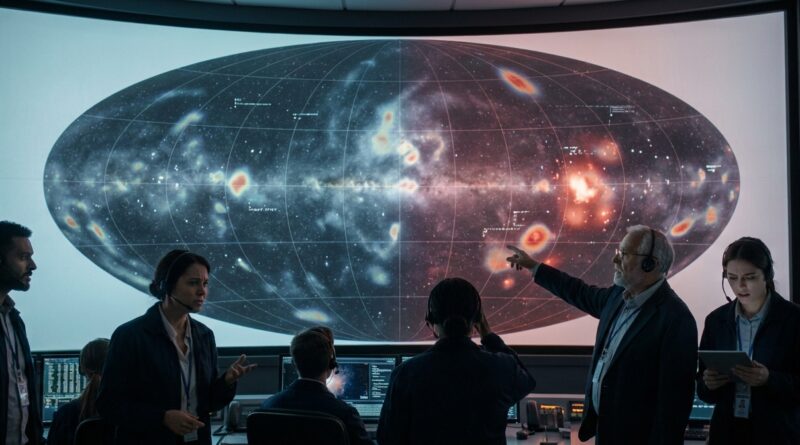
This universe not uniform new cosmology study suggests that may not be fully true. Researchers looked at deep-sky data and found a directional pattern that could mean one region of the universe is not matching another in the way the standard model expects.
That does not mean we have found the edge of the universe, or that Earth sits in a special place, or that physics is broken by lunchtime. It means there may be a large-scale asymmetry hiding in the data.
Why this is a big deal, even if it turns out to be wrong
Science stories often get framed as either “proven” or “debunked.” Real research is much less tidy than that.
What makes this one important is not that it is final. It is that it touches a foundation stone. Modern cosmology depends heavily on the assumption that the universe is homogeneous and isotropic at large scales. That assumption helps scientists model cosmic expansion, estimate the role of dark matter and dark energy, and interpret the afterglow of the Big Bang.
If the universe has a real large-scale lopsidedness, then a lot of calculations may need adjusting. Maybe only a little. Maybe a lot. Either way, it would not be a small footnote.
Think of it like a map app with one bad setting
If your phone’s map thinks north is slightly off, every route can still look normal at first. But the farther you travel, the more the error matters. A small wrong assumption at the base can echo through everything built on top of it.
That is why cosmologists get uneasy when anisotropy, meaning direction-dependent behavior, shows up in the numbers.
So what could explain a lopsided universe?
Right now, no one has a clean answer. That is part of what makes this story worth watching.
1. It could be a data or method issue
This is the least exciting possibility, but often the most common. Deep-sky surveys are complicated. Telescopes have biases. Dust gets in the way. Distance measurements are hard. Selection effects can create patterns that look cosmic but are really just artifacts of how the data was gathered or processed.
Before anyone rewrites textbooks, other teams will want to test the same question using different tools and different sky maps.
2. It could point to new physics
If the signal survives those checks, then things get interesting fast. Maybe dark energy is not behaving the same everywhere. Maybe early-universe conditions left a preferred direction. Maybe our standard model of cosmology is missing a term, a field, or a piece of structure.
That sounds dramatic because it is.
3. It could connect to bigger speculative ideas
This is where people start mentioning inflation oddities, giant cosmic structures, or even multiverse-adjacent ideas. Important note. Those are possibilities, not conclusions. A weird pattern in the data does not give us a free pass to jump straight to the wildest theory on the shelf.
Still, that is exactly why researchers pay attention to these anomalies. Sometimes they fade. Sometimes they become the first clue that a model is incomplete.
What scientists will want to check next
When a result threatens a central assumption, the next steps are usually boring in the best possible way.
Independent confirmation
Other groups need to test the claim without copying the original pipeline. If multiple teams using separate methods see the same directional imbalance, confidence starts to rise.
Different data sets
The strongest case comes from agreement across several surveys. If one telescope sees it but another does not, that is a warning sign. If galaxy counts, supernova measurements, and other large-scale probes all hint at the same asymmetry, that is much harder to dismiss.
Statistical strength
Space data is noisy. Sometimes weirdness happens by chance. Scientists will keep asking: how unlikely is this under the standard model? Is it a real signal, or are we looking at a cosmic coincidence that feels more dramatic than it is?
What this does not mean
It helps to clear away a few common misunderstandings.
- This does not mean the Big Bang has been disproven.
- This does not mean the universe has a simple center that we have now located.
- This does not mean all of physics is collapsing.
- This does mean one key assumption in cosmology may need a harder look.
That distinction matters. Good science is often less about smashing everything and more about finding where the model stops fitting cleanly.
Why curious readers should pay attention
A lot of major science coverage rushes past stories like this because they are awkward. The signal is intriguing, but not settled. The stakes are huge, but the language is technical. That leaves most people with either overhyped headlines or dry summaries that hide the real tension.
The real value is in sitting with the uncertainty. This is one of those rare live moments in science where mainstream researchers are not selling certainty. They are admitting the universe may be stranger than the simplified version many of us learned.
And honestly, that is when science gets most interesting.
At a Glance: Comparison
| Feature/Aspect | Details | Verdict |
|---|---|---|
| Core claim | Large-scale deep-sky data may show the universe is not behaving the same in every direction. | Serious enough to investigate, not strong enough to call settled. |
| Impact on cosmology | Could challenge isotropy, one of the standard assumptions behind modern models of cosmic expansion. | Potentially major if confirmed. |
| Best next step | Independent replication using different surveys, instruments, and statistical tests. | Essential before any big theoretical leap. |
Conclusion
This is why stories like this matter. They sit right at the line between hard measurement and the unsettling possibility that one of our cleanest cosmic assumptions may be off. A possible break in isotropy is not a fringe idea dressed up for clicks. If it holds up, it cuts into the foundations of the standard model of cosmology and could end up linked to dark energy, multiverse thinking, or something nobody has named yet. For curious readers, this is a rare chance to watch science in real time, before the mystery is cleaned up for textbooks. You do not need to pick a side yet. Just keep your eye on the follow-up work. If the universe really is lopsided, we may be looking at one of those quiet turning points that only seems obvious later.