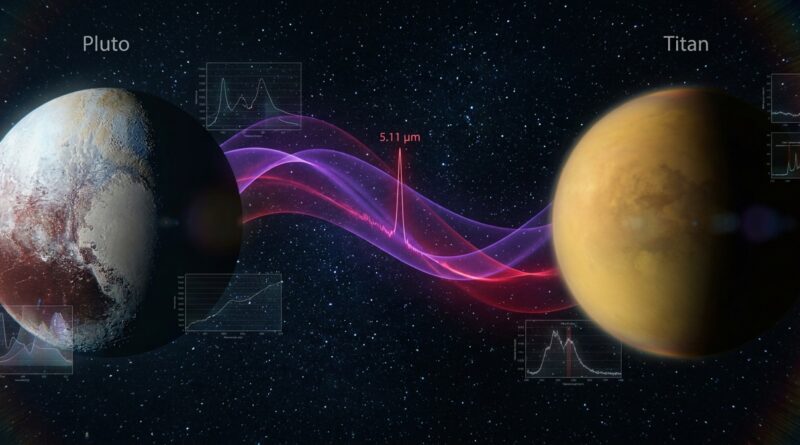
The Mystery Molecule Over Two Worlds: Webb Finds the Same ‘Impossible’ Signal on Pluto and Titan
You are not imagining it. A lot of space headlines really do overpromise, then leave you with a shrug and a quote about “more research is needed.” This one is different. James Webb has picked up the same unexplained infrared signal, centered around 5.11 microns, on Pluto and on Saturn’s moon Titan. That is odd enough on its own. What makes it genuinely interesting is that these worlds are very different places, with different temperatures, atmospheres, and surface chemistry. Yet Webb appears to be seeing the same molecular fingerprint on both, and scientists cannot cleanly match it to the usual suspects. No, this is not an alien-life claim. It is better than that. It is a real scientific puzzle. And if you want to understand what was actually found, why researchers are cautious, and why this “impossible” match matters, you do not need a chemistry degree. You just need the plain-English version.
⚡ In a Hurry? Key Takeaways
- Webb detected the same unexplained 5.11 micron spectral feature on Pluto and Titan, and researchers do not yet know which molecule is causing it.
- When reading claims like this, focus on three things: where the signal appears, whether it repeats on different worlds, and whether known molecules fail to fit the data.
- This is a chemistry mystery, not proof of life. The value is in the anomaly itself, because good science starts by taking strange signals seriously without jumping to wild conclusions.
What Webb Actually Found
The key phrase here is “spectral fingerprint.” James Webb looks at infrared light. Molecules absorb and emit very specific wavelengths, almost like a barcode. If a spectrum shows a bump or dip at a certain position, scientists can often match that feature to a known molecule.
In this case, Webb saw a feature near 5.11 microns on Pluto and Titan. That sounds tiny and abstract, but it is the whole story. Two distant icy worlds. One matching signal. No easy explanation.
That matters because Pluto and Titan are not close cousins in any simple way. Titan has a thick nitrogen atmosphere, methane weather, haze, and active organic chemistry. Pluto has a far thinner atmosphere, a much colder environment, and a very different surface-atmosphere balance. If both worlds are showing the same infrared marker, then one of two things is likely true. Either the same molecule can form in more places than expected, or scientists are missing part of the chemistry on both worlds.
Why People Are Calling It “Impossible”
“Impossible” is a dramatic word, but here it points to a real mismatch between expectation and observation.
Planetary scientists have catalogs of likely molecules for places like Titan and Pluto. They know many of the common ices, gases, hydrocarbons, and nitriles that tend to show up. Usually, a new spectrum gets compared with those libraries. Often the answer is boring in the best way. Methane. Ethane. Acetylene. Carbon monoxide. Done.
This time, the 5.11 micron feature does not slot neatly into that filing cabinet.
That does not mean the laws of chemistry broke. It means the current list of candidates is not doing the job. Maybe the signal comes from a rare molecule. Maybe it comes from a molecule under unusual temperatures or pressures. Maybe it is a blend, where two or three compounds overlap and fake a “new” feature. Or maybe the lab data we have on icy, radiation-processed compounds is still incomplete.
Infrared Spectra, Explained Like a Human Being
If spectra make your eyes glaze over, here is the simple version.
Think of light like a piano
Each wavelength is a key. Molecules do not play every key. They “hit” specific notes depending on how their atoms vibrate.
A spectral feature is a repeated note
When Webb sees a feature at 5.11 microns, it is noticing a note that keeps showing up at the same place.
The detective work is in the matching
Scientists compare that note to lab measurements. If no known molecule matches well enough, the case stays open.
That is why this is not just another flashy headline. The weird part is not that Webb saw something. Webb sees lots of things. The weird part is that the same note turned up on two worlds that should not be sharing an unresolved chemical signature.
Why Pluto and Titan Make Such a Strange Pair
Titan is basically the solar system’s chemistry lab. It has a dense atmosphere and a long list of organic reactions driven by sunlight and Saturn’s environment. Pluto is more like a deep-freeze oddball, with nitrogen, methane, carbon monoxide ice, seasonal transport, and brutal cold.
So if both show the same unexplained signal, scientists have to ask some uncomfortable questions.
- Is there a common photochemical pathway happening on both worlds?
- Are radiation and ice chemistry making a molecule we have underestimated?
- Do our spectral databases have gaps for exotic cold compounds?
- Could surface coatings or hazes create a similar signature in two different settings?
These are good questions. Better than “Is it aliens?” by a mile.
What the 5.11 Micron Signal Might Be
Right now, the honest answer is simple. We do not know.
Still, there are a few broad buckets scientists will likely explore.
1. A known molecule under weird conditions
Molecules can shift their spectral behavior depending on temperature, pressure, crystal structure, or whether they are mixed into ice. A compound that looks ordinary in a lab at one setup can look less familiar on a frozen dwarf planet.
2. A poorly studied organic product
Titan especially is famous for making complex organics. Pluto may also produce more complicated surface chemistry than people once assumed. If the same family of compounds can form on both, that would be a big clue.
3. A blended feature
Sometimes a signal that looks like one mystery molecule is really several overlapping signals. Astronomers deal with this all the time. It is like hearing a chord and trying to guess whether it is one instrument or three.
4. Missing lab reference data
This is a boring explanation, but boring explanations often win. You can only identify a molecule if you have something to compare it with. If the laboratory spectrum does not exist yet, nature can get there first.
Why This Matters Even If It Turns Out to Be “Nothing Exotic”
This is the part a lot of headlines skip. A mystery does not need to end in life, intelligence, or a rewritten physics textbook to be worth your attention.
If the James Webb unexplained 5.11 micron signal on Pluto and Titan turns out to be a real shared chemical pathway, that tells us something important about how organic chemistry works in cold, distant environments. It could connect two worlds we thought of as chemically separate. It could also sharpen how we read spectra from exoplanets, where we have even less information and far more room to fool ourselves.
In other words, solving a weird local mystery helps scientists avoid bigger mistakes later.
How to Read a Space Mystery Without Getting Burned
If you are tired of clickbait, here is a simple filter you can use.
Ask whether the signal repeats
One strange measurement can be noise. A matching feature on two worlds is harder to dismiss.
Ask whether scientists are naming a molecule or admitting uncertainty
Counterintuitively, uncertainty is often a good sign. It means researchers are not forcing the data into a neat story.
Ask what instrument found it
Webb is not perfect, but it is one of the best infrared observatories ever built. That gives this anomaly weight.
Ask whether the claim is about life or chemistry
Most of the time, chemistry is the real story. And chemistry is plenty weird enough.
What Happens Next
The next steps are less cinematic than people want, but more useful.
- Scientists will compare the feature against more laboratory spectra.
- They will test ice mixtures and organic compounds under Pluto-like and Titan-like conditions.
- They will look for nearby spectral features that should appear if certain candidate molecules are present.
- They will check whether geometry, haze, or surface texture could be shaping the signal.
This is how mysteries get solved in planetary science. Not with one magical announcement, but with a pile of careful eliminations.
Why Anomalies Like This Deserve Better Coverage
There is a bigger reason this story stands out. It fits a pattern space fans know well. Sometimes the most important discoveries are not clean detections. They are the stubborn leftovers. The features that do not belong. The data points that refuse to behave.
That is where real progress often starts. Not with certainty, but with irritation. A molecule that should not be there. A temperature that does not make sense. A spectrum with the wrong note in it.
Those are the moments worth slowing down for.
At a Glance: Comparison
| Feature/Aspect | Details | Verdict |
|---|---|---|
| Observed signal | A matching infrared feature near 5.11 microns appears in Webb data from both Pluto and Titan. | Real anomaly worth watching |
| Likely explanation | Unknown for now. Possibilities include an overlooked known molecule, a complex organic product, or incomplete lab reference data. | Open case, not solved |
| Public meaning | This is not evidence of alien life. It is a strong example of how good instruments can expose holes in our chemical assumptions. | Important, but stay grounded |
Conclusion
This is why the Pluto-Titan story matters right now. It is fresh, specific, and genuinely unresolved. Even planetary scientists cannot yet tuck this matching 5.11 micron fingerprint into a neat chemistry label. For the Anomal community, that is exactly the sweet spot. Wonder, with receipts. Instead of vague talk about “cosmic weirdness,” you get a concrete anomaly, a plain-English way to understand infrared spectra, and a reminder that the most valuable discoveries are often the ones that do not fit on first contact. If this signal ends up being a missing molecule, a weird ice effect, or a gap in our lab data, that is still a win. It means we learned something real about how strange our own solar system still is. And it is a good reminder that the best way to treat mysteries is neither blind hype nor smug dismissal. It is careful attention. Webb just gave us a very good reason to pay it.