Are Alien Signals Being Scrubbed Out By Their Own Suns? New Study Says We Might Be ‘Listening Wrong’
If you are tired of hearing about possible alien signals that always end in “probably nothing,” you are not alone. After decades of SETI scans, fast radio burst headlines, and one more maybe that turns into a no, it is easy to feel like the universe is either empty or playing a cruel joke. A new study suggests the problem may be much more ordinary, and much more interesting. We might be listening for the wrong kind of signal.
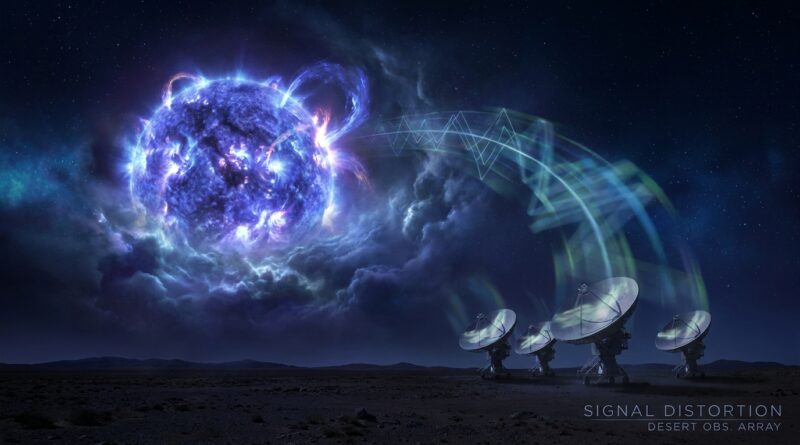
Researchers led by Vishal Gajjar are looking at how space weather scrambling alien signals could make a clean, intentional radio transmission look messy by the time it reaches us. In plain English, a civilization near an active star might send out something obvious, but the plasma around that star could smear, stretch, and scatter it so badly that our search software tosses it aside as interference or natural noise. That does not prove aliens are out there. It does mean some past “non-detections” may deserve a second look, especially if we have trained our systems to trust neat patterns and reject the cosmic equivalent of a warped voicemail.
⚡ In a Hurry? Key Takeaways
- Yes, this study suggests alien radio signals could be distorted by their own stars, which means we may be filtering out the very signals we want to find.
- When reading SETI news, pay attention to terms like scattering, plasma, broadening, and turbulence. Those may signal a target worth revisiting.
- This does not mean aliens have been confirmed. It means “we found nothing” may be less final than it sounds.
Why this idea matters
Most people picture an alien signal as a crisp beacon. A narrow-band ping. A clean, repeating tone. Something that stands out from space noise like a flashlight in a dark room.
That assumption makes sense. It is also a bit optimistic.
Space is not empty. Stars throw off charged particles. Plasma swirls around them. Magnetic activity can stir up local conditions in ways that rough up radio waves before those waves ever leave the neighborhood. By the time a signal crosses light-years and reaches Earth, it may not look tidy at all.
That is the heart of this new argument. Space weather scrambling alien signals may turn an artificial transmission into something our systems classify as too smeared, too broad, or too weird to count.
What the study is really saying
Gajjar’s team is not claiming, “We found aliens.” The point is more subtle, and in some ways more useful.
They are asking whether our search methods are biased toward a very specific kind of ideal signal. If so, then our results may be skewed from the start. We may be great at finding textbook examples and bad at finding real-world ones.
Think of it like listening for a song on an old car radio during a thunderstorm. If your software is trained to only accept studio-quality audio, it will reject the song every time. Not because the song is not there, but because the medium is messy.
Clean signals versus realistic signals
Traditional SETI searches often favor narrow-band transmissions because nature rarely makes them. That is a smart starting point. A super-thin radio line can look engineered.
But if that signal passes through dense stellar plasma, it can broaden. It can pick up delays across frequencies. It can flicker in intensity. It can look less like a laser pointer and more like a flashlight shining through fog.
And foggy flashlight beams do not always survive the filter.
What “space weather” means here
When most of us hear space weather, we think of solar flares messing with satellites or causing auroras on Earth. Same basic idea.
Now imagine that effect around another star, possibly a more active one than our Sun. Red dwarfs, for example, are famous for flare activity. If a civilization lives in that environment, any radio signal leaving the system may have to pass through a churning soup of charged particles.
That soup can do a few important things:
1. Scattering
The signal bounces around slightly as it passes through uneven plasma. Instead of arriving in a sharp packet, it gets spread out in time.
2. Broadening
A narrow signal can become wider in frequency. That makes it look less artificial and more like background clutter.
3. Turbulence fingerprints
If the plasma is turbulent, the signal can flicker, stretch, and vary in ways that look annoying rather than meaningful.
4. Dispersion-like effects
Different frequencies can arrive at slightly different times. Astronomers already correct for this in many contexts, but if the distortion is more complex than expected, some signals may still slip through the cracks.
Why past searches may have missed something
This is where the story gets interesting for anyone feeling burned out by decades of silence.
A non-detection is only as good as the assumptions behind the search. If your system is built to find clean, stable, narrow-band beacons, then a warped beacon may never even make the finals. It gets tagged as natural, uncertain, low-confidence, or plain old junk.
That means some historical observations filed under “nothing to see here” might be worth reviewing with fresh models.
Not because every old mystery is suddenly alien. Most will not be. But because the standard for what counts as a promising signal may need to loosen up in a smart way.
How to spot the clues in signal reports
If you follow SETI, FRB research, or strange astronomy alerts, here are a few things to watch for. You do not need a physics degree. You just need to know the telltale words.
Look for “scattering”
This usually means a signal has been blurred by material between source and observer. That does not prove intelligence. It does tell you the signal’s path was messy.
Look for “temporal broadening”
That is a fancy way of saying a short burst got stretched out. If a supposedly artificial signal gets broadened enough, it may stop looking artificial at first glance.
Look for “plasma lensing” or “turbulence”
These terms suggest the local environment around a source may be shaping what we receive. Again, not proof. But they are exactly the sort of effects this new work says we should take seriously.
Look for reports of “rejected interference” or “odd morphology”
Sometimes the most interesting data gets dismissed because it does not fit a clean category. That is often the right call. Sometimes it may be a clue that the category itself needs work.
What this means for fast radio bursts
Fast radio bursts are still one of the most headline-friendly mysteries in astronomy. Most researchers think they come from extreme natural sources such as magnetars. That is still the leading view.
But FRB science has also taught us something broader. Radio signals crossing space get modified. A lot. Their paths matter. Their environments matter. The medium is part of the message.
That is one reason this study lands so well right now. It does not ask us to throw out mainstream astronomy. It asks us to use what astronomy already knows about messy propagation and apply it more seriously to SETI.
The quiet universe might not be quiet
This is the emotional center of the whole thing.
Many space fans have reached the same tired conclusion: maybe the universe is silent. Maybe every intriguing blip is just another neutron star, another flare, another instrument quirk. Curiosity starts to harden into fatigue.
But if space weather scrambling alien signals is common, then the silence may be partly man-made, on our side. Not fake silence. Filtered silence.
That is a very different feeling.
It means the cosmic haystack may still be huge and frustrating, but some of the needles could have been tossed out because they looked bent.
What scientists may do next
The practical next step is not wild speculation. It is better signal models.
Researchers can simulate how intentional radio transmissions would look after passing through active stellar environments. Then they can train search pipelines to catch those altered versions too, not just idealized beacons.
That could include:
- re-checking archival SETI data for broadened or scattered narrow-band features
- adjusting machine-learning tools so they do not over-reward pristine signals
- targeting star systems with known active plasma environments using wider search criteria
- comparing suspicious rejections across different observatories
This is the kind of change that sounds technical but has a simple effect. It broadens the net.
Should this make you more hopeful?
Cautiously, yes.
Not because it raises the odds that the next weird blip is definitely alien. It does not. But because it gives a concrete reason why “we have not found anything” may not be the full story.
That is healthier than blind hype and more interesting than cynical shrugging.
It also gives readers a better BS detector. If a headline says a search came up empty, you can now ask: empty for what kind of signal? Clean and narrow only? Or distorted and realistic too?
At a Glance: Comparison
| Feature/Aspect | Details | Verdict |
|---|---|---|
| Traditional SETI target | Prefers clean, narrow-band, stable radio signals that stand out from natural sources. | Useful, but probably too strict on its own. |
| New plasma-smearing model | Assumes signals may be broadened, scattered, and distorted by stellar plasma and turbulence. | A realistic upgrade that could recover missed candidates. |
| Meaning of past non-detections | Many “nothing found” results may only rule out neat signals, not messy artificial ones. | Worth revisiting with better filters and fresh eyes. |
Conclusion
If your interest in alien life has started to sag under the weight of endless false alarms and official shrugs, this new angle offers something rare. A reason to stay curious without switching off your common sense. Vishal Gajjar’s team’s work suggests the universe may not be going out of its way to hide intelligent signals. The signals may just be getting roughed up by the stars they come from, then rejected by search tools built to prefer clean, tidy patterns. That changes the mood from “nothing is out there” to “our filters may be too picky.” More important, it gives readers a practical way back into the story. Watch for turbulence, scattering, plasma broadening, and odd-looking signal shapes in future reports. Ask which famous non-events were judged by old assumptions. The search for other minds has not suddenly become easy. But it has become strange again, in exactly the way that keeps this mystery worth following.