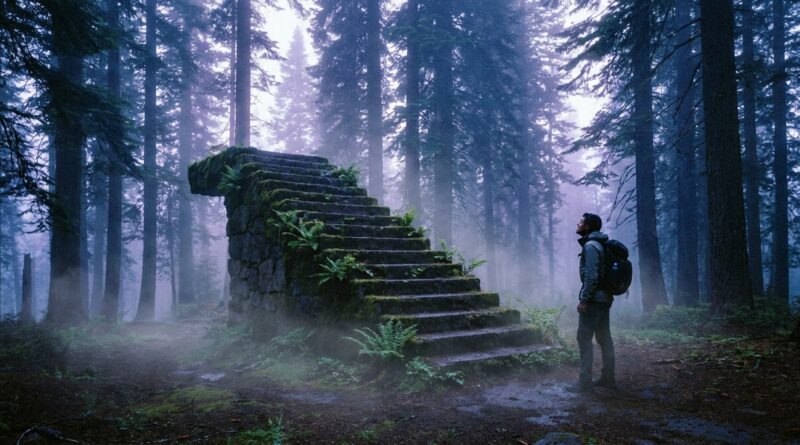
The ‘Eerie Staircase’ On Mount Shasta: Why A New Discovery Has Hikers Spooked And Scientists Shrugging
If you are tired of mystery stories that turn out to be blurry lights, recycled UFO clips, or the same haunted-house claims with a new thumbnail, you are not alone. That is exactly why the mysterious staircase mount shasta story has caught so much attention. It feels physical. Testable. You can point to it on a slope and ask a simple question. Why does that look so much like a staircase? Hikers are spooked because the formation appears oddly regular in a place already loaded with legends. Scientists, at least so far, are much less dramatic about it. Their basic view is simple. Mountains create weird shapes all the time, and human brains are very good at seeing patterns that may not mean much. Still, this is the kind of anomaly people actually want. It is grounded, visible, and specific. Better yet, it gives us a chance to practice something rare in modern mystery culture. Curiosity without losing our heads.
⚡ In a Hurry? Key Takeaways
- The mysterious staircase mount shasta is most likely a natural rock formation, but its shape is unusual enough to deserve a closer look.
- If you investigate claims like this, start with terrain maps, older photos, and geology before jumping to hidden-civilization theories.
- Mount Shasta is real wilderness. Mystery hunting is fun, but safety, access rules, and respect for the land come first.
Why This Story Hit a Nerve
Mount Shasta does not need help attracting myth. The mountain already carries a heavy load of stories about lost civilizations, spiritual portals, strange lights, and secret bases. Most of that material has been chewed over for years.
This new staircase claim feels different because it is not just another tale. It is a visible feature people think they can inspect. That matters. Real-world mysteries feel stronger when there is something concrete to stand in front of and question.
That is also why hikers are reacting more emotionally than scientists. Hikers see a weird set of steps cut into a dramatic mountain and think, “Who made that?” Scientists see a mountain made of volcanic rock, erosion, fractures, and debris movement, and think, “What process shaped that?”
What People Mean by the “Eerie Staircase”
From the descriptions circulating online, the so-called staircase appears to be a stepped formation on Mount Shasta that looks surprisingly orderly from certain angles. That visual order is doing most of the work here.
When people say something “should not be there,” they usually mean one of three things:
1. It looks too geometric
Human minds are built to spot straight lines, symmetry, and repeated shapes. That is useful for survival, but it also means we often mistake natural patterning for design.
2. It is in the “wrong” place
A staircase belongs in a ruin, not on a volcanic mountain. The mismatch itself creates unease.
3. The mountain already has a reputation
If this same shape showed up in a random rocky area with no folklore attached, fewer people would call it eerie. Context changes everything.
Why Scientists Are Shrugging
The shrug is not dismissal. It is caution.
Geologists spend their lives looking at landforms that seem impossible until you know the recipe. Volcanic rock can fracture into blocks. Layers can erode unevenly. Freeze-thaw cycles can widen cracks. Rockfalls can pile debris in terraced ways. What looks man-made from one angle can look completely ordinary from another.
That is the part mystery forums often skip. Nature does not have to be random-looking. In fact, it often produces shapes that seem eerily intentional. Basalt columns, for example, can look like architecture. Sedimentary layering can look stacked by hand. Erosion can carve ledges that resemble stairs.
So when scientists shrug, they are usually saying, “Interesting shape. Show me measurements, context, and close inspection.”
The Most Likely Explanations
Right now, several boring explanations are also the strongest ones. Boring does not mean wrong.
Natural erosion
This is the frontrunner. Repeated weathering can create step-like ledges, especially where rock hardness varies across layers or fracture zones.
Volcanic structure
Mount Shasta is a stratovolcano. That means its body is built from repeated eruptive material over time. Different deposits break down in different ways. The result can look surprisingly organized.
Talus and slump patterns
Loose rock moving downslope can stack in terraces. If the material catches on harder layers beneath it, the formation can briefly resemble steps.
Optical illusion
This one matters more than people like to admit. A photo taken at a certain distance with flattened perspective can exaggerate straightness and hide irregular detail.
Could It Be Man-Made?
It is not impossible in the abstract. Human-made features do show up in strange places. But extraordinary claims need a stronger base than “it looks weird in a photo.”
To take a man-made explanation seriously, investigators would need things like:
- Consistent step height and width
- Tool marks or cut surfaces
- Evidence of associated structures nearby
- Reliable location data
- Historical records, surveys, or older photos showing the feature clearly
Without that, the staircase label is just a label. Not proof.
Why Hikers Are More Spooked Than Geologists
Part of it is simple exposure. Hikers experience landscape emotionally. They are in the cold air, on the slope, with the scale of the mountain pressing on them. A strange formation in that setting can feel deeply wrong.
Geologists are trained to break that feeling apart. They ask what the rock is, how it formed, whether similar features exist nearby, and how viewpoint affects perception.
Neither response is silly. The emotional jolt is real. The job is not to mock it. The job is to separate the jolt from the conclusion.
How to Investigate a Claim Like This Without Becoming Clickbait Fuel
This is the useful part. If you care about real anomalies, the mysterious staircase mount shasta story is a good test case.
Start with location
If no one can say exactly where the feature is, that is a red flag. Vague mystery is often weak mystery.
Check multiple images
One dramatic photo can lie by omission. You want close shots, side angles, drone images if legal, and wide views showing the formation in context.
Look for scale
Without a person, tree, trekking pole, or known object in frame, size is guesswork. What looks like giant steps might be small broken ledges.
Use terrain and geology sources
Topographic maps, satellite imagery, and regional geology reports are not glamorous, but they often solve half the mystery before lunch.
Ask what would count as disproof
This is a big one. If nothing could convince you it is natural, then you are not investigating. You are rooting for a story.
Mount Shasta Makes Everything Feel Stranger
There is a reason stories stick to this mountain. Mount Shasta has the perfect mystery recipe. It is visually dramatic, spiritually loaded, geologically active in a deep-time sense, and remote enough to keep details fuzzy.
That fuzziness is powerful. It lets normal features grow teeth online.
Still, that does not mean people should ignore fresh reports. It means they should handle them carefully. A good anomaly is not something you protect from scrutiny. It is something that gets more interesting the more you check it.
What To Watch For Next
If this story keeps growing, the next useful developments will be practical, not theatrical.
- Exact coordinates or at least a well-defined area
- Ground-level close-ups from several angles
- Comparisons with older photos to see whether the feature changed
- Comments from local geologists, climbing guides, or land managers
- Reports on access and whether people can safely approach it
If those details never show up, that tells you something too.
At a Glance: Comparison
| Feature/Aspect | Details | Verdict |
|---|---|---|
| Visual appearance | Step-like shape appears oddly regular in photos and from a distance | Interesting, but not proof of construction |
| Scientific explanation | Erosion, volcanic layering, fracture patterns, and perspective can all produce staircase-like forms | Most likely natural for now |
| Mystery value | It is a grounded, site-specific anomaly people can actually investigate | Worth watching with a careful, evidence-first mindset |
Conclusion
The best thing about the mysterious staircase mount shasta story is not that it proves anything dramatic. It is that it gives mystery-minded readers something rare. A fresh, physical anomaly tied to a real place, not another endless loop of pixels and speculation. Covering it now plugs into a live conversation without recycling the same space signals and lab stories everyone has already seen. More important, it shows how to approach the unknown like an adult with a pulse. Stay curious. Check the basics. Respect the terrain. Do not cry hoax on minute one, and do not jump to supernatural answers on minute two. That mix of wonder and discipline is what keeps weird research fun, and useful. It also helps make Anomal the kind of place where serious weirdos do more than swap chills. They learn how to think better about what they are seeing.