The Sugar That Shouldn’t Be There: Astronomers Find A ‘Pre‑DNA’ Molecule Floating In Deep Space
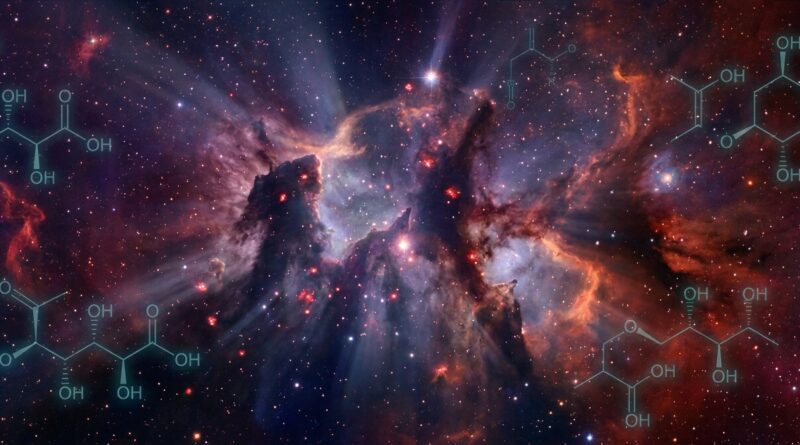
It is frustrating how often space news gets flattened into either clickbait or dry lab language. You hear “possible building blocks of life” so many times that it starts to sound meaningless. But this one is different. Astronomers have now reported what appears to be the first clear detection of erythrulose, a real sugar tied to prebiotic chemistry, inside an interstellar cloud about 26,000 light years away. That matters because sugars are not just random organics. They sit close to the chemistry that makes RNA, DNA, and metabolism possible. If a molecule this biologically relevant can form and survive in deep space, then life’s ingredient list may not be rare or local after all. It may be part of the universe’s normal chemistry. That does not prove aliens. It does mean the old idea that life on Earth was a one-off chemical accident just got a little harder to defend.
⚡ In a Hurry? Key Takeaways
- Astronomers report finding the sugar erythrulose in an interstellar cloud, which makes the case for life-related chemistry in space much stronger.
- If you follow space and anomaly news, pay attention to “prebiotic chemistry” stories. They often matter more than flashy exoplanet headlines.
- This is not proof of life, but it is a solid clue that some ingredients linked to genetics may form naturally far from planets.
Why this finding hits differently
We have found organic molecules in space before. Lots of them, in fact. Alcohols, simple carbon chains, even amino-acid-adjacent compounds. So why is this making researchers perk up?
Because sugar chemistry is a bigger deal.
Erythrulose is a ketose sugar. It is not DNA itself, and it is not a living thing. But it belongs to the sort of chemistry people watch closely when asking how biology gets started. Sugars matter because the backbone of RNA and DNA depends on sugar molecules. Change the sugar, and you change the whole information system life uses.
That is why the interstellar sugar discovery erythrulose pre dna life in space angle is getting so much attention. This is not just “we found another carbon molecule.” This is more like finding a spare gear from a clock inside a cave and realizing the cave may know how to make clocks on its own.
What exactly was found?
The reported molecule is erythrulose, a four-carbon sugar. It was detected in a dense molecular cloud near the center of our galaxy, roughly 26,000 light years from Earth. These clouds are cold, dusty regions where chemistry happens slowly on grain surfaces and in thin gas.
That may sound like a bad place to build anything complex. Oddly, it can be a very good one.
Dust grains in these clouds act a bit like tiny chemical workbenches. Atoms and simple molecules freeze onto them, get hit by radiation, then recombine into more complicated structures. Over long stretches of time, space can do patient chemistry better than almost anywhere else.
Why scientists care about this particular cloud
The galactic center is chemically busy. It is packed with radiation, shocks, gas, and dust. That makes it messy, but also rich. If a true biological sugar can show up there in detectable amounts, then the chemistry making it may be more common than expected.
That is the unsettling part. It suggests these molecules may not need a calm, Earth-like nursery. They may form in wild, harsh places too.
What “pre-DNA” really means here
Let’s keep the label honest.
Calling erythrulose “pre-DNA” does not mean it turns directly into DNA like a Lego piece snapping into place. It means it sits in the same broader family of chemistry that matters for making nucleic acids and other biological systems. In other words, it is life-adjacent chemistry. Close enough to matter. Not close enough to declare victory.
This distinction is important because space reporting often jumps three steps ahead. A sugar in space is not a fossil microbe. It is not proof that life is everywhere. What it does show is that some of the chemistry life depends on may start long before planets fully form.
Why this challenges the “life is a freak accident” idea
If Earth were the only place where life’s ingredients assembled, you could argue our biology was a bizarre local fluke. But that argument gets weaker each time astronomers find another important molecule floating between the stars.
Think about the pattern. First you find simple organics. Then more complex organics. Then compounds linked to amino acids. Now a proper sugar with prebiotic relevance. At some point, the recipe starts looking less accidental and more built-in.
That does not mean life pops out automatically everywhere. Plenty of ingredients never become dinner. But it does suggest the universe may be biased toward making the raw material.
Panspermia is back in the chat
This is why panspermia keeps hanging around. Panspermia is the idea that life, or at least the seeds of life, can spread through space on dust, ice, comets, or meteorites. You do not need fully formed bacteria riding a rock for the idea to matter. Even the transfer of useful prebiotic ingredients would count as a big deal.
If molecular clouds are already stocked with sugar chemistry, then newborn solar systems may inherit part of life’s pantry from interstellar space. That shifts the question from “How did Earth make everything from scratch?” to “How much of Earth’s chemistry was delivered preassembled?”
How do astronomers even spot a sugar that far away?
Not with a camera.
They use radio astronomy and spectroscopy. Every molecule rotates and vibrates in its own way, and that creates a kind of fingerprint in the radio or millimeter-wave spectrum. Telescopes pick up those signals, and scientists compare them with lab measurements to see what matches.
This is careful work because space is chemically crowded. Signals overlap. Molecules can mimic parts of each other’s spectrum. That is why a “clear detection” matters more than a tentative hint. Researchers have to rule out impostors before they can say a molecule is really there.
Why this is harder than it sounds
Imagine hearing one instrument in an orchestra from the next city over. Now imagine several instruments are playing almost the same note. That is what molecular identification can feel like.
So when a complex sugar gets called out by name, it usually means the team has done a lot of cross-checking.
What this does not mean
Let’s keep our feet on the ground for a minute.
- It does not mean DNA is floating around intact in space.
- It does not mean the cloud is alive.
- It does not prove Earth life came from space.
- It does not mean aliens are confirmed.
What it does mean is just as interesting. Space appears increasingly good at making molecules we once thought belonged mostly to biology. That is a real shift in the story.
Why everyday readers should care
You do not need to be an astrochemist to see why this matters.
Most of us grew up with a neat mental dividing line. Space was rocks, gas, radiation. Life was ponds, oceans, and planets. That line is getting blurrier. The more we look, the more the cosmos seems to be doing chemistry that rhymes with biology.
That changes how we think about our place in the universe. If ingredients for genetics are common, then life may not be the weird exception. It may be what chemistry tends to do when given enough time and enough places to try.
The bigger question hiding underneath
Here is the real reason this story sticks in your head. It forces a simple, uncomfortable question.
If the universe keeps making pieces that look suspiciously useful for life, at what point do we stop calling life improbable?
Maybe planets like Earth are rare. Maybe intelligence is rare. Maybe civilizations are rare. All of that can still be true. But the chemistry itself may be common. Very common.
And if that is true, then biology may not begin on planets so much as continue there.
At a Glance: Comparison
| Feature/Aspect | Details | Verdict |
|---|---|---|
| What was discovered | Erythrulose, a four-carbon sugar with prebiotic relevance, detected in an interstellar cloud about 26,000 light years away. | A meaningful step beyond generic “organic molecules in space” stories. |
| Why it matters | Sugars are closely tied to the chemistry behind RNA, DNA, and metabolic systems. | Strong clue that life-friendly chemistry may be widespread. |
| What it does not prove | No direct evidence of organisms, DNA, or extraterrestrial life itself. | Important but not a final answer. |
Conclusion
This is exactly the kind of anomaly worth sitting with. A complex sugar, erythrulose, showing up 26,000 light years away in a galactic cloud is not just a cool chemistry footnote. It is a concrete sign that the universe may be far better at assembling life-adjacent molecules than we used to think. For the Anomal community, that opens a much bigger door. Maybe the recipe for genetic material is not a rare Earth trick. Maybe it is written into interstellar chemistry itself. That does not settle panspermia, cosmic biology, or whether life is common. But it does sharpen the question in a way that is hard to ignore. If sugars tied to prebiotic chemistry are drifting between the stars, then “life as a lucky accident” no longer feels like the safest default story.