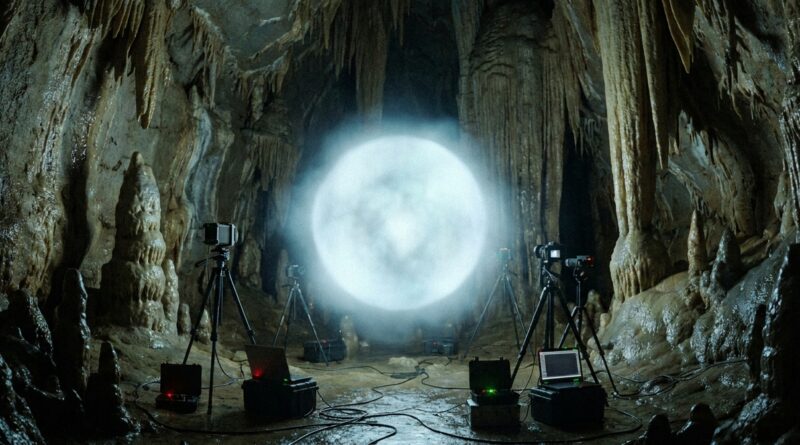
The Cave That Glows Back: Scientists Find A Living ‘Light Anomaly’ Deep Underground
Most people are worn out by blurry UFO clips, recycled Reddit lore, and “trust me bro” mystery threads. That is why this report has landed so hard. Deep inside a sealed cave chamber, scientists say they logged a self-pulsing light field that seems to brighten, fade, and shift across mineral walls without any obvious outside source. Better yet, this is not just a spooky story passed around online. The event was picked up by instruments, documented over repeated visits, and written up in a peer-reviewed paper. That does not mean the case is solved. Far from it. It means we finally have a mysterious glowing cave light anomaly unexplained by any single clean theory, yet grounded enough for serious debate. If you have been craving a real anomaly with data attached, this one is worth your time. It feels like folklore. It reads like lab work. And that tension is exactly why people cannot stop talking about it.
⚡ In a Hurry? Key Takeaways
- This cave light case stands out because it is instrument-logged and peer-reviewed, but still unexplained.
- Focus on the hard evidence first, sensor logs, repeat observations, and competing natural hypotheses, before jumping to wild claims.
- The value here is not proving magic or aliens. It is having a rare anomaly with a clear line between what is known and what is still strange.
What scientists say they found
The core claim is simple, even if the implications are not. In a remote underground chamber with no normal daylight access, researchers recorded a recurring field of low-level visible light. Not a flashlight beam. Not a one-time flash. A patterned glow that appeared to pulse and spread over parts of the cave interior.
According to the report, the chamber had limited airflow, stable temperature, and no obvious human-made power source nearby. The team used light meters, time-lapse imaging, environmental sensors, and repeat site visits. That matters because it moves this out of the “someone saw something weird” category and into the much more interesting “something weird showed up on instruments” category.
The strangest detail is the behavior. The glow reportedly was not random in the usual sense. It had a rhythm. Not a perfect clock, but enough structure that researchers began testing whether humidity swings, rock stress, trace gas release, or biological activity could be driving it.
Why this is getting attention
Because it checks boxes that almost never line up at the same time.
It feels uncanny
A sealed cave that seems to glow back at observers sounds like the setup for a campfire story. People respond to that right away. It is vivid. It is local. It feels old, even if the data is new.
It is not just hearsay
This is the big one. The case was documented, revisited, and reviewed. Scientists can argue over methods, sample size, contamination, and interpretation, but they are arguing over a real record, not a compressed social clip posted with dramatic music.
No single explanation has won yet
If the paper had ended with “turns out it was a tourist LED reflection,” the story would be over. Instead, several ideas remain on the table, and none cleanly explains every feature of the anomaly.
The leading explanations so far
Here is where it helps to slow down. “Unexplained” does not mean “supernatural.” It means the current evidence does not let one theory fully close the case.
1. Bioluminescent microbes
This is the crowd favorite because it sounds both exotic and plausible. Certain fungi, bacteria, and other organisms can emit light. In caves, life often adapts in odd ways. If a living biofilm or microbial colony is involved, that could explain the “living” feel of the light field, especially if the pattern changes with moisture or chemistry.
The problem is scale and rhythm. Researchers would need to show that the brightness, spread, and pulsing behavior match known biological mechanisms, or point to a new one. That is a big ask.
2. Triboluminescence or piezoelectric effects
Some minerals can produce light when stressed, fractured, or electrically stimulated. Deep underground, rock pressure shifts all the time. Tiny stress changes could in theory create faint glows or pulses, especially in a mineral-rich chamber.
This explanation has real scientific legs. But it also runs into questions. Why this chamber? Why this pattern? And why does the glow seem to persist in a way that looks less like a quick spark and more like a field?
3. Chemiluminescent gas reactions
Another idea is that trapped gases, perhaps released in small bursts, interact with cave minerals or moisture to create visible light. This would fit an underground setting and could, at least on paper, create pulses.
Again, the challenge is consistency. Researchers would need evidence of the right gas mix and a repeatable reaction path. Without that, it stays a decent idea, not a solved mechanism.
4. Instrument artifact or observer effect
This is the boring answer, but good science has to consider it. Sensors can drift. Cameras can bloom in low light. Human eyes are famously unreliable in dark spaces. The reason this case has not died quickly is that multiple tools reportedly picked up something unusual. Even so, skeptics are right to keep this option alive until independent teams reproduce the result.
What is actually known, and what is still up in the air
Known. There was a reported light phenomenon in a hard-to-access cave chamber. It was tracked with instruments. It showed recurring behavior over time. The case made it through peer review.
Unclear. What the energy source is. Whether the source is biological, mineral, chemical, or some mix. Whether the “pulse” is truly intrinsic to the phenomenon or created by shifting environmental conditions. Whether another team using different equipment would get the same result.
That split is healthy. It keeps the case interesting without turning it into nonsense.
Why the phrase “living light anomaly” is sticking
Not because anyone proved the cave is alive in a sci-fi sense. It is sticking because the glow seems to behave more like a process than a static feature. It changes. It responds. It appears to grow or recede across surfaces in ways that make people reach for biological language.
Scientists often hate phrases like that, and for good reason. They can oversell a finding. But in this case, the phrase also captures the emotional truth of the report. This is not just a weird rock. It is a weird system.
How to read this without getting fooled
If you follow anomaly stories, this is the part that saves you time.
Separate the paper from the retelling
The further a case travels online, the more extra claims get attached to it. Soon the cave is “sentient,” the light “communicates,” and somebody swears ancient locals warned about it. Maybe. Maybe not. Start with the actual documented observations.
Look for replication
The next big step is independent confirmation. Can another team visit, use different gear, and still record the same effect? That is where a fascinating report turns into a solid scientific puzzle.
Watch the missing details
Good mystery stories often glide past the boring parts, calibration methods, chamber maps, contamination controls, timing of visits, and baseline darkness measurements. Those boring parts are where real answers usually hide.
Why this matters beyond one cave
Caves are natural laboratories. They trap gases, isolate microbes, preserve minerals, and create conditions you just do not get on the surface. If this anomaly turns out to be biological, it could point to a poorly understood form of subterranean life signaling or reacting to its environment. If it is mineral or chemical, it may reveal a light-producing process that has been overlooked because so few places are dark and stable enough to show it clearly.
And if the final answer is mundane, that is still useful. A well-documented dead end teaches more than a thousand viral fakes.
What serious anomaly hunters can do with this case
This is the rare kind of mystery that rewards careful reading. You can compare the reported pulse timing with humidity changes. You can ask whether the chamber mineralogy supports piezoelectric behavior. You can check whether the spectral profile, if released, lines up better with biological glow or chemical excitation.
In other words, this case gives people something to work on. Not just react to.
At a Glance: Comparison
| Feature/Aspect | Details | Verdict |
|---|---|---|
| Evidence quality | Instrument logs, repeat visits, and peer-reviewed reporting push it above ordinary internet mystery claims. | Strong enough to take seriously |
| Best current explanations | Bioluminescent microbes, mineral stress light, gas-driven chemistry, or measurement artifacts all remain in play. | Open case, no clear winner |
| Community value | Offers a fresh, verifiable mystery with real data instead of recycled clips and rumor chains. | Excellent shared touchstone for debate |
Conclusion
This is why the cave story feels different. It gives people something rare in high-strangeness, a mystery that is carefully documented and still honestly unresolved. You get data artifacts to argue over, several possible explanations to test, and a clean line between what has been observed and what is still uncanny. That is healthy for the community. It keeps curiosity anchored to evidence. In a feed packed with recycled sky videos and fake certainty, a mysterious glowing cave light anomaly unexplained by current science is a far better use of your attention. Maybe the answer ends up being microbes, minerals, or a weird cave chemistry nobody had pinned down before. Maybe it stays open for a while. Either way, this is the kind of case serious anomaly hunters can sink their teeth into for weeks, and that alone makes it worth following.