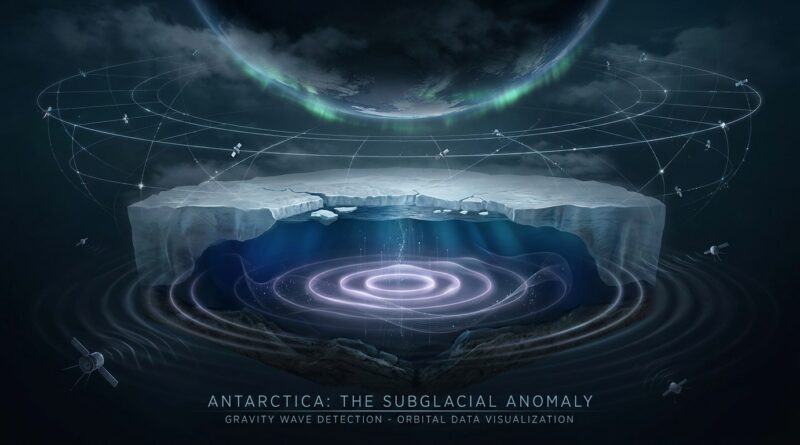
The Ocean That Hums At Night: Why A New ‘Gravity Song’ Under Antarctica Has Geophysicists Spooked
If you are tired of every mystery story getting forced into either “it’s aliens” or “it’s nothing,” this one will feel different. A mysterious gravity signal under Antarctica is catching attention because it does not act like a normal buried mountain, a simple ice shift, or a one-off sensor glitch. Instead, satellites appear to be picking up a repeating anomaly, a kind of pulse from the Southern Ocean and the crust below it, subtle enough to hide in the data but strange enough to make geophysicists pause. That matters because gravity maps are usually boring in the best way. They reveal mass, density, and shape. They are not supposed to feel rhythmic. Right now, nobody credible is saying this is proof of anything supernatural. But they are saying it deserves a closer look. And honestly, that may be the most interesting part. The mystery is still alive, and the data is real enough to argue over.
⚡ In a Hurry? Key Takeaways
- A mysterious gravity signal under Antarctica appears to pulse in a repeating pattern, which is unusual for a standard geological structure.
- The smartest way to follow this story is to watch for satellite data updates, peer-reviewed papers, and independent confirmation, not viral clips.
- This is a real scientific puzzle, but “unexplained” does not automatically mean alien, dangerous, or fake.
What exactly was detected?
At the center of this story is a gravity anomaly. That sounds abstract, so let’s make it plain.
Earth’s gravity is not perfectly even. Different materials have different densities. A thick block of cold rock, a deep sediment basin, a hidden ridge, or a thinning ice sheet can slightly change the local pull of gravity. Satellites can measure those tiny differences by tracking how Earth’s mass is distributed.
What has people paying attention here is not just that a heavy or light patch exists under or near Antarctica. Those are common enough. It is that this signal seems to show a repeating behavior, almost like a pulse or hum when processed over time. That is why some observers have started calling it a “gravity song.”
That nickname is dramatic, sure. But it points to the real issue. Geology is expected to be lumpy. It is not expected to look rhythmic unless something dynamic is involved.
Why geophysicists are uneasy about it
Scientists get “spooked” in a very specific way. Usually not by monsters. By data that refuses to sit neatly inside the existing model.
A static mass anomaly is one thing. You can blame buried crust, mantle structure, old tectonic scars, or glacial loading. A signal with repeat timing is harder. Not impossible. Just harder.
That leaves a few broad possibilities.
1. It could be an ocean-driven effect
The ocean moves an absurd amount of mass around. Tides, deep currents, pressure shifts, and seafloor interactions can all create patterns that show up in satellite readings. Around Antarctica, where ice, ocean, and crust are all affecting each other, the system gets messy fast.
This is the least exotic explanation, and often the most likely. But even a “normal” ocean explanation could still be a major discovery if it reveals a process we do not fully understand yet.
2. It could be tied to the crust or mantle below
Antarctica is not just a big white slab. Under the ice are mountain ranges, rift systems, sediment basins, and sections of crust with very different histories. Some regions still show signs of slow adjustment from ancient tectonic activity and the huge weight changes caused by ice sheets.
If the anomaly reflects deep-Earth movement, that would be a bigger deal. It might point to a process in the lithosphere or mantle that is creating periodic mass redistribution.
3. It could be an ice-ocean-crust feedback loop
This is where things get especially interesting. Antarctica is one of the few places where ice loss, pressure changes, rebound of the land, ocean circulation, and even slight shifts in Earth’s shape are all connected. A pulse in gravity might not come from one source. It could be a chain reaction between several.
That would explain why the signal feels odd without requiring anything supernatural.
4. It could still be a data-processing artifact
This may be the least exciting answer, but it has to stay on the table. Satellite gravity work is powerful, but it is also very sensitive. Researchers have to strip away noise from tides, atmosphere, seasonal water movement, instrument drift, and orbital effects. Sometimes a pattern looks meaningful until someone finds the math that accidentally created it.
That is not a failure. That is science doing its job.
Why people are comparing it to a heartbeat
Because humans are pattern hunters. We hear rhythm and instantly think signal. We see repetition and assume intention.
Still, the “heartbeat” comparison is useful if you treat it as a metaphor, not a conclusion. It tells you the anomaly appears time-structured rather than random. That is why it stands out from the usual map of blobs and gradients.
In plain English, a weird heavy patch under the ice is one story. A weird heavy patch that seems to “breathe” or “throb” is a very different one.
Why Antarctica keeps producing these stories
Antarctica is tailor-made for mystery headlines. It is remote, expensive to study, and buried under miles of ice in places. We know a lot about it, but not enough to remove the sense that huge chunks of the map are still half-hidden.
That creates a perfect storm. Real scientific uncertainty meets public imagination.
The problem is that this often leads to two bad habits. One camp turns every anomaly into a secret civilization or UFO base. The other camp rolls its eyes and dismisses everything before the data is even checked. Neither approach helps.
The better move is to stay curious and disciplined at the same time.
What the satellites are actually good at
Satellite gravity missions do not “see” underground the way an X-ray sees a bone. They infer changes in mass by measuring tiny shifts in motion and distance. That makes them great for spotting broad patterns across huge regions.
They are especially useful in places humans can’t easily cover with instruments, like the waters and ice margins around Antarctica.
But they have limits.
They do not hand you a neat label saying “this is magma” or “this is a hidden canyon” or “this is a deep current.” They give you a clue. Then geophysicists have to compare that clue with seafloor mapping, seismic data, ocean models, ice movement records, and crustal studies.
So when you hear about a mysterious gravity signal under Antarctica, think of it as the opening of an investigation, not the ending.
What would count as a solid explanation?
For this mystery to move from spooky headline to accepted science, researchers will need a few things.
Independent confirmation
Another team, using the same or different datasets, should be able to see the same pattern.
A clear timeline
If the pulse is real, how regular is it? Daily? Seasonal? Multi-year? Does it line up with tides, current shifts, ice melt cycles, or deep-Earth processes?
A physical mechanism
This is the big one. Scientists need more than “we found a pattern.” They need a believable reason that pattern exists.
Consistency with other measurements
If gravity is pulsing because of ocean mass movement, then ocean data should support that. If crustal rebound is involved, GPS and seismic records may need to match.
So, should UFO and anomaly fans care?
Yes, but for the right reason.
Not because this is secret proof of visitors or hidden machines under the ice. There is no good evidence for that. You should care because this is what a live scientific mystery looks like before the internet sands off all the rough edges.
That is rare. Usually the public only hears about a discovery after the argument is mostly over. Here, the argument is the story.
And for readers who spend most of their time watching the skies, this is a nice reality check. Earth itself is still full of signals we do not fully understand. Some of the strangest ones are not coming from deep space. They are coming from deep water, deep ice, and deep rock.
How to follow this story without getting fooled
If you want to track the mysterious gravity signal under Antarctica like a grown-up, here’s the simple checklist.
Watch the source, not just the summary
Try to find the original research group, conference abstract, data release, or scientific discussion. Headlines usually compress uncertainty into clickbait.
Look for repeatability
If only one chart on one social post shows the pulse, be careful. If multiple teams begin discussing the same pattern, confidence goes up.
Be suspicious of certainty
The people worth listening to will usually sound cautious. If somebody says they already know exactly what this is, they are probably selling something.
Keep “weird” and “verified” separate
A signal can be weird and real. It can also be weird and misread. Those are different categories.
What this probably is not
Let’s trim away a few easy misconceptions.
It is probably not a literal sound coming from the ocean floor. “Hum” and “song” are descriptive labels, not proof that something is acoustically singing under the ice.
It is probably not a giant hollow chamber, a doomsday weapon, or a hidden spacecraft. There is no serious evidence for those claims.
And it is definitely not proof that geophysics is broken. In fact, this is what geophysics is for. Find a pattern. Test it. Try to break your own explanation. Then test again.
Why this story matters more than a lot of viral mystery news
Because it sits in the sweet spot.
There is enough data here to justify attention. But there is still enough uncertainty to keep the case open. That makes it far more useful than the usual mystery content that is either pure fantasy or instantly debunked.
It also reminds us that Earth science can be every bit as strange as astronomy. We are used to hearing about impossible radio bursts, odd exoplanet signatures, or unexplained lights in the sky. Meanwhile, our own planet keeps putting on quieter, deeper, weirder shows that most people miss entirely.
At a Glance: Comparison
| Feature/Aspect | Details | Verdict |
|---|---|---|
| Nature of the signal | A repeating gravity anomaly detected near or under Antarctica, unusual because it appears time-structured rather than purely static. | Interesting and worth study |
| Most likely explanations | Ocean mass shifts, ice-ocean-crust interactions, deep geological structure, or a processing artifact. | Natural causes still lead |
| Public mystery value | Unlike many solved or overstated anomalies, this one appears to be genuinely open and still under active interpretation. | Rare real-time mystery |
Conclusion
The best part of this story is not that it proves something wild. It is that it doesn’t. Not yet. That leaves room for the thing curious readers almost never get anymore, a deep-Earth mystery unfolding in real time, before it gets packed into a neat box with a tidy label. With so much attention fixed on strange signals from space, this is a good reminder that our own planet still refuses to behave exactly the way the textbooks say it should. If the gravity song under Antarctica turns out to be an obscure ocean effect, that will still be fascinating. If it points to a deeper geophysical process, even better. Either way, this is the kind of anomaly worth following because it rewards skepticism without demanding cynicism. Stay curious. Just keep one foot on the data.