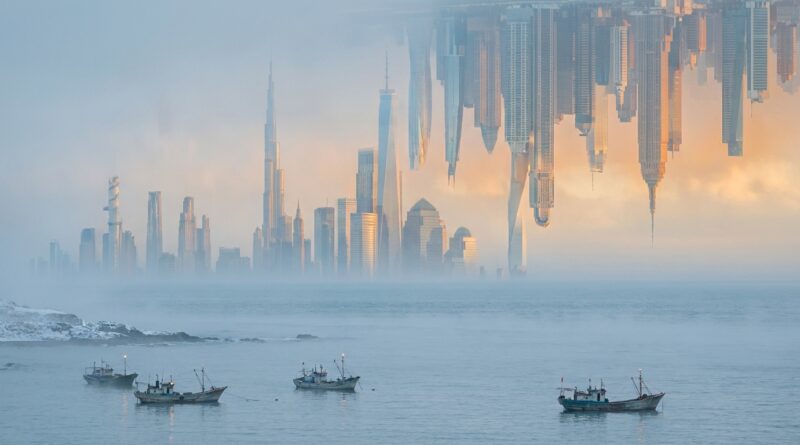
The City That Rises From Nowhere: Why ‘Skyline Mirages’ Are Fueling New Ghost City Legends
You are not silly for looking at a video of a floating city or a ship hanging in the sky and thinking, “Come on, that cannot be just heat and light.” That reaction is exactly why these clips spread so fast. They look impossible. And when the explanation is reduced to “just a mirage,” it can feel dismissive, like someone is waving away what your own eyes can clearly see. The truth is more interesting than the brush-off. A fata morgana ghost city mirage is real, dramatic, and strange enough to inspire legends for hundreds of years. People did not invent ghost city stories out of nowhere. They were often trying to describe a genuine optical event that turns coastlines, ships, and distant buildings into stacked, stretched, upside-down skylines. Once you know how it works, the mystery does not vanish. If anything, it gets better, because now you can spot the clues and understand why these visions seem to rise from nowhere.
⚡ In a Hurry? Key Takeaways
- A fata morgana ghost city mirage is a real atmospheric effect that can make distant land, ships, or buildings look like floating cities.
- If you spot one, record the time, location, weather, direction faced, and take steady video. Those details help separate a true mirage from a misleading zoom clip.
- These events are usually harmless to watch, but they can confuse boaters and viewers, so treat them as optical phenomena, not proof of a hidden city or incoming disaster.
Why these “impossible city” videos feel so convincing
Because they often show something that really is there, just badly warped.
That is the key point people miss.
A fata morgana is not a fake image in the sense of a computer effect. It is a distorted view of a real object beyond the normal horizon or near it. The atmosphere bends light in layers, almost like giant uneven glass. If those layers are stacked just right, distant ships can stretch into tower-like shapes. Shorelines can rise, flatten, split, and stack. Cliffs can look like skylines. Apartment blocks on a far coast can turn into something that looks like a futuristic city hanging over the sea.
So when someone says, “It is just a mirage,” the word “just” is the problem. This is not boring. It is physics doing special effects in real time.
What a fata morgana ghost city mirage actually is
At the simplest level, light usually travels through the air in a fairly predictable way. But air is not one solid thing. It comes in layers with different temperatures and densities. Light bends when it moves through those layers.
When a strong temperature inversion forms, meaning cold air sits below warmer air or the layers change sharply, the bending can get dramatic. The result can be:
- objects appearing higher than they really are
- objects looking stretched vertically
- objects flipping upside down
- multiple copies of the same object stacking on top of each other
- distant coasts or ships seeming to float above the water
That stacked, castle-like look is why fata morgana has been tied to ghost city tales for centuries. The name itself comes from Morgan le Fay from Arthurian legend, because people thought they were seeing enchanted castles in the distance.
Why ghost city legends keep attaching themselves to these sightings
Because the human brain hates a gap in the story.
If someone on a shoreline sees a city-shaped mass appear where no city should be, they will reach for the best explanation they have. A century ago, that might have been a phantom island, a lost kingdom, or a warning sign. Today, it is more likely to become a TikTok mystery, a Reddit thread, or a claim that authorities are hiding something.
The pattern is old. The tools are new.
Reports of phantom lands and floating coasts show up all over maritime history. Sailors described islands that vanished, towers over the sea, and strange fleets in the air. Some stories were mistakes. Some were exaggerations. But many likely began with real optical distortions.
Why social media makes the effect look even stranger
Phone zoom compresses distance
When you zoom in hard across water, everything gets flattened visually. That makes a far-off ship or skyline look even more unnatural. It can seem huge, close, and detached from the horizon.
Short clips remove context
You often do not see what happened five minutes before or after. But mirages can shimmer, collapse, stretch, and reform quickly as air layers shift.
Captions do half the storytelling
A calm video labeled “rare superior mirage over harbor” gets one reaction. The same clip labeled “city appears in sky with no explanation” gets millions of views.
That does not mean every clip is dishonest. It means framing matters.
How to tell when you may be looking at a real fata morgana
You do not need a physics degree. Start with a few plain clues.
1. The sighting is over water, ice, or a very flat horizon
These conditions are common places for strong temperature layers to form.
2. The shape looks stretched or stacked
Real skylines do not usually look like they were pulled upward like warm taffy. Mirages often do.
3. Parts of the object seem detached from the surface
Ships can appear to float. Land can appear to hover. That is classic.
4. The image wobbles or changes shape
A building does not reshape itself every few seconds. A mirage can.
5. There is a known coast, island, ship lane, or structure in that direction
This is a big one. Many “mystery cities” turn out to be distant shorelines, offshore platforms, cargo ships, or buildings from a coast that is usually hidden by curvature and haze.
What these sightings usually are, and what they usually are not
Usually, they are one of three things.
- A distant skyline or coastline being lifted and distorted
- A ship or several ships stretched into bizarre vertical forms
- A mix of land, structures, and atmospheric layering that creates a city-like silhouette
They are usually not:
- a brand-new city appearing out of nowhere
- a portal or hologram
- proof that every old phantom island tale was literally true
Still, the old stories matter. They remind us that people have been seeing these events long before edited phone clips and clickbait headlines. That historical record is useful, not embarrassing.
How local communities can document these events better
This is where things get genuinely helpful.
Instead of arguing in circles online, people can build a shared log of sightings. Not a hype page. Not a debunk page. A record.
What to write down
- date and exact time
- viewing location
- direction you were facing
- temperature and weather if known
- whether the image changed over minutes
- photos and video, both zoomed and wide-angle
- any known landmarks, shipping lanes, or islands in that direction
Why this matters
Patterns start to show up fast. You may notice certain harbors produce sightings in spring mornings. Or after cold water meets warm air. Or only when looking toward a particular coastline. That is how a local legend turns into something testable without draining all the wonder out of it.
Why the science does not kill the magic
This is the part I think gets lost most often.
People hear “optical phenomenon” and assume that means “nothing to see here.” But the atmosphere creating a floating city effect across miles of water is not nothing. It is astonishing. It is the same world you walk through every day suddenly showing what it can do under rare conditions.
You are not wrong to feel awe first and skepticism second. Both belong here.
What to do the next time you see a ghost city clip
Pause before sharing the wildest explanation
Ask where it was filmed and what lies over that horizon.
Look for distortion, not just weirdness
If the edges shimmer, stretch, or stack, that points toward a fata morgana ghost city mirage.
Check local reports
Small newspapers, harbor groups, sailing forums, and weather watchers often catch these events before national outlets do.
Save the evidence
If you took the clip yourself, keep the original file. Compression and reposting can make analysis harder.
At a Glance: Comparison
| Feature/Aspect | Details | Verdict |
|---|---|---|
| What people think they are seeing | A city, ship, or landmass appearing from nowhere above the horizon | Often based on a real distant object, but heavily distorted by the atmosphere |
| Best explanation | Temperature layers bend light and create a superior mirage or fata morgana effect | Strong scientific fit, especially over water and in shifting weather |
| What viewers should do | Record location, time, weather, direction, and capture both wide and zoomed footage | Best way to turn a viral mystery into useful evidence |
Conclusion
Right now, social feeds are packed with strange skyline videos, while local papers quietly keep noting baffling harbor and sea mirages. That is why this topic matters. A fata morgana ghost city mirage sits in the sweet spot between folklore and physics. It connects today’s viral clips with centuries of ghost city reports, gives you a grounded explanation that does not talk down to you, and offers a better path than either instant debunking or breathless hype. If more people start logging where, when, and how these sightings happen, we can build something more useful than a comment war. We can keep the wonder, add evidence, and finally treat these sky cities as what they are. Not nonsense. Not magic. Real events that still know how to stop us in our tracks.