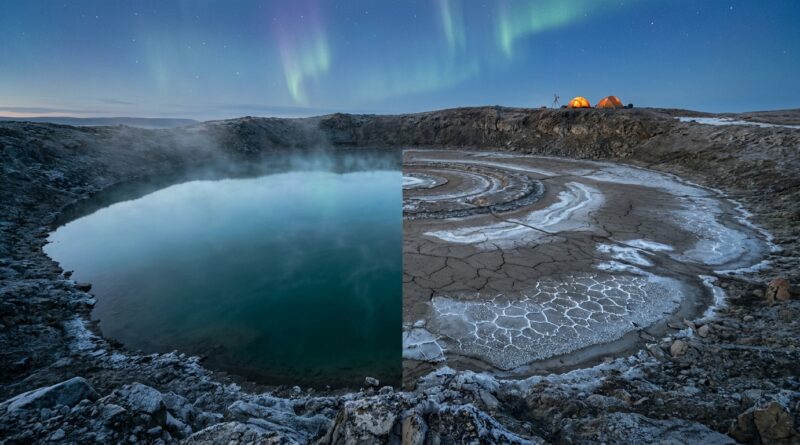
The ‘Ghost Lake’ That Keeps Vanishing: Why A Remote Crater’s Disappearing Water Has Climate Scientists Stumped
If you are worn out by every so-called mystery ending with “bad sensor data” or “someone misread the photo,” this one will feel different. A real lake inside a remote impact crater has been appearing, shrinking, draining, and then coming back in ways that do not fit neatly with rainfall records, evaporation rates, or standard groundwater models. That is why this mysterious disappearing crater lake unexplained climate anomaly has caught so much attention. It is not just weird for the sake of being weird. It is measurable, visible from satellites, and frustrating enough that scientists cannot yet give one clean answer. That matters. Good mysteries in science are not about spooky claims. They are about moments when nature stops matching the map. This “ghost lake” is one of those moments, and it gives regular readers a rare chance to watch real investigation happen while the evidence is still coming together.
⚡ In a Hurry? Key Takeaways
- The lake is real, the changes are real, and scientists do not yet have a single explanation that fits all the observations.
- If you want to follow this story well, pay attention to satellite images, rainfall data, and groundwater research instead of viral mystery posts.
- This is a useful reminder that “unexplained” does not mean “anything goes.” It means the evidence is ahead of the model.
What is the ghost lake, exactly?
At the center of the story is a crater lake in a remote impact basin that does something lakes are not supposed to do so dramatically. It fills. Then it drops. Sometimes fast. Then it returns again.
On paper, a lake’s water level should be shaped by a pretty familiar mix. Rain falls in. Water evaporates out. Some may seep into the ground. Some may flow in from surrounding land. Usually, if you gather enough measurements, you can get a decent answer.
Here, the numbers do not line up cleanly.
That is what makes this more than a fun internet oddity. Scientists looking at the site can compare images over time, track local weather patterns, estimate evaporation, and study the crater’s geology. Even after that, the lake’s behavior still looks odd enough to keep the case open.
Why climate scientists are paying attention
This is not just about one moody lake in the middle of nowhere. It touches a bigger problem. Climate science depends on models. Hydrology depends on models. Groundwater science depends on models. When a real system keeps slipping through them, that tells researchers something important is missing, oversimplified, or poorly measured.
That missing piece could be local rather than global. The crater may have hidden underground channels. It may sit over fractured rock that acts like a plumbing system. It may be unusually sensitive to small shifts in pressure, temperature, or seasonal water movement.
But even a local explanation matters, because it shows where standard assumptions can break.
Why crater lakes are tricky in the first place
Impact craters are not normal bowls in the ground. They can have cracked bedrock, unusual mineral layers, steep walls, and isolated drainage behavior. Think of them less like a backyard pond and more like a strange natural tank built on damaged plumbing.
If the crater floor has hidden faults or porous zones, water may drain sideways or downward in bursts rather than at a steady pace. That can make the lake look like it is breaking the rules when it may actually be following a set of rules we do not fully understand yet.
What could explain the disappearing water?
There are a few serious ideas on the table. None completely settles the case by itself.
1. Hidden groundwater pathways
This is the most sensible first guess. Water may be moving through cracks, lava tubes, porous rock, or fault systems under the crater. If underground pressure changes seasonally, or if a subsurface channel opens and closes, the lake level could swing more than expected.
The trouble is that proving this is hard. You need the right field data, local drilling, geophysical mapping, or repeated monitoring over time. Remote places do not give up those answers easily.
2. Evaporation is part of it, but probably not all of it
Hot, dry, windy places can strip water from a lake surprisingly fast. Many people underestimate how much can disappear into the air. But in this case, researchers are asking whether evaporation alone is enough to explain the timing and scale of the changes. So far, it seems unlikely to be the full story.
3. Rainfall and runoff may be more complex than maps suggest
Remote areas often have sparse weather stations. That means local storms can be missed, and runoff into the crater may be underestimated. It is possible the lake is getting short, intense pulses of water that broad climate records do not capture well.
Still, that only solves half the puzzle. It might explain some refilling. It does not fully explain the draining behavior.
4. Geological shifts or sediment plugs
One more possibility is mechanical change inside the crater itself. Sediment can clog outlets. Then later it can give way. A hidden seep can stay sealed for a while, then reopen. If so, the lake might act less like a stable water body and more like a system with a sticky valve.
Why this is better than a recycled internet mystery
Most viral mysteries online are dead on arrival. Blurry clip. Wild claim. Zero context. Then two days later it turns out to be lens flare, compression artifacts, or somebody’s drone.
This story is better because it gives you something solid to track. Satellite data. Geological context. Hydrological limits. Competing explanations. Open questions.
That is the sweet spot if you like high-strangeness without falling for nonsense. You do not have to pick between “I believe everything” and “nothing interesting ever happens.” You can sit in the useful middle and watch the evidence build.
How to follow the case without getting fooled
If you want to be an informed observer, start with the boring stuff first. That sounds unglamorous, but it is how good mystery-solving works.
Check the source of the images
Ask whether a dramatic before-and-after image came from a reputable satellite source, a research team, or a random repost. Cropped screenshots travel faster than full datasets, and they often drop the timeline that makes the story make sense.
Look for timescales
Did the lake drain over days, weeks, or months? That one detail changes the likely explanation a lot. Fast changes hint at drainage pathways or sudden releases. Slow changes lean more toward seasonal water balance.
Watch for the phrase “scientists baffled”
Sometimes that phrase is fair. Often it is clickbait. In this case, the better reading is simpler. Scientists are not waving their arms in panic. They are saying the current models do not yet explain the system cleanly. That is very different.
Separate “unexplained” from “supernatural”
This is the big one. Nature produces weird behavior all the time. “We do not know yet” is not proof of aliens, secret weapons, or a portal under the crater. It is proof that science still has work to do.
What this tells us about climate science as a whole
A case like this is a nice reminder that climate science is not one giant weather app with every answer built in. It is a living field. It gets better when the world throws it a hard case.
That can be uncomfortable for people who want instant certainty. But it is actually a strength. Real science keeps the question open when the data says it should stay open.
And that is why this mysterious disappearing crater lake unexplained climate anomaly matters beyond one remote site. It shows where water, geology, and climate overlap in messy ways. It shows that local systems can behave differently from broad expectations. And it shows that unsolved does not mean sloppy. Sometimes it means the planet is more complicated than our clean diagrams.
At a Glance: Comparison
| Feature/Aspect | Details | Verdict |
|---|---|---|
| Observed behavior | The crater lake appears, drains, and refills in patterns that do not neatly match simple rainfall and evaporation expectations. | Genuinely unusual, worth serious study. |
| Best current explanation | A mix of hidden groundwater movement, crater geology, and incomplete local climate data is the leading idea. | Plausible, but not fully proven. |
| Public takeaway | This is a rare case where the anomaly is data-rich and still unresolved, making it useful to follow in real time. | Excellent example of mystery without hype. |
Conclusion
The best part of this story is that it asks you to do something smarter than just gasp at a headline. It asks you to pay attention. Right now the web is saturated with recycled UAP clips and rehashed mysteries, but this story offers something rarer: a fresh, data-rich anomaly at the edge of climate science where readers can actually follow along as the evidence comes in. By focusing on a single ghost lake that appears, drains and returns without a settled mechanism, we get a real case study in how genuine unexplained phenomena are investigated, where models break, and how to separate open questions from hype. That is grounded high-strangeness at its best. You do not have to be a scientist to enjoy it. You just have to stay curious, stay skeptical, and let the evidence lead.