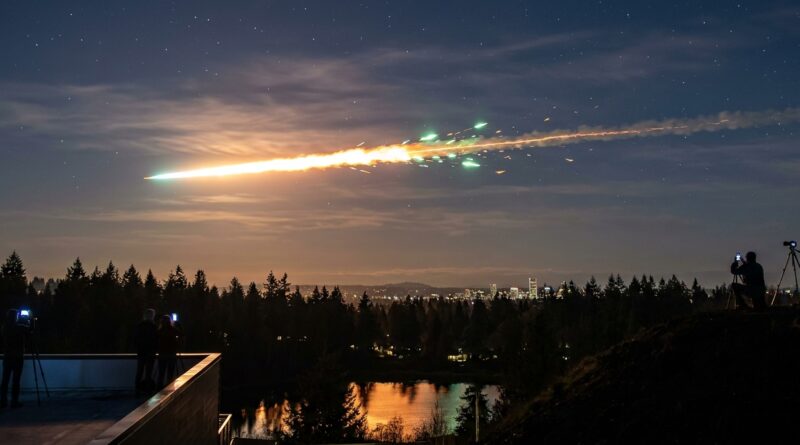
The Fireballs That Wouldn’t Fade: Why Back‑to‑Back Mystery Meteors Are Freaking Out Skywatchers in the Pacific Northwest
If you were in Seattle, Tacoma, Olympia, or Portland last night, you are not overreacting. Seeing one bright streak flash across the sky is exciting. Seeing two unusually long lasting fireballs on different nights over the same region is the kind of thing that makes people start checking doorbell cameras, neighborhood apps, and astronomy forums before coffee. The frustrating part is that the first wave of expert answers is usually careful and slow. That can feel unsatisfying when you know what you saw looked odd.
What makes this more than just routine sky drama is the timing and behavior. Witnesses described bright objects that seemed to hang around longer than a typical quick meteor. That does not automatically mean anything exotic. It does mean investigators will want better data before calling it a normal meteor, space junk reentry, or something else entirely. The good news is that regular people often provide the most useful clues, if they report what they saw the right way.
⚡ In a Hurry? Key Takeaways
- Two back-to-back sightings of a mysterious long lasting fireball over Pacific Northwest sky are unusual, but not yet proof of anything beyond meteors or possible space debris.
- If you saw it, write down the exact time, direction, color, duration, and whether it broke apart. That is the stuff scientists can actually use.
- Do not go hunting for “meteor pieces” in unsafe areas or assume it was dangerous. Most bright fireballs burn up high above the ground.
Why these sightings have people so rattled
A normal meteor is often over in a blink. You glance up, catch a sharp streak, and it is gone. What has people talking here is the reported duration. Multiple witnesses say these fireballs lasted long enough to follow with the eye, and in some cases seemed to move more slowly than expected.
That is a big reason the story is spreading. A mysterious long lasting fireball over Pacific Northwest sky does not fit the average person’s mental picture of a shooting star. When it happens again the next night, people naturally start wondering if the two events are connected.
What it probably was, and what experts will check first
There are a few usual suspects. None are boring, but some are a lot more likely than others.
1. A meteor or bolide
A fireball is basically an unusually bright meteor. A bolide is an even brighter one, often dramatic enough to fragment or flare. If the object came in at a shallow angle, it can appear to travel a long way across the sky and stay visible longer than people expect.
2. Reentering space junk
This is the other big possibility whenever people report a long, slow, glowing object. Old satellite parts or rocket debris can reenter the atmosphere and create a drawn-out, broken-apart light show. These events often look slower and more fragmented than a classic meteor.
3. A second unrelated event that just feels connected
This is less exciting, but it happens all the time. Humans are very good at spotting patterns. Two bright sky events in two nights can be linked in our minds even if they came from completely different causes.
To sort that out, investigators look for reports from different towns, all-sky camera footage, weather radar, satellite tracking data, and security camera video with timestamps.
What makes a “long lasting” fireball unusual
Duration matters. Bright meteors can absolutely last a few seconds. But once many witnesses start saying things like “it kept going” or “it looked like it was gliding,” experts start comparing the reports against reentry behavior.
They will also pay attention to these details:
- Did it break into multiple glowing pieces?
- Was there a persistent trail left behind?
- Did the color change from white to green, orange, or red?
- Did people across a wide area describe the same direction of travel?
- Were there sonic booms or delayed sounds?
A clean, fast streak points one way. A slower object that crumbles and keeps glowing points another way.
Why experts stay cautious at first
This part annoys people, but it is fair. Eyewitness reports are valuable, yet they are also messy. Bright objects at night can seem closer, bigger, slower, and lower than they really are. Two honest observers can describe the same event in very different ways.
That is why scientists try to avoid bold claims in the first few hours. They want triangulated reports, timestamps, camera evidence, and orbital or atmospheric data. Until then, “we are still checking” is not a dodge. It is the responsible answer.
How to report your sighting so it actually helps
If you saw the mysterious long lasting fireball over Pacific Northwest sky, your report can be useful. But “it was crazy” is not enough.
Write this down right away
- Exact date and time, as close as possible
- Your location, including city or neighborhood
- Which direction you were facing
- Where it started and where it ended in the sky
- Estimated duration in seconds
- Color, brightness, and whether it flickered or broke apart
- Any sound, and whether it came later
Check for camera footage
Doorbell cams, dashcams, wildlife cams, and parking lot cameras are gold for this kind of event. If you find video, keep the original file if possible. Do not just upload a compressed clip to social media and call it done. The timestamp and metadata can matter.
Send reports to the right places
Groups like the American Meteor Society and local astronomy networks collect witness reports in a format researchers can compare. If there is talk of possible reentry debris, satellite trackers and aerospace monitors may also weigh in.
Could these two nights be connected?
Maybe. But right now, that is the part people should be most careful about.
Back-to-back events over the same broad region can happen by chance. The Pacific Northwest has lots of observers, lots of cameras, and plenty of cloudy nights that make clear-sky events feel even more dramatic when they do happen. If the trajectories, timing, and behavior line up, then yes, a connection becomes more plausible. If not, it may just be two separate sky events landing in the same conversation.
That is why good reporting beats fast speculation every time.
What not to do
Do not assume military activity, alien craft, or a meteorite landing in the nearest field without evidence. And do not drive out at night trying to find impact debris based on social media guesses. Most fireballs never leave recoverable material, and even when they do, the possible fall zone is usually much larger than people think.
Also, be careful with edited clips online. Brightness, speed, and color often get distorted by phones and reposted videos.
At a Glance: Comparison
| Feature/Aspect | Details | Verdict |
|---|---|---|
| Likely cause | Could be a bright meteor or reentering space debris. Duration and breakup pattern will matter most. | Too early for certainty |
| Why people noticed | Witnesses described unusually long visibility on two separate nights across the same region. | Genuinely unusual |
| Best next step for readers | Record time, direction, duration, and check for camera footage before memory fades. | Most useful action |
Conclusion
This is what makes the story fun. It is fresh, still unfolding, and open to real community help instead of recycled mystery lore. A mysterious long lasting fireball over Pacific Northwest sky sounds dramatic because it is dramatic. But the smartest response is not panic or wild guessing. It is better notes, better clips, and better reports. Once you know what makes these fireballs so odd, what experts check first, and how to send in a sighting that scientists can actually use, you stop being a passive spectator. You become part of the way the mystery gets solved.