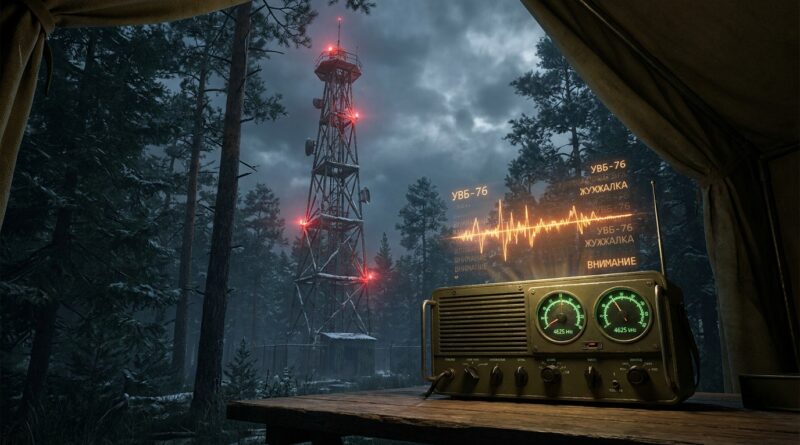
Did Russia’s ‘Doomsday’ Radio Just Whisper A Warning? Inside The UVB‑76 Messages No One Can Decode
If you have ever fallen down the UVB-76 rabbit hole, you know the feeling. Hours of that flat, mechanical buzzing, then suddenly everyone online starts saying, “Wait, did it just say something?” That is the frustration and the thrill of this station. Russia’s so-called “Doomsday” radio, better known as The Buzzer, appears to have aired fresh voice bursts in the last 24 hours, and as usual, nobody outside a tiny niche of listeners can say for sure what they mean. That uncertainty is exactly why people cannot look away. For some, it is Cold War leftovers. For others, it is proof that old systems never really die. The big thing to keep in mind is this. A new UVB-76 message does not automatically mean a crisis, a launch order, or some secret world event. But it does mean the mystery is alive, and regular listeners now have something new to compare, log, and argue about in real time.
⚡ In a Hurry? Key Takeaways
- Yes, UVB-76 appears to have transmitted fresh voice messages recently, but there is no public proof they signal an emergency.
- You can listen yourself with a cheap shortwave radio or an SDR app and compare what you hear with hobbyist logs.
- That is the real value here. This is a rare mystery regular people can help document without taking risks or spreading panic.
What actually happened with UVB-76?
UVB-76 is a famous shortwave station, usually heard around 4625 kHz, known for its near-constant buzzing tone and occasional spoken messages in Russian. In the past day, listeners reported new bursts that broke the usual drone. These were the kinds of short, clipped voice transmissions that have fueled theories for decades.
The search term people are flocking to right now is UVB-76 mysterious Russian number station new messages, and that sums it up well. There are new messages, they are mysterious, and they fit a pattern that nobody outside official channels can fully decode.
What matters is not just that a voice appeared. It is that the latest traffic gives radio hobbyists something concrete to study. Timing, word structure, call signs, repeated phrases, and changes in signal quality all give clues, even when the meaning stays out of reach.
Why people call it the “Doomsday” radio
The nickname is dramatic, but it did not come from nowhere. For years, UVB-76 has been linked, fairly or not, to Russian military communications, continuity planning, and the kind of backup systems countries keep around when they want something simple and hard to disrupt.
Shortwave radio has one big advantage. It is old, but stubborn. It can travel long distances, it does not depend on consumer internet, and it keeps working in situations where newer systems might fail or be easier to jam. That does not make every message sinister. It just explains why old-school transmissions still matter.
So is this a number station?
Sort of, but not in the movie version people imagine. Traditional number stations usually broadcast strings of numbers, letters, or code groups to intelligence assets. UVB-76 is a bit different. It is more like a persistent channel with a signature sound, interrupted now and then by coded voice traffic. That is one reason it stands out from the classic “numbers read by a calm voice” stations many people know.
What the new messages probably do, and what they probably do not
Here is the grounded view. These messages are likely functional. They may be checks, routing markers, readiness traffic, authentication phrases, or signals meant for recipients who already know how to interpret them. That is boring compared with internet theories, but boring is often how real communications work.
What they probably are not is a plain-language warning to the world. If there were a real public threat message, it would not be hidden inside cryptic shortwave phrasing that only dedicated listeners on forums noticed first.
This is where people get tripped up. Mystery does not equal apocalypse. A station can be eerie without being a live countdown to disaster.
Why this matters to normal readers, not just radio nerds
Because this is one of the few internet-era mysteries where you can still hear the raw source yourself. No algorithm summary. No cropped screenshot. No need to trust one viral account. You can tune in and listen.
That makes this story feel different. It is not just content to consume. It is something you can check with your own ears. In a time when so many stories arrive prepackaged, that is oddly refreshing.
How to listen to UVB-76 yourself
You do not need a bunker or a giant antenna farm in your backyard.
Option 1: Use a shortwave radio
A basic shortwave receiver can often pick up the frequency, depending on your location and conditions. Tune near 4625 kHz in USB or AM mode if your radio supports it, then fine-tune slowly. Reception changes by time of day, weather, and local interference.
Option 2: Use an SDR app or web SDR
This is the easiest path for most people. A software-defined radio setup, or a public web SDR receiver, lets you tune through a browser or app. Search for receivers in Europe for better odds, since geography matters a lot with shortwave.
Option 3: Follow live listener communities
Radio hobbyists often log transmissions as they happen, comparing timestamps and transcriptions. That helps because what sounds like gibberish to one listener may become clearer when several people compare notes.
How to tell if you are hearing something real
This part is important. Shortwave is messy. You will hear static, fading, overlapping signals, and weird noises that can sound more meaningful than they are.
- Check whether multiple listeners heard the same thing at roughly the same time.
- Write down the UTC time, frequency, and mode you used.
- Record audio if possible, even a phone recording near your speaker helps.
- Do not trust a transcript unless several people agree on the words.
That is how you avoid turning random noise into a conspiracy.
Why nobody can “decode” it publicly
People often ask a fair question. If the messages are on the open airwaves, why can’t the internet crack them?
Because hearing a message is not the same as understanding it. Even if a transmission is copied perfectly, the codebook, meaning of call signs, authentication system, and context may be missing. Think of it like hearing someone read out “Blue 7, Maple, 41, repeat.” You can hear every word and still have no clue what action it triggers.
That is why every fresh burst revives the same cycle. Excitement. Speculation. Then a lot of shrugs.
The sensible way to think about the latest UVB-76 traffic
The smartest response sits in the middle. Do not dismiss it as nothing. But do not turn it into a movie plot either.
New transmissions suggest the station is active and still part of some communication routine. That alone is interesting. It tells us this relic is not really a relic. It is still being used. Beyond that, caution matters.
If you enjoy mysteries, this is a good one because the evidence is public even when the answer is not. That is rare.
At a Glance: Comparison
| Feature/Aspect | Details | Verdict |
|---|---|---|
| Recent activity | Fresh voice bursts reportedly interrupted the usual buzzing pattern within the last 24 hours. | Interesting and worth logging, but not proof of a major event. |
| Ease of listening | Possible with an inexpensive shortwave radio or an SDR app/web receiver. | Very accessible for curious beginners. |
| Chance of public decoding | Listeners may transcribe words, but meaning likely depends on private code systems and context. | Low odds of a full public decode, high odds of ongoing debate. |
Conclusion
UVB-76 keeps pulling people in because it sits in that sweet spot between history, technology, and pure unease. The latest messages may not unlock the grand secret of The Buzzer, but they do give the Anomal community something better in a way. A real-time mystery you can join. With a cheap shortwave receiver or an SDR app, you can listen, compare notes, and help crowd-scrutinize what this strange station is doing now, not years after the fact. That turns a Cold War ghost signal into a living global investigation, and that is a lot more fun than just reading someone else’s theory thread.