Yellowstone’s ‘Ghost Blast’: The Mystery Pool That Exploded Before Sunrise
You see a headline about Yellowstone and your first thought is probably not, “Ah yes, a routine hydrothermal event.” It is more like, “Wait. A new pool appeared overnight, the river turned milky, and the ground basically failed before sunrise?” That reaction is fair. The official language around the Yellowstone Biscuit Basin mysterious hydrothermal explosion June 22 2026 can sound cold and technical, but the simple version is this: superheated water, steam, and fragile underground rock likely teamed up fast enough to blast apart part of the surface and leave behind a brand new collapse pool. The unnerving part is that these events can happen with little obvious warning to casual visitors. The reassuring part is that scientists know this is very different from a volcanic eruption. It is a local hydrothermal blowout, still dangerous up close, but not a sign that all of Yellowstone is suddenly about to explode.
⚡ In a Hurry? Key Takeaways
- The most likely cause was a sudden hydrothermal explosion, where pressurized hot water flashed into steam and blew out weak ground at Biscuit Basin.
- If you are tracking this story, watch for updates from Yellowstone National Park and the USGS, especially on closures, thermal mapping, and water discoloration reports.
- This is serious and unpredictable near the site, but it is not the same thing as a giant Yellowstone volcanic eruption.
What actually happened at Biscuit Basin?
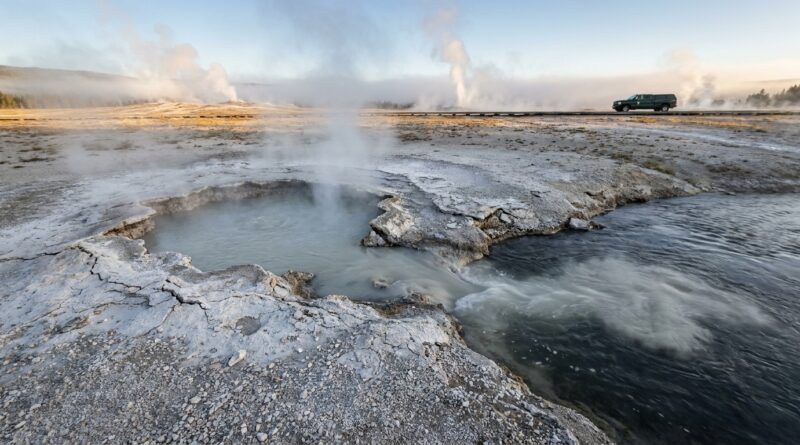
Based on the early reports, a section of Biscuit Basin changed dramatically before sunrise on June 22, 2026. A new collapse pool appeared where solid-looking ground used to be. At about the same time, people noticed an eerie pale or milky plume moving into the Firehole River.
That detail matters. Milky water in a thermal area often means fine clay, silica, and mineral-rich debris got churned up and flushed out. In plain English, something underground broke open hard enough to send hot water, mud, and altered rock into the local drainage.
That is why this is getting attention. It is not just a geyser acting up. It looks like the plumbing itself changed.
The simple explanation: a pressure cooker under thin ground
Yellowstone is full of underground water moving through hot rock. Usually, that water escapes in a fairly stable way through geysers, hot springs, fumaroles, and vents. But “stable” in Yellowstone is a relative term. The system is always changing a little.
A hydrothermal explosion happens when trapped water gets so hot that it is under intense pressure, then suddenly loses that pressure. The moment that happens, some of the water flashes into steam. Steam takes up much more space than liquid water. So the ground above it can crack, lift, and burst apart.
Think of it like opening a pressure cooker all at once, except the cooker is made of mud, silica crust, fractured rock, and boiling groundwater.
Why would it happen before sunrise?
The timing is probably coincidence from a human point of view. Yellowstone does not care what time it is. These systems can shift when a sealed passage opens, a mineral crust weakens, groundwater flow changes, or small fractures connect in just the wrong way.
It feels spooky because nobody was there to see the lead-up. One minute, it was familiar terrain. A few hours later, it was a new pool.
Why the “mystery pool” part matters
New pools do not just appear because water filled a puddle. In a place like Biscuit Basin, a sudden new pool often means the underground plumbing and the surface structure both changed at once.
That raises a few big questions scientists will want to answer:
Did the explosion create a crater, or did the ground collapse after material was blasted out?
Sometimes it is both. An explosion can eject material, then the roof over a shallow cavity drops in later or at the same time.
Is the new pool connected to an older hot spring or geyser channel?
If yes, nearby features could change too. One spring might get cloudier, another might dry up, and a geyser’s timing can shift.
Is the milky plume still ongoing?
If the river keeps showing mineral-rich discharge, that suggests the system is still flushing debris or reorganizing underground.
Could it happen again without warning?
Short answer, yes, at least in the sense that hydrothermal areas can change fast and not give everyday visitors a clear signal first.
That does not mean random blasts are happening everywhere all the time. It means thermal basins are active ground, not scenic pavement. Some events are preceded by subtle clues, like changing water levels, new cracking, hotter flow, different chemistry, or odd noises. But those clues are often too subtle for tourists to spot, and sometimes only instruments pick them up clearly.
So if your real question is, “Could another local blast happen in Yellowstone without a dramatic public countdown?” the answer is yes. That is exactly why boardwalks, closures, and restricted zones matter.
What this does not mean
This is the part that needs saying clearly. A hydrothermal explosion at Biscuit Basin is not the same as Yellowstone’s giant magma system gearing up for a supereruption.
The heat source deep below powers the whole thermal landscape, yes. But these near-surface blowouts are usually about water, steam, pressure, and weak rock in the shallow hydrothermal system. They can be violent on a local scale. They can injure people if they are nearby. They can remake part of a basin overnight. But they do not automatically point to a park-wide volcanic crisis.
Why the milky plume in the Firehole River is such a big clue
If you only remember one visual from this story, make it that strange pale plume. Rivers are useful truth-tellers in places like Yellowstone. They carry evidence away from whatever just happened.
A milky plume can point to:
- Freshly disturbed silica-rich sediment
- Clay from hydrothermally altered rock
- Hot spring water entering the river in unusual volume
- A newly opened vent or fractured pathway underground
Scientists will likely sample the water, compare temperatures, and test its chemistry against known nearby thermal features. That helps them figure out whether this was a one-time burst, an ongoing discharge, or part of a broader shift in local plumbing.
What scientists will probably check next
When a thermal area changes suddenly, the follow-up is not just people staring into a hole. Teams usually try to build a before-and-after picture using multiple tools.
1. Drone or aerial imaging
This helps map the new pool, debris field, and any broken ground around it.
2. Thermal measurements
They will want to know what is still hot, what is cooling, and whether nearby vents are changing temperature.
3. Water chemistry
The chemistry can reveal whether deep thermal fluids, shallow groundwater, or dissolved minerals suddenly got mixed in new ways.
4. Seismic and acoustic data
Sometimes small local signals show up before or during these events. Even if there was no obvious “earthquake” to the public, sensitive instruments may still have caught something.
5. Ground stability checks
This may be the biggest practical issue. Freshly changed thermal ground can be dangerously thin and unstable.
What visitors and armchair geology fans should do with this story
First, take it seriously without jumping to the biggest possible conclusion.
Second, if you are visiting Yellowstone soon, follow closures exactly. Not loosely. Not creatively. Thermal ground can look crusty and solid while hiding boiling water just inches below.
Third, if you are following from home, pay attention to the details in official updates. The useful clues are not just “an event happened.” Watch for mentions of:
- new closures or expanded hazard zones
- ongoing discoloration in the Firehole River
- changes to nearby named hot springs or geysers
- temperature and chemistry results
- whether the new pool is growing, stabilizing, or draining
That is how you separate real system changes from recycled dramatic headlines.
Why this story feels so unsettling
Because it breaks the postcard illusion.
Most of us think of Yellowstone as scenery first. Steam, color, boardwalk, photo, move on. But this event is a reminder that the park is not a museum display. It is a live geologic machine. Beautiful, yes. Also unstable in places. A patch of ordinary-looking ground can become a pool in a matter of hours.
That is what makes the Yellowstone Biscuit Basin mysterious hydrothermal explosion June 22 2026 worth watching closely. It is not just weird news. It is a rare chance to see scientists work on an active mystery while the evidence is still fresh and the explanation is still being argued out.
At a Glance: Comparison
| Feature/Aspect | Details | Verdict |
|---|---|---|
| Most likely cause | Sudden hydrothermal explosion from pressurized hot water and steam beneath weakened surface rock | Plausible and consistent with a new collapse pool and milky river plume |
| Risk to the wider park | Local danger near the site, possible instability and changing thermal features nearby | Serious up close, but not evidence of a giant Yellowstone eruption |
| Can it happen again suddenly? | Yes, hydrothermal systems can change quickly and may not give obvious warning to visitors | Best response is strict respect for closures and close attention to official updates |
Conclusion
This is one of those Yellowstone stories that deserves more than a shrug and a “nature is wild” comment. A milky plume suddenly flooding the Firehole River and a brand new pool appearing where firm ground used to be is not just quirky park drama. It is a live geologic puzzle. And because this story is breaking today, you have a rare chance to watch the explanation take shape in real time, not after the mystery has been cleaned up into a neat press release. That is the real value here. It reminds us that Yellowstone’s beauty sits on top of an active, shifting system, and that the line between scenic wonder and real hazard can be very thin. If you keep an eye on the science, the closures, and the changes in the basin itself, you will understand far more than people who just scroll past the headline.