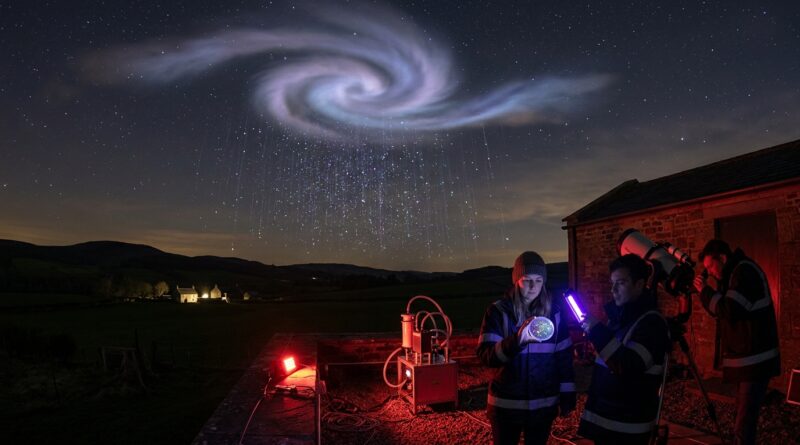
The Sky Is Raining Alien Dust: New Study Says ‘Impossible’ Space Grains Are Falling On Us Right Now
You have every right to roll your eyes at headlines like this. “Alien dust is raining down on Earth” sounds like the kind of claim that usually falls apart the minute you read past the first sentence. Either it turns out to be ordinary meteor debris with a flashy title, or the real science is buried under enough jargon to make your coffee go cold. This time, though, the reason people are paying attention is simpler and stranger. Researchers are reporting ultra-fine particles passing through Earth’s atmosphere that do not neatly line up with the usual suspects, like known meteor showers, common interplanetary dust, or standard near-Earth debris models. That does not mean aliens. It does mean scientists have measurements they are having trouble fitting into the existing playbook. And that is the part worth your time. Not the hype, not the memes, just the awkward fact that some of the data appears to be genuinely hard to explain.
⚡ In a Hurry? Key Takeaways
- Scientists are studying mysterious ultra-fine space dust falling to Earth that does not clearly match known meteor streams or standard dust models.
- When you see claims about “alien dust,” look for three things first: how the particles were measured, whether their paths were tracked, and whether the chemistry matches known cosmic sources.
- There is no public sign of danger here. The value is scientific. It may point to an overlooked source of near-Earth material, or gaps in how we model tiny incoming space grains.
What scientists actually found
At the center of this mysterious space dust falling to Earth study is a pretty specific claim. Researchers have detected very small incoming particles in Earth’s upper atmosphere whose speed, direction, size, or composition do not fit comfortably with the standard categories.
Normally, tiny particles falling from space are not a big mystery. Scientists expect a constant drizzle of micrometeorites and interplanetary dust. Most of it comes from comets, asteroid collisions, and the general mess of our solar system. Earth sweeps through that material all the time.
What makes this case different is that some of these grains appear “impossible” only in the sense that they do not behave the way the models say they should. Their trajectories may not line up with known streams. Their composition may be odd. Their abundance may be higher than expected in a given region or at a given time.
That is a scientific red flag, not a sci-fi one. It means the observations and the rulebook are arguing with each other.
Why the word “impossible” is being used
Scientists use strong language very differently from headline writers. When a researcher says a result seems impossible, they usually mean one of two things.
1. It should not be there under current models
If existing models predict that particles from a certain orbit, source, or composition should burn up, miss Earth, or be too rare to detect, but the instruments still pick them up, that is a problem worth chasing.
2. It may break an assumption, not physics itself
This is important. “Impossible” rarely means the laws of nature have stopped working. More often, it means one of the assumptions was wrong. Maybe the particles came from an unknown parent body. Maybe there is a temporary dust reservoir near Earth. Maybe the atmospheric filtering process is not understood as well as scientists thought.
That is how real scientific surprises usually look. They start small, awkward, and annoying.
What these particles might be
Before anyone jumps to the wild stuff, there are several grounded possibilities.
Unknown or poorly mapped meteor sources
Not every dust stream is neatly cataloged. Some parent objects may shed particles in ways that are hard to track, especially if the grains are tiny and spread out over long periods.
Fragments from near-Earth asteroids
Asteroids are not just giant boulders. They can produce fine material through impacts, thermal cracking, and surface shedding. Some of that dust could drift into Earth-crossing paths in patterns that are messier than our models assume.
Interstellar dust with unusual properties
Some dust does pass through our solar system from outside it. If a fraction of these grains have odd speeds or chemistry, they can look very strange compared with ordinary solar system debris.
Human-made contamination or measurement issues
This is the boring answer, but it has to stay on the table. Instrument noise, calibration errors, atmospheric contamination, or industrial particles can all create fake mysteries if the data is not cleaned carefully.
Good science keeps all of these options alive until the evidence starts ruling them out.
Why composition matters so much
Think of composition as the dust’s fingerprint. If scientists can measure what these grains are made of, they can start asking much sharper questions.
For example, do the particles contain mineral ratios typical of asteroids? Do they resemble cometary grains? Are there isotopic signatures that hint at material older than the solar system? Are they rich in metals that should not be common in that orbital population?
This is where the story gets more interesting than the headline. Weird chemistry is often more meaningful than weird motion. A strange orbit could be the result of drag, collisions, or a modeling gap. A strange chemical makeup can point to a source we genuinely have not identified yet.
Why orbit and direction are just as important
If composition tells you what a grain might be, direction tells you where it may have come from.
Scientists watch for whether particles arrive from a known radiant, which is the apparent point in the sky a meteor stream seems to come from. If the grains are arriving from directions that do not match known streams, that narrows the usual explanations.
They also care about speed. Fast particles can hint at interstellar origins or unusual orbital dynamics. Slower ones may suggest local solar system sources. Tiny changes in those numbers can completely change the best explanation.
So is this “alien” in the everyday sense?
Yes, technically. It is from space. No, not in the little-green-men sense.
That distinction matters because sloppy language wrecks good stories. “Alien dust” makes people think biology, spacecraft, or intelligence. The actual claim here is much more modest and much more believable. Some incoming space grains look hard to explain with current models.
That is enough. It is already interesting.
What scientists are quietly admitting
The most important part of this story is not that anyone has proven something exotic. It is that some researchers appear willing to say, in careful language, that the data does not fit neatly.
That kind of honesty is gold. Science moves forward when people admit the mismatch instead of forcing the result into an old box.
When you hear “does not fit the rulebook,” what you should picture is not panic. Picture a lot of spreadsheets, spectra, orbital calculations, and irritated experts trying to work out which assumption failed first.
How to read this story without getting fooled
If you want to stay curious without getting dragged into nonsense, use this quick checklist.
Check the instrument
Was this measured by radar, high-altitude collectors, satellite sensors, or atmospheric sampling? Each method has strengths and blind spots.
Check whether the result is repeatable
One weird detection can be noise. A repeated pattern across different instruments is much harder to dismiss.
Check the chemistry
If the reporting never mentions composition, isotopes, or elemental analysis, the story may be running ahead of the data.
Check what the researchers actually said
There is a huge difference between “unexplained” and “proof of something extraordinary.” Most of the time, the scientists are being careful and the headline is doing cartwheels.
Why this matters beyond the headline
This is not just a curiosity piece. Tiny incoming particles matter for several reasons.
First, they tell us about the local space environment around Earth. If there is an unrecognized source of fine debris nearby, that affects how we understand near-Earth space.
Second, micrometeoroids matter for satellites and instruments. Very small particles can still damage surfaces, sensors, and solar panels over time.
Third, odd dust can reveal bigger hidden structures. A weird grain population may point to a disrupted asteroid, an overlooked debris stream, or a patch of solar system history we have not mapped properly.
What happens next
The next stage is usually less exciting to watch, but more important.
Scientists will try to reproduce the detections, compare results across teams, test for contamination, refine orbital reconstructions, and run the chemistry against known cosmic materials. They will also try to see whether the particle flux changes with season, altitude, or Earth’s position in orbit.
That is how a mystery either becomes a discovery or quietly evaporates.
What you should keep in mind right now
The honest middle ground is this. Something unusual may be falling through Earth’s atmosphere in the form of ultra-fine grains. The early measurements appear odd enough that scientists are not brushing them off. But odd does not automatically mean extraordinary.
It means we may be watching a real puzzle form in public.
At a Glance: Comparison
| Feature/Aspect | Details | Verdict |
|---|---|---|
| What was detected | Ultra-fine incoming particles in Earth’s atmosphere with properties that do not clearly match standard meteor dust expectations. | Genuinely interesting, but still under investigation. |
| Best current explanations | Unknown dust stream, unusual asteroid debris, interstellar grains, or less exciting measurement and contamination issues. | Several plausible options remain open. |
| What it does not mean | It does not automatically mean alien life, alien craft, or any immediate threat to people on the ground. | Keep curiosity high and hype low. |
Conclusion
This helps the community today because it gives readers a single, grounded explainer on a breaking and deeply strange result: ultra-fine particles falling through Earth’s atmosphere that do not obviously match any known meteor stream or standard model of near-Earth debris. Instead of recycling secondhand UFO hype, we focus on what the measurements say, the anomalies in their composition and orbits, and the uncomfortable questions those raise about what might be lurking in near-Earth space. For Anomal’s audience, it is a chance to follow a live mystery at the moment when scientists are openly stumped, to learn how to read the data as it comes out, and to join a discussion that blends curiosity, skepticism and genuine wonder in a way that big tech news sites rarely have the patience for. In plain English, this is the good kind of strange. Not because it proves anything dramatic today, but because it shows science doing its most honest work when the answers are not ready yet.