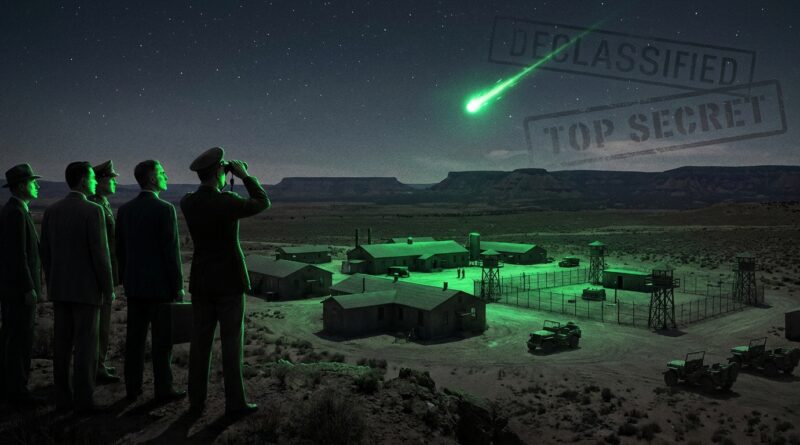
Trump’s New UFO Files Revive the ‘Green Fireball’ Mystery Over America’s Nuclear Heartland
If you are tired of every UFO story turning into either a partisan food fight or obvious clickbait, you are not alone. The fresh attention on the Los Alamos green fireball UFO files matters because this is not just another blurry-light internet rumor. These were repeated sightings over New Mexico in the late 1940s, right near some of America’s most sensitive nuclear facilities. Even more striking, the newly resurfaced and declassified material shows that military officers, intelligence staff, and top scientists at Los Alamos took the reports seriously and still could not pin down a clean explanation. That is the part worth your time. Not the social media shouting. The actual paper trail. The short version is simple. The “green fireballs” were real enough to trigger investigations, serious enough to worry national security officials, and weird enough that the people closest to the atomic program were left guessing. That is why this old mystery suddenly feels very current again.
⚡ In a Hurry? Key Takeaways
- The new attention on the Los Alamos green fireball UFO files is significant because the reports were linked to nuclear sites and investigated by real military and scientific officials, not just folklore.
- When a new UFO claim hits your feed, start with the documents, who observed it, what was ruled out, and whether the event clustered around sensitive locations.
- The safest takeaway is not “aliens confirmed.” It is that some cases remain genuinely unexplained, and the green fireballs are one of the better documented examples.
Why these files have people talking again
Whenever a batch of “UFO files” gets tied to Trump, Washington, or declassification headlines, the signal-to-noise ratio gets awful fast. People either assume it is all nonsense or jump straight to the wildest possible conclusion.
The green fireball case sits in the middle, which is exactly why it is interesting.
The sightings, reported mainly in 1948 and 1949, described bright green objects streaking across the sky over New Mexico. Witnesses often said they did not behave like ordinary meteors. The objects appeared low, bright, unusually green, and in some accounts seemed to travel on flatter paths than a normal fireball from space.
That alone would be a good mystery. But the location changed everything. These events were repeatedly reported near Los Alamos, Sandia, Kirtland, and other parts of America’s nuclear heartland. In plain English, this was not happening over random empty desert. It was happening around the crown jewels of the early atomic age.
What the Los Alamos green fireball UFO files actually show
The biggest value in the Los Alamos green fireball UFO files is that they pull the story out of legend and back into paperwork.
Scientists were not laughing it off
One of the most important points is that people at Los Alamos did not treat these reports as campfire chatter. Physicist Edward Teller and other high-level figures were aware of the issue. The concern was serious enough that meetings were held and formal attention was given to the sightings.
That does not mean they concluded the objects were extraordinary craft. It means the reports were consistent and troubling enough that they could not just shrug and move on.
Military and intelligence officers were involved
The files show a familiar pattern that still appears in modern UAP cases. Once strange activity is reported near strategic sites, the response shifts from curiosity to security. Officials wanted to know whether the lights were natural phenomena, secret Soviet technology, misidentified aircraft, or something else entirely.
That national security angle is a big reason this case has lasted so long. A weird light over a highway is one thing. A weird light over atomic installations during the Cold War is another.
Ordinary explanations were considered first
This part matters. The investigators did not begin with a fantastic answer. They looked at meteors, astronomical events, aircraft, balloons, hoaxes, and optical effects. That is exactly what you want to see in a credible case review.
And yet, some officials and scientists still felt the standard answers did not fully fit what was being reported.
The famous question at the center of the mystery
The core puzzle is not “Were there lights in the sky?” Yes, there were reports of lights. The real question is this: were the green fireballs just an unusual burst of meteor activity that happened to occur over sensitive sites, or did they show signs that pointed to something more controlled and less natural?
Reasonable people still split on that.
Some researchers argue the green color itself may not be that exotic. Certain meteors can glow green because of their chemical composition. On paper, that sounds tidy.
But witnesses at the time often described features that made the meteor explanation feel incomplete. The objects were said to appear without the kind of fragmentation expected from meteors. Some seemed too low. Some looked too level in flight. And perhaps most importantly, the concentration of reports near nuclear facilities made people wonder whether there was a pattern beyond coincidence.
Why nuclear sites keep showing up in UFO history
This is where the green fireball story connects with modern UAP interest. Again and again, from the early atomic era to later missile-base incidents, reports of strange aerial objects seem to cluster around nuclear technology.
That does not automatically prove a single cause. There are several possible reasons.
Reason 1. Sensitive sites get more attention
Nuclear facilities are watched carefully. More guards, more observers, more logs. If something odd appears nearby, there is a better chance it gets reported and preserved.
Reason 2. Secret programs create confusion
Military research, test flights, and classified systems can produce sightings that outside observers cannot explain. During the Cold War, that was especially true.
Reason 3. Some cases still do not fit neatly
This is the uncomfortable one. Even after you account for observation bias and secret projects, a residue remains. The green fireballs fall into that pile for many readers because the witnesses included trained observers and the official explanations never fully closed the case.
What changed with the latest release and renewed coverage
The recent buzz is less about one single smoking-gun memo and more about renewed access, recirculation, and framing. Older declassified records are getting fresh attention because modern audiences are now primed to look for patterns in UAP history. Once people saw the green fireball case tied directly to Los Alamos and other nuclear sites, interest spiked.
That is understandable. A lot of older UFO lore sounds vague until you see the names, dates, memos, and meeting notes. Then it stops feeling like folklore and starts feeling like an unresolved file cabinet problem.
That is the useful shift here.
How to read a UFO file without getting fooled
If you want a framework you can use the next time a declassification story blows up online, here is a simple one.
Start with the source
Ask whether you are looking at original records, a reliable archive, or a social media screenshot with no context. Documents beat memes every time.
Check who made the observation
A trained pilot, scientist, radar operator, or security officer does not automatically make a case true. But it does change the weight of the report.
See what was ruled out
The best cases are not the ones with the biggest claims. They are the ones where ordinary explanations were seriously tested first.
Look at the setting
Events near nuclear labs, missile fields, test ranges, and military bases deserve a closer look because there are both higher stakes and better reporting channels.
Be comfortable with “unexplained”
This is the part many people struggle with. “Unexplained” does not mean extraterrestrial. It also does not mean fake. It simply means the evidence did not produce a confident answer.
So, were the green fireballs UFOs?
That depends on what you mean by UFO.
If you mean “flying objects that were not identified at the time,” then yes, many of these reports fit that label perfectly.
If you mean “proof of alien craft,” no. The files do not give you that.
What they do give you is something more durable. They show a real historical case in which reputable people observed something odd near critical nuclear sites, investigated it seriously, and failed to settle on a satisfying explanation. That is enough to make the story worth revisiting.
Why this old case still matters now
The green fireball mystery is useful because it teaches two habits at once. First, stay skeptical. Second, do not be lazy.
Too much of today’s UFO conversation swings between those extremes. Either people dismiss everything instantly, or they believe everything instantly. The Los Alamos green fireball UFO files are a reminder that the grown-up approach is slower and more boring, but also more honest. Read the records. Follow the chain of concern. Notice who was worried, what they checked, and what remained unresolved.
That process is the real story.
At a Glance: Comparison
| Feature/Aspect | Details | Verdict |
|---|---|---|
| Document trail | Reports, memos, and official concern linked the sightings to Los Alamos and nearby nuclear facilities. | Strong reason to treat the case as historical fact, not just folklore. |
| Possible ordinary explanation | Meteors and atmospheric effects can explain some green-light reports, at least in part. | Plausible, but not fully satisfying for every reported detail. |
| Modern relevance | The case mirrors today’s UAP debates by mixing real witnesses, national security concerns, and incomplete explanations. | Very relevant as a framework for judging new claims. |
Conclusion
The best thing about revisiting the Los Alamos green fireball UFO files is that they give you something rare in this space. Solid ground. Right now the conversation around UFOs and UAPs is buried under politics, noise and low quality clickbait, which makes it almost impossible for curious readers to separate myth from the genuinely unexplained. A clear, grounded walkthrough of the green fireball files and how they relate to modern sightings gives our community something solid to chew on today: real documents, real scientists admitting they had no explanation, and a concrete case study in how high-strangeness clusters around nuclear technology. That not only helps answer the immediate “what actually just happened?” question around the Trump file release, it also gives you a simple framework to use the next time another sky video or declassification dump lands in your feed. Start with the paperwork. Work outward. And do not let the shouting do your thinking for you.