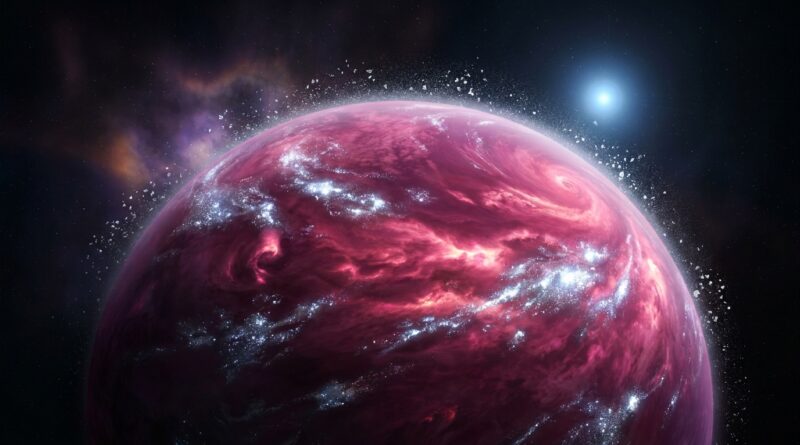
The Pink Planet With Salt Clouds: Why This Weird World Shouldn’t Exist
Space headlines can start to feel like wallpaper. Another exoplanet. Another strange blip. Another claim that sounds huge until you read the details and realize it changes nothing. That is why this pink exoplanet salt clouds mystery stands out. It is not just “huh, neat.” It is the kind of find that makes planet scientists stop, recheck the numbers, and admit the usual formation story may be missing something.
The world in question is a small, scorching exoplanet reported as unusually pink, with evidence pointing to high-altitude clouds made from mineral salts. That alone is odd. The bigger problem is where it exists and how it seems to have formed. By the standard playbook, a planet with this size, density, temperature, and atmosphere should be rare, or at least easier to explain than this one is. Instead, it looks like a world caught between categories. Not a normal rocky planet. Not a typical gas dwarf. Not behaving the way textbooks would prefer.
⚡ In a Hurry? Key Takeaways
- This “pink planet” appears to have salt-rich clouds and properties that do not fit cleanly into standard planet-formation models.
- If you want to follow the story, watch for new spectroscopy results, better mass-radius updates, and any follow-up from JWST or major ground telescopes.
- The value here is that this is a real, documented science puzzle, not recycled internet mystery bait.
What exactly was found?
The short version is simple. Astronomers spotted an exoplanet whose atmosphere appears to scatter light in a way that gives it a pinkish look, and the best current explanation includes clouds made of mineral material, including salts. Think less “cotton candy sky” and more “superheated chemistry lab wrapped around a planet.”
Scientists usually figure out this kind of thing by watching a planet pass in front of its star. As starlight filters through the atmosphere, different chemicals leave their fingerprints in the light. Those fingerprints can hint at temperature, cloud layers, and what the atmosphere is made of.
In this case, the atmosphere does not look simple. It looks layered, hazy, and chemically awkward. That is part of the appeal. A weird result is fun. A weird result that survives follow-up checks is where things get serious.
Why the pink color matters
The color is not just a cosmetic detail. It is a clue.
When astronomers say a planet looks pink, they usually mean its atmosphere is reflecting and scattering certain wavelengths of light more strongly than others. That can happen because of dust, haze, metal compounds, or cloud particles of a certain size. So the pink tone is really a signpost saying, “something unusual is happening in this atmosphere.”
And that leads straight to the bigger issue. If the cloud deck really includes salt particles, then the atmosphere is doing chemistry that does not fit neatly with the simple, expected models people often use for hot exoplanets.
Why salt clouds are such a headache
Clouds on Earth are made mostly of water droplets or ice crystals. On extremely hot exoplanets, all bets are off. There, clouds can be made from silicates, metals, or vaporized minerals that condense high in the atmosphere.
So yes, “salt clouds” sounds bizarre, but not automatically impossible.
The problem is the temperature-pressure recipe. For salts to condense into cloud particles at the altitudes suggested by the data, the atmosphere has to behave in a very particular way. The vertical mixing, heat transport, and chemical balance all have to line up. If the planet is hotter than expected, the salts should stay vaporized. If it is cooler in the wrong layers, other compounds might dominate instead. That is why researchers are still scratching their heads.
Put plainly, the atmosphere seems to be making ingredients show up in places where the standard models do not expect them.
Why this world “shouldn’t exist” in the usual story
This phrase always needs a little translation. Scientists do not mean the planet literally cannot exist, since clearly it does. They mean it is hard to explain using the most common formation models.
It may sit in an awkward size class
Exoplanets often fall into broad buckets. Rocky worlds. Gas giants. Mini-Neptunes. Puffy sub-Neptunes. This one appears to blur the lines. Its size and atmosphere suggest one history, while its density and heat suggest another.
Its atmosphere may be too substantial, or too strange, for its environment
Close-in planets get blasted by radiation from their stars. Over time, that radiation can strip away lighter gases. If this planet still has an atmosphere with complex clouds, scientists have to explain how it kept it, rebuilt it, or changed it.
Its chemistry may point to migration or a violent past
One possibility is that the planet did not form where it is now. It may have formed farther out, then moved inward. Another is that giant impacts, tidal heating, or interior outgassing changed the atmosphere after formation. That is where this gets interesting, because each explanation has different predictions astronomers can test.
What scientists think might be going on
Right now, there is no single clean answer. There are a few competing ideas.
1. The atmosphere is more dynamic than expected
Strong vertical winds could be hauling vaporized minerals upward, where they cool and condense into cloud particles. If that mixing is stronger than the models assume, the “impossible” cloud layers may become possible.
2. The planet formed elsewhere and moved inward
This is a favorite explanation when a world seems chemically out of place. If it formed in a cooler region of its star system, it may have collected material that now looks odd for its current orbit.
3. The data is right, but the labels are wrong
Sometimes the surprise comes from us forcing a new world into old categories. This might not be a failed rocky planet or a stripped gas dwarf. It could be a class of planet we are only now getting enough data to recognize properly.
4. There are other cloud materials mixed in
“Salt clouds” may be shorthand for a more complicated cloud cocktail. Mineral salts, metal oxides, sulfides, and hazes could all be contributing. If so, the pink signal might be coming from the full mix, not one simple ingredient.
Why this is better than the usual “mystery object” headline
This is the kind of anomaly worth your attention because it is grounded in real measurements. No blurry footage. No giant claim built on nothing. No UFO-style hand waving.
It is a live science problem. That means the fun is in watching the explanation improve over time. One paper suggests a strange atmosphere. Follow-up observations test it. New data narrows the options. Some ideas die. Better ones survive.
That process is slower than internet hype, but it is also far more satisfying.
What to watch next if you want the real story
If you want to follow the pink exoplanet salt clouds mystery without getting lost in noise, focus on three things.
Better spectroscopy
This is the big one. More precise atmospheric spectra can reveal whether the cloud signatures really match salts, or whether another mineral mix fits better.
Refined mass and radius measurements
Even small updates can change the planet’s estimated density. That matters because density is one of the main clues to what kind of world this actually is.
Temperature maps and phase curves
By watching how the planet’s brightness changes during its orbit, astronomers can estimate day-night temperature differences. That helps test whether clouds could survive where researchers think they are.
Why regular readers should care
You do not need a PhD to get why this matters. Planet science works by patterns. Then one weird object comes along and exposes the holes in the pattern. Those are often the most useful discoveries.
This planet is useful because it gives people one solid, current anomaly to track. Not “maybe aliens.” Not “scientists baffled” clickbait. A real object. A real atmosphere. A real mismatch between observation and expectation.
That makes it the perfect shared case file for anyone who likes science-first mysteries.
At a Glance: Comparison
| Feature/Aspect | Details | Verdict |
|---|---|---|
| Main anomaly | Pink-looking atmosphere with evidence for mineral or salt-rich cloud layers | Genuinely unusual and worth watching |
| Why it breaks expectations | Its chemistry, heat, and likely formation history do not line up cleanly with standard models | Challenges the usual playbook |
| What comes next | More spectroscopy, better density estimates, and follow-up atmospheric modeling | Still an open case, not a settled conclusion |
Conclusion
If you are tired of space news that sounds dramatic but goes nowhere, this is the kind of story to pin to the board. It gives you one genuinely strange, documented phenomenon that is still developing in real time. The pink exoplanet salt clouds mystery is useful because it does not ask you to choose between blind hype and total cynicism. It offers a clear puzzle instead. A planet that seems to bend the rules, an atmosphere that should be simpler than it is, and a set of follow-up clues that anyone can track as new data comes in. That helps anchor the daily flood of science headlines to something real, specific, and testable. For a community that likes grounded mysteries, this is exactly the right kind of anomaly to watch, discuss, fact-check, and build careful theories around.