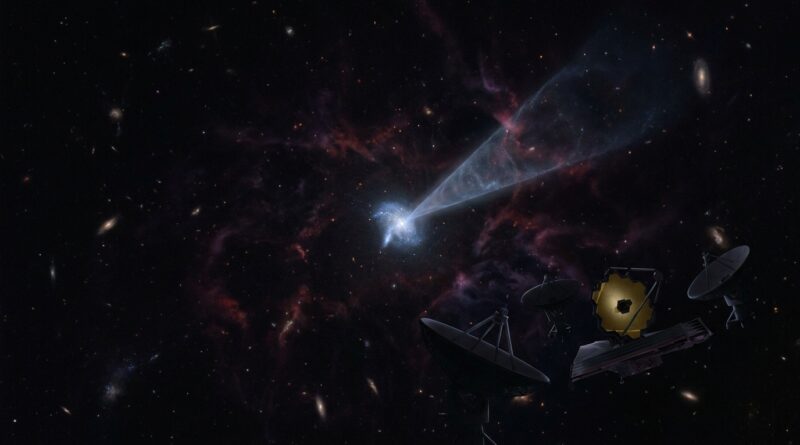
The Burst That Outran Time: Why A 10-Billion-Year-Old Radio Flash Just Became The Strangest Cosmic Message Yet
If you follow every “mystery signal” story, you already know the drill. A weird pulse shows up, headlines scream aliens, then a week later it turns into dust, a dead satellite, or “probably a magnetar.” That gets tiring fast. This time, though, the signal really does deserve your attention. Astronomers have confirmed the most distant fast radio burst ever recorded, a blast of radio energy that traveled for more than 10 billion years before reaching Earth. It came from a time when the universe was only about 3 billion years old. That alone makes it extraordinary. What makes it stranger is that it was powerful enough to stand out across almost all of cosmic history, yet we still do not know exactly what engine produced it. So let’s strip away the hype and sort out what is solid, what is likely, and what is still completely open.
⚡ In a Hurry? Key Takeaways
- The most distant fast radio burst ever recorded came from more than 10 billion light years away, making it one of the earliest and most extreme radio flashes ever detected.
- When you see future “alien signal” headlines, first ask three things: how far away was it, was a host galaxy identified, and do scientists know the likely class of object behind it.
- This is not evidence of extraterrestrial intelligence, but it is real, important, and useful for studying the early universe.
What actually happened
A fast radio burst, or FRB, is a very short and very bright flash of radio waves. We are talking milliseconds. Blink and you miss it. But in that tiny instant, an FRB can release an astonishing amount of energy.
The new event grabbed attention because it appears to be the most distant fast radio burst ever recorded. Its signal set out more than 10 billion years ago. That means the burst happened when the universe was much younger than it is now, only around 3 billion years old.
That matters because distance in astronomy is not just about remoteness. It is also time travel. The farther away something is, the farther back in time we are seeing it. So this burst is not just far. It is ancient.
Why scientists care so much about this one
Plenty of cosmic events are bright. Very few are bright enough to punch through that much space, survive the trip, and still trip our instruments on Earth.
This burst tells astronomers at least three big things.
1. The early universe could make these monsters
We already knew FRBs were powerful. This one shows that whatever creates them was already active when the universe was still relatively young. That pushes the mystery deeper into cosmic history.
2. Intergalactic space leaves fingerprints
As radio waves travel through space, they pass through thin gas and plasma. Lower frequencies get slowed more than higher ones. Astronomers use that spread, called dispersion, to estimate how much material the signal crossed.
In plain English, the burst did not just arrive. It arrived carrying a travel log.
3. It helps map the “missing matter” problem
A lot of ordinary matter in the universe is hard to spot directly because it is spread out in faint gas between galaxies. FRBs are useful because their signals get stretched and delayed by that gas. So each one can help scientists estimate what is floating out there in the dark.
If that sounds familiar, it is a bit like what made The ‘Ghost Neutrino’ From Nowhere: How One Particle Exposed a Hidden Galaxy 11 Billion Years Away so compelling. In both cases, one tiny incoming messenger revealed a much bigger hidden story about the deep universe.
So was it aliens? Short answer, no
This is where it helps to stay calm. “Mysterious” does not mean “artificial.” It usually means “we have not nailed down the exact natural engine yet.”
Fast radio bursts are widely thought to come from extreme astrophysical objects. Magnetars are the leading suspects in many cases. These are neutron stars with absurdly strong magnetic fields. They can produce violent outbursts that fit at least some FRB observations.
But not every FRB behaves the same way. Some repeat. Some do not. Some come from surprising galactic neighborhoods. Some are so energetic that they force scientists to keep more than one explanation on the table.
That is the honest answer here. We are looking at a real cosmic event, not a hoax and not a little green postcard. But the exact engine behind this specific burst is still not settled.
How they figured out where it came from
Finding an FRB is one thing. Pinning it to a host galaxy is much harder.
Radio telescopes can detect the flash, but researchers then need follow-up observations to narrow down the source and connect it to a galaxy. That is how they estimate the distance more securely, instead of just making a rough guess from the radio data alone.
In this case, identifying the host galaxy was a big deal. It turned a “bright weird signal” into a dated event from the early universe.
The host galaxy matters
Once astronomers know the host galaxy, they can ask better questions. Is the galaxy actively forming stars? Is it chaotic? Is it compact? Does it have conditions that might produce magnetars or other extreme remnants?
That context is where the science gets stronger and the clickbait gets weaker.
What remains flat-out mysterious
Even with a distance estimate and host galaxy in hand, several things are still unresolved.
The power source
Was it a magnetar flare? A compact object interaction? Some rare, short-lived event in a dense environment? Scientists have candidates, not closure.
Why some FRBs are so extreme
There is still no neat one-size-fits-all story for every fast radio burst. Nature may be using more than one mechanism.
How common these ancient bursts really are
We only catch the ones our instruments are sensitive enough to detect. So every record-breaking burst raises another question. Is this event rare, or are there many like it that we have been missing?
How to read future “mysterious signal” headlines without getting played
This is the part worth keeping. You do not need a PhD to sort signal from nonsense.
Ask these three questions first
Was the source localized?
If astronomers can tie the burst to a host galaxy, the claim is much stronger.
How far away was it?
Distance tells you whether this is a nearby oddball or a message from the deep past of the universe.
What do scientists actually claim?
If the researchers say “likely magnetar” and the headline says “possible alien beacon,” trust the paper, not the thumbnail.
Watch for the classic exaggerations
“Scientists baffled” often just means “there are multiple plausible models.”
“Signal from nowhere” usually means “we have not found the source yet.”
“Impossible energy” often means “surprisingly high, but still within physics.”
Why this burst feels bigger than a normal astronomy story
There is the technical side, of course. A radio flash crossed more than 10 billion years of expanding space and still hit our detectors hard enough to study. That is already wild.
But there is also the human side. This event happened before Earth existed in anything like its current form. Before oceans, trees, dinosaurs, mammals, or us. Yet the signal kept going. It crossed eras, galaxies, and empty space, only to end its journey in machines built by a species that showed up unimaginably later.
That is not proof of aliens. It is something better in its own way. It is a reminder that the universe is active, ancient, and under no obligation to be simple.
At a Glance: Comparison
| Feature/Aspect | Details | Verdict |
|---|---|---|
| Distance | More than 10 billion light years away, from when the universe was about 3 billion years old | Record-setting and scientifically important |
| Likely explanation | A natural astrophysical source such as a magnetar or another compact extreme object | No good evidence for aliens |
| Why it matters | Helps study early cosmic environments, hidden matter between galaxies, and the range of FRB behavior | A real breakthrough, not just another spooky headline |
Conclusion
The most distant fast radio burst ever recorded is worth your attention precisely because it does not need hype to be amazing. We know it was extraordinarily far away. We know it came from a very early chapter of the universe. We know it was energetic enough to survive a journey of more than 10 billion years and still shake our instruments here on Earth. We also know the central mystery is still alive. What exact engine made it fire remains unsettled. That is the sweet spot for good science coverage. You get a solid grip on what is real about its energy, distance, and host galaxy, while staying honest about what scientists have not solved yet. And that gives you a better filter for every future “cosmic message” headline. Not everything strange is profound. But sometimes, something truly ancient really does scream across time, and for a moment, we hear it.