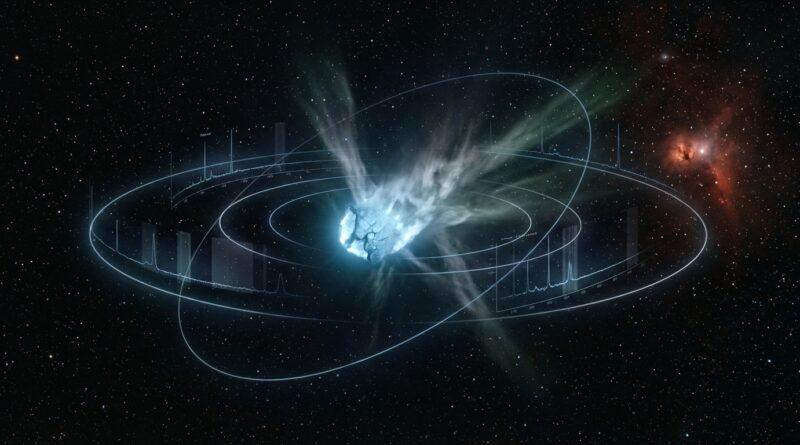
The Interstellar Visitor That Breaks All The Rules: Why 3I/ATLAS Has Scientists Whispering About ‘Impossible’ Space Chemistry
If you have tried to read about 3I/ATLAS lately, you have probably run into the same mess everyone else has. One post says it is an alien probe. Another says it is a doomsday comet. A third claims scientists are “panicking.” None of that helps if you just want to know what is actually strange here. The truth is more interesting, and a lot more grounded. 3I/ATLAS appears to be only the third confirmed interstellar object ever seen passing through our Solar System, and early observations suggest it may be carrying chemistry that does not fit neatly with what we expect from comets born around stars like our Sun. That is why serious researchers are excited. Not because it is proof of aliens, but because it may be a frozen sample of matter from a very different place and a very different time in the galaxy, possibly older than the Solar System itself.
⚡ In a Hurry? Key Takeaways
- 3I/ATLAS is not “impossible” in the magic sense, but it is unusual enough that scientists are rechecking how interstellar comets form and what kinds of ices can survive between stars.
- If you want to avoid hype, focus on three things: its hyperbolic path, the gases it releases, and whether multiple observatories agree on the measurements.
- The real value here is not a scary headline. It is a rare chance to watch good science happen live as researchers test, revise, and sometimes drop their first ideas.
What 3I/ATLAS actually is
Let’s start with the boring-sounding but important part. The “3I” means “third interstellar.” That label is only used when astronomers are confident an object did not come from our own Solar System.
They work that out from its orbit. If an object is on a strongly hyperbolic path, it is moving too fast and on the wrong kind of trajectory to be a normal long-period comet that has been orbiting the Sun for ages. In plain English, it is a visitor, not a local.
ATLAS is the survey system that found it. That is short for Asteroid Terrestrial-impact Last Alert System. Despite the dramatic name, finding strange moving objects is exactly what it is built to do.
Why people are calling it “rule-breaking”
The phrase is a little overcooked, but there is a real reason behind it. 3I/ATLAS seems odd in more than one way at once.
Its chemistry may not match the usual script
Comets in our Solar System are often described as dirty snowballs, which is simple but not wrong. They contain water ice, carbon dioxide, carbon monoxide, dust, organics, and other frozen material. As they warm up near the Sun, those substances turn to gas and stream away. Astronomers read that gas like a barcode.
What has researchers whispering is that 3I/ATLAS may be releasing an unusual mix of volatiles, especially highly fragile ices that are hard to preserve over long times unless the object formed in a very cold environment. If those readings hold up, the object may have formed far from its parent star, or even in a type of stellar nursery with conditions that differ sharply from the one that made our Solar System.
It may be extremely old
Some early modeling has suggested that 3I/ATLAS could be far older than the Sun, possibly on the order of 12 billion years. That does not mean someone looked at it with a telescope and read off a birthday. Age estimates come from statistical modeling, its incoming speed, its probable galactic orbit, and how likely it is to have been thrown out from ancient star systems over cosmic time.
So, important reality check. The age is not a settled fact in the same way the orbit is. But if even the rough picture is right, we may be looking at material that condensed when the galaxy was much younger and chemically poorer than it is now.
Its outgassing may be weird
Comets do not always behave neatly. Jets can switch on and off. Dust can hide what gases are really there. Sunlight can change everything quickly. But 3I/ATLAS appears to have shown outgassing that does not line up perfectly with the easy assumptions people make about icy bodies.
That matters because outgassing is not just a side effect. It is a clue to the interior. Different gases activate at different temperatures. If an object starts venting in an unexpected way, it can hint at unusual layering, unusual ice ratios, or an origin story outside the usual models.
What is internet hype, and what is not
Hype: “Impossible chemistry” means science is broken
No. When scientists say something looks impossible, they usually mean “impossible under our current assumptions.” That is a very different statement. Science is full of moments like this. A strange object shows up, the first model fails, and then the model gets better.
Hype: It must be artificial
There is no good evidence that 3I/ATLAS is a spacecraft, probe, or engineered object. “We do not yet understand this well” is not the same thing as “aliens did it.” That leap gets clicks because it is exciting, not because it is supported.
Not hype: It is genuinely rare
This part is true. We have only confirmed a tiny number of interstellar objects. First came 1I/ʻOumuamua, which was discovered in 2017 and sparked years of argument because it looked and moved in odd ways. Then came 2I/Borisov, which was easier to recognize as a comet. Now 3I/ATLAS gives scientists a third data point, and third data points are gold. They start turning one-off curiosities into patterns.
Not hype: It may force model changes
If the chemistry and activity measurements hold up, astronomers may need to rethink how common certain ice mixtures are in other planetary systems, how long they survive in interstellar space, and how often ancient objects from older parts of the galaxy pass through our neighborhood.
Why the chemistry matters so much
This is the bit that can sound dry, but it is really the heart of the whole 3I ATLAS interstellar object mystery.
Matter does not form randomly in space. The mix of elements and molecules inside a comet reflects where it formed, how cold it was, what radiation hit it, whether it got heated later, and whether it was kicked out of its home system early or late. A comet is like a badly dented but still readable shipping crate from another star.
If 3I/ATLAS contains exotic ices in unexpected ratios, that tells us something basic. The building blocks of planets and comets in other systems may be more diverse than the neat textbook picture suggests. It could also mean the Milky Way’s oldest systems were making frozen leftovers with a chemistry we have barely sampled before.
That is why researchers care. This is not just “one weird comet.” It is a test of how matter gets sorted and preserved across billions of years and trillions of miles.
Why its trajectory caused confusion at first
Another reason this story got messy is that trajectories are not always obvious from the first sighting. Early observations give you a short arc, basically a tiny slice of the object’s path. With only that slice, several orbital solutions can seem possible.
As more measurements come in, the orbit gets pinned down. In some cases, outgassing can also nudge a comet slightly, making the track harder to model cleanly at first. So when you hear that 3I/ATLAS had a trajectory “only understood after the fact,” that does not mean astronomers missed something obvious. It means the object was a moving puzzle and the answer sharpened as the data improved.
How scientists test whether the weirdness is real
This is the part I wish more clickbait stories explained. Nobody sane in astronomy sees one odd graph and announces a revolution.
They check the orbit with independent teams
Different groups use different software and assumptions. If they converge on the same hyperbolic orbit, confidence goes up fast.
They compare spectra from multiple telescopes
A claimed gas detection is much stronger if different instruments, on different nights, see the same signature.
They separate dust effects from gas effects
Comets can look chemically strange when dust is simply masking or boosting part of the signal. This takes careful cleanup.
They update models in public
One nice thing about modern astronomy is that a lot of this unfolds in papers, preprints, observing notes, and conference talks that can be cross-checked. The story changes because the evidence changes.
So, is 3I/ATLAS really older than the Sun?
Maybe. That is the honest answer.
The “12 billion years old” claim is the kind of thing that spreads fast because it sounds huge and cinematic. It may turn out to be broadly right. It may also soften into “likely from an old stellar population” rather than “this exact object is 12 billion years old.”
For non-specialists, the smart move is to treat age estimates as a ranking of confidence. Orbit, high confidence. Interstellar origin, high confidence if the current data holds. Exact chemistry, medium confidence until repeated. Exact age, lower confidence and likely to be refined.
What makes this different from earlier interstellar visitors
Compared with ʻOumuamua
ʻOumuamua was famous because it was the first known interstellar object and because it did not look like a normal comet. It showed no obvious tail at first, yet it appeared to have slight non-gravitational acceleration. That opened the door to all kinds of wild speculation.
3I/ATLAS, by contrast, seems to be giving astronomers more direct chemical clues. If that continues, it could be easier to classify physically even if its chemistry is stranger.
Compared with Borisov
Borisov felt more familiar. It looked like a comet, acted like a comet, and fit more comfortably into the categories astronomers already had. It was still exciting because it was from another star, but it did not throw as many conceptual punches.
3I/ATLAS may be harder to fit into the “familiar comet” box. That is exactly why people are paying attention.
How to spot bad 3I/ATLAS coverage in the wild
Here is a simple filter you can use anytime the next viral post lands in your feed.
Red flag 1: One dramatic claim, no instrument named
If a story says “scientists detected impossible molecules” but never says which telescope, which spectrum, or which team, be careful.
Red flag 2: They jump from unusual to artificial
That is not reporting. That is storytelling.
Red flag 3: They skip uncertainty entirely
Good science writing tells you what is known, what is likely, and what is still under debate.
Green flag: They explain what could falsify the claim
This is the best sign of all. Real scientists are always asking what result would prove them wrong.
What to watch as the story develops into 2026
If you want to follow the object without getting buried in noise, keep an eye on these specific questions.
- Do repeated spectra confirm the same unusual volatiles?
- Does the outgassing pattern stay odd as the object moves and heats up?
- Do orbital backtracking studies still place it in an ancient galactic population?
- Do researchers start revising models of comet formation in cold outer disks around other stars?
- Does 3I/ATLAS end up looking unique, or does it help explain past interstellar mysteries too?
Why this matters beyond one comet
We are entering a period where sky surveys are getting much better at spotting faint, fast-moving visitors. That means 3I/ATLAS may not stay a once-in-a-decade curiosity for long. It may be part of the start of a new class of astronomy, where we directly sample leftovers from other star systems just by waiting for them to pass through.
That is a big deal. Meteorites tell us about our own Solar System. Interstellar objects can tell us how common, strange, or ordinary our Solar System really is.
At a Glance: Comparison
| Feature/Aspect | Details | Verdict |
|---|---|---|
| Interstellar status | Its orbit appears strongly hyperbolic, which points to an origin outside our Solar System. | Well supported and the least controversial part of the story. |
| Chemistry and exotic ices | Early observations suggest unusual volatile behavior and possibly fragile ices linked to very cold formation conditions. | Genuinely interesting, but needs repeated confirmation. |
| Alien or doomsday claims | No solid evidence supports either idea. These claims mostly grow out of uncertainty and social media hype. | Ignore unless new hard data appears. |
Conclusion
3I/ATLAS is exactly the kind of anomaly worth your attention because it is weird for the right reasons. Not because someone put spooky music under a video, but because the data itself is hard to fit into the usual boxes. Right now it looks like a rare interstellar comet, possibly ancient, possibly carrying exotic ices, and definitely forcing astronomers to ask sharper questions about how matter forms and survives between the stars. That makes it a perfect case study for anyone tired of recycled ghost stories dressed up as science. If you keep your eye on the orbit, the chemistry, and the level of agreement between research teams, you will be able to follow this story with a cool head as it unfolds in 2026. And that is the real fun here. You get to watch a serious scientific mystery happen in real time, with enough facts on the table to separate the genuinely strange from the internet nonsense.