The Fossil Time Trap: New Chinese ‘Zoo’ Of Impossible Creatures That Rewrites How Life Began
You can be forgiven for feeling a little whiplash here. For years, the standard story was simple. Complex animal life shows up in the Cambrian, fast and dramatic, almost like nature hit a start button. Now a new fossil discovery rewrites timeline of complex life in a way that makes that neat story look a lot less neat. In southwest China, researchers have uncovered an unusually rich fossil site packed with tiny, strange creatures preserved in full three dimensions. That matters because soft-bodied life usually gets flattened, smeared, or lost altogether. Here, scientists can study details that are normally gone forever. And the age is the real punch in the gut. These fossils date to about 539 million years ago, right at the opening edge of the Cambrian, and they suggest many animal groups were already diversified earlier than textbooks often imply. That does not mean everything we knew was wrong. It means the timeline just got messier, richer, and much more interesting.
⚡ In a Hurry? Key Takeaways
- This Chinese fossil site suggests complex animal life was already more diverse and established earlier than the old “sudden Cambrian explosion” story implies.
- When you see big claims about life’s origins, check three things first: the fossil’s age, how well it is preserved, and how much of the conclusion is evidence versus interpretation.
- The find is exciting, but it does not “solve” evolution or overturn all biology. It sharpens the timeline and exposes gaps in the fossil record we are still trying to fill.
What was actually found?
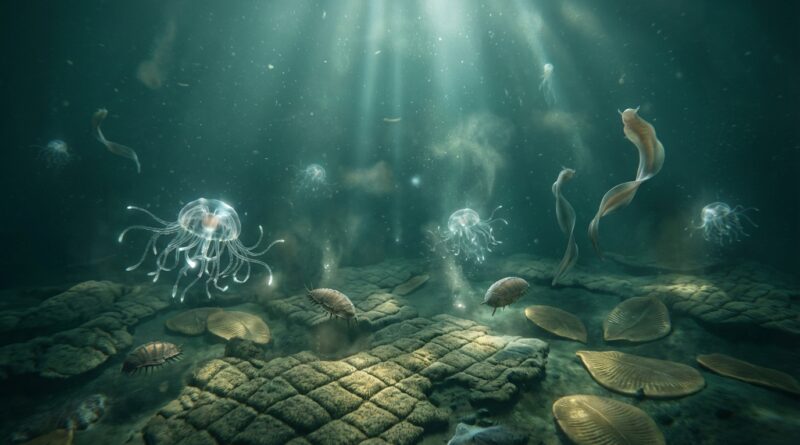
The new site, in southwest China, is being talked about as a kind of fossil “zoo” because the variety is the story. Researchers report tiny animals and animal-like organisms with body plans that look surprisingly advanced for their age. Some appear jelly-like. Some seem armored. Some are so odd that scientists are still arguing about where they fit on the tree of life.
The standout detail is not just what they found, but how they found it preserved. These fossils are three-dimensional, not the usual paper-thin impressions you see in many very old fossil beds. That gives paleontologists a much better shot at studying shape, symmetry, outer coverings, openings, and other clues that help identify what kind of organism they are looking at.
Think of it like the difference between trying to identify a car from a tire mark versus having the whole toy model sitting on your desk. You still may not know everything, but you are not guessing from a smear.
Why this is such a headache for the textbook version
The classic public version of the Cambrian story goes something like this: for a long time life was simple, then around 541 million years ago complex animals appear in a burst. That broad outline is still useful, but it has always been a little too tidy. This new site adds more pressure to that tidy version.
If these fossils really capture a wide range of early complex animals at about 539 million years ago, then the evolutionary groundwork had to begin before that. You do not wake up one morning with a crowded ecosystem of odd, specialized creatures unless there was already a longer period of experimentation behind the scenes.
In plain English, this means the “explosion” may be less about animals suddenly appearing from nowhere and more about the fossil record finally getting good enough to show us what had already been building.
So was the Cambrian Explosion fake?
No. That would be swinging too far the other way.
The Cambrian Explosion is still a real pattern in the rocks. A lot of animal diversity does appear over a geologically short stretch of time. What changes is how we explain that pattern. Was it truly a sudden biological event? Was it partly a preservation event, where conditions finally allowed more soft-bodied creatures to fossilize? Was it both? This new find strengthens the case that the answer is probably a mix.
Why three-dimensional fossils matter so much
Most very old soft-bodied organisms are a nightmare to study. They get crushed flat. Internal details vanish. Tiny features that could tell you whether something is related to jellyfish, worms, arthropods, or something totally extinct are often missing.
That is why this discovery has people excited. Three-dimensional preservation can capture structure in a way flattened fossils simply cannot. You can see whether a body cavity is real. You can inspect repeated segments. You can look for armor, spines, mouthparts, or external patterning.
That does not remove all doubt. Fossils can still fool you. Mineral growth can mimic anatomy. Distortion can create fake features. But the better the preservation, the less scientists have to fill in with imagination.
Why that should matter to regular readers
Because this is exactly where big science headlines often go off the rails. A headline says, “Scientists rewrite evolution.” Then, when you read the study, you find out the claim rests on one partial specimen and a lot of debate.
Here, the better question is not, “Does this prove everything?” It is, “How strong is the evidence compared with past finds?” On that front, this site seems important because it improves the quality of the evidence, not just the drama of the claim.
The creatures themselves sound almost made up
This is the part that grabs people, and honestly, fair enough. Early animal life often looks like science fiction designed by committee. Some forms resemble tiny blobs with organization that should not show up so early. Others have armored exteriors or repeated body structures that hint at more advanced developmental rules already in play.
That is what makes these fossils such a problem for oversimplified timelines. If these organisms were already present, then the machinery needed to build them, genes, development, ecology, predator-prey pressures, had to be underway earlier.
In other words, the fossils are not just weird. They carry hidden calendar information.
Where the evidence stops, and where the speculation starts
This is the part worth slowing down for.
What the fossils can tell us is that a surprisingly diverse set of organisms existed around 539 million years ago, and that some of them preserve complex anatomy in unusual detail. They also suggest the early Cambrian world was already biologically busy.
What the fossils cannot tell us on their own is the complete origin story of all major animal groups. They do not erase genetics, molecular clock studies, or other fossil sites. And they do not automatically settle debates about exactly when each branch of the animal family tree split off.
This is where skepticism is healthy. Not hostile skepticism. Useful skepticism.
Three questions to ask every time you see a fossil “breakthrough”
1. How secure is the dating?
If the rock layer’s age is uncertain, every conclusion built on the timeline gets shaky fast.
2. How direct is the anatomy?
Are researchers seeing clear body structures, or making inferences from vague outlines and mineral traces?
3. Is this a new branch, or a new window?
Sometimes a site changes the story because it reveals brand-new organisms. Other times it changes the story because it preserves familiar organisms much better than before. Both matter, but in different ways.
Why China keeps showing up in these fossil stories
China has some of the most important early fossil deposits on Earth, especially for the Cambrian period. Certain rock formations there preserve soft-bodied organisms with an unusual level of detail. That makes the region a recurring source of finds that shake up old assumptions.
It is not that life began there, of course. It is that the rocks there are acting like an incredibly rare time capsule.
That point is important because people often confuse “we found it here” with “it started here.” Fossil records are patchy by nature. The places with the best preservation can dominate the story, even if the actual biology was global.
What this means for the bigger story of life on Earth
The biggest takeaway is not that science got caught lying. It is that the clean schoolbook version was always a simplified sketch. Real science is messier. It updates. It argues with itself. It gets surprised by rocks.
This new fossil discovery rewrites timeline of complex life by pushing us to think less in terms of a magic moment and more in terms of a build-up. Complex animals may have been assembling in stages, with the fossil record only catching flashes of the process when preservation conditions were just right.
That is less dramatic than “everything appeared at once,” but it is actually more interesting. It means there may be many more missing chapters out there.
How to read future claims without getting fooled
If you follow anomaly stories, deep-time science, or anything that pokes at “settled” history, this is a useful case study. The strongest stories are not built on mystery alone. They are built on anomaly plus evidence.
So when the next headline lands, use this simple filter:
Look for the age
If a find is older than expected, ask, “Older by how much?” A shift of one or two million years can matter a lot in early animal evolution.
Look for preservation quality
A beautifully preserved fossil can change more minds than a hundred blurry ones.
Look for scientific caution
If the researchers themselves are careful and modest, that usually makes the discovery more credible, not less.
Look for whether the claim changes the timeline, the mechanism, or both
Some discoveries move dates around. Some change how scientists think evolution happened. The rare big ones do both.
At a Glance: Comparison
| Feature/Aspect | Details | Verdict |
|---|---|---|
| Age of the fossils | About 539 million years old, near the dawn of the Cambrian but suggesting deeper roots for complex animals | Strong reason the standard timeline needs fine-tuning |
| Preservation quality | Three-dimensional fossils preserve body form better than flattened impressions | Makes the evidence more useful and harder to dismiss |
| Impact on evolution story | Does not erase the Cambrian Explosion, but weakens the idea that complexity appeared out of nowhere | Revision, not demolition |
Conclusion
This is why discoveries like this matter so much. They hit a part of science most people assume is already settled, when and how truly complex animal life appeared, and they remind us that “settled” often just means “good enough until better evidence shows up.” These ghostly, jelly-like, and armored creatures from 539 million years ago do not hand us a final answer. What they do give us is better ground under our feet. Hard data. Better preservation. A sharper anomaly. For wonder-seekers, that opens a lost world that looks stranger than fiction. For skeptics, it offers a clean test case in how to separate a real scientific shift from hype. Keep this one on your radar, because if more sites like this turn up, the story of early life may stop looking like a sudden explosion and start looking more like a long fuse we are only now learning to see.