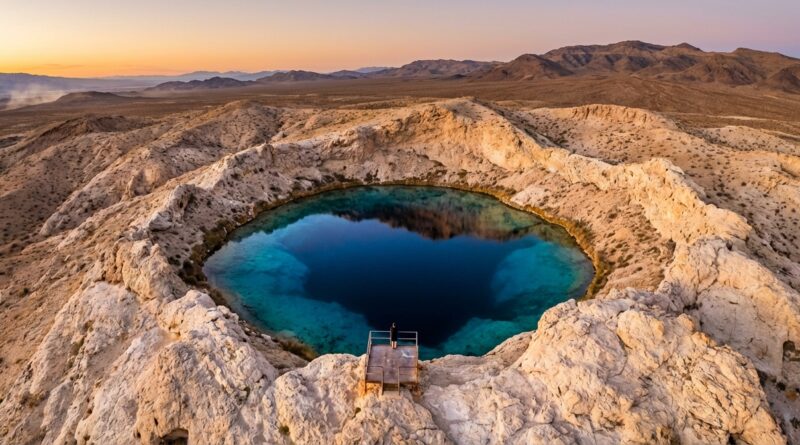
The Bottomless Desert Pool No One Can Explain: Inside Nevada’s ‘Infinity Cave’ Phenomenon
You have probably seen the clips. A still blue pool in the Nevada desert. A caption screaming “bottomless cave” or “scientists can’t explain this.” Then the video ends right when it should start getting useful. That is the annoying part. The real story is not that Nevada has a magic hole that breaks physics. It is that some desert spring caves are genuinely hard to map, dangerous to dive, and geologically weird enough to keep producing mystery long after the clickbait wears off. The place most often mashed into the so-called “Infinity Cave” idea is Devil’s Hole and a handful of deep geothermal spring systems in southern Nevada. They are real. They are not literally bottomless. But some are deep enough, narrow enough, and complex enough that even with dive logs, sonar, and USGS work, we still do not have a clean, complete picture of every passage. That is where the real mystery lives, and honestly, it is more interesting than the viral version.
⚡ In a Hurry? Key Takeaways
- There is no proven “bottomless cave in Nevada desert pool unexplained depth,” but there are very deep, partly mapped desert spring caves like Devil’s Hole that still resist full exploration.
- When you see a viral claim, check for hard sources like USGS surveys, National Park Service records, and named dive expeditions before believing the “bottomless” label.
- These sites are not tourist swim holes. They are fragile, legally protected, and dangerous even for expert cave divers.
What people mean by Nevada’s “Infinity Cave”
First, let’s clean up the name. “Infinity Cave” is not the official name of a famous Nevada cave on government maps. It is more of an internet nickname. Viral posts tend to blend together several real places, mostly deep desert pools, geothermal springs, and water-filled cave openings in Nevada and nearby desert country.
The heavyweight in this conversation is Devil’s Hole, a detached unit of Death Valley National Park near Pahrump, Nevada. It looks almost too simple from the surface. Just a limestone opening filled with clear water. But below that opening is a submerged cave system that drops far beyond what casual visitors expect.
That is why it keeps getting pulled into “bottomless” stories. It feels impossible. You stand in the desert and look at a calm pool, then learn it connects to a deep groundwater system inside rock that has been shaped over huge stretches of time.
Is Devil’s Hole actually bottomless?
No. “Bottomless” is the myth word. “Not fully mapped in ordinary human terms” is the more accurate one.
Scientific and dive work has shown that Devil’s Hole is very deep. Explorers and survey teams have documented the cave extending to at least several hundred feet below the water surface, and the system includes sloping passages, constrictions, and geometry that make complete mapping difficult. Public-facing summaries often mention explored depths beyond 500 feet. That alone is enough to fuel legends.
But deep is not the same as infinite. There is no evidence that the cave goes on forever, and no scientist is claiming that it breaks geology. What scientists do say is that the opening connects to a much larger regional aquifer system, and the submerged cave shape is challenging enough that every answer tends to come with another question attached.
Why scientists still cannot give you one neat final depth number
This is where the story gets good, because the reasons are practical, not mystical.
The cave is narrow and awkward
Some deep water caves are like underwater hallways. Others are more like cracked plumbing inside a mountain. Devil’s Hole and similar desert spring systems can include steep drops, shelves, offsets, and tight sections that make instrument placement and diver movement hard.
It is dangerous even for experts
Cave diving is already one of the highest-risk forms of diving. Add depth, confined spaces, and the need to preserve a protected site, and your options shrink fast. You do not just send in a bigger flashlight and call it a day.
The site is protected for biological reasons
Devil’s Hole is home to the endangered Devils Hole pupfish, one of the rarest fish in the world. That means the site is not simply an open lab where anyone can run unlimited tests. Access is tightly controlled, and for good reason.
Water and rock can fool instruments
Sonar, line surveys, and visual estimates all have limits. Clear water helps, but cave angles, ledges, and side passages can still make clean readings difficult. A map can be accurate and still incomplete.
“Depth” is not always one straight measurement
People want a single number. Nature often gives a shape instead. A cave system might have a main shaft, sloping passages, side chambers, and inaccessible cracks. So asking “How deep is it?” can be like asking how tall a crumpled ladder is. The question sounds simple. The actual answer depends on what part you mean.
What USGS and researchers do know
Here is the grounded version. Nevada’s desert springs and water-filled caves are tied to long, complex groundwater systems in limestone and other rock formations. Over time, slightly acidic water dissolves rock, opens fractures, and creates voids and passageways. In geothermal areas, heat can also affect water chemistry and flow.
Devil’s Hole is part of this bigger hydrologic story. It is not an isolated magic pit. It is a window into a regional groundwater system. That matters because it explains why water levels there have been so important in legal fights and scientific monitoring. When groundwater pumping changes the system, Devil’s Hole responds. So this is not just folklore. It is measurable, physical, and documented.
The USGS and park scientists have studied water levels, seismic effects, cave geometry, and the site’s ecology for years. One of the most striking findings is how sensitive the water can be. Large earthquakes from far away have caused seiches, which are standing-wave sloshes, inside Devil’s Hole. That sounds paranormal until you realize it is simply geology and fluid physics acting on a very unusual natural feature.
Why viral videos keep making it sound stranger than it is
Because “real but complicated” does not travel as well as “unexplained abyss.”
The internet loves three tricks here. First, it swaps “deep” for “bottomless.” Second, it blends different locations into one legend. Third, it treats a lack of complete mapping as if scientists are baffled by the existence of the pool itself. They are not. They understand a lot about how these systems form. What remains uncertain is the exact extent and fine structure of some passages.
That difference matters. If you care about strange places, you should want the true version. It is sturdier. It survives fact-checking.
Local lore versus the documented record
Every place like this collects stories. Native traditions, mining-era rumors, tales from ranchers, and diver bar stories all mix together. Some say the cave connects impossibly far underground. Some insist gear has been lost forever. Some claim no one has reached the real bottom.
A few of those stories may contain a grain of truth. Deep caves do eat equipment. Surveys do get updated. Explorers do turn back. But lore tends to flatten details. It turns “we do not have a fully public, final map of every submerged passage” into “nobody knows anything.” That is not the same thing.
The documented record is more satisfying anyway. We have legal cases, scientific papers, park management records, and dive reports that show this site has been observed carefully for decades. The mystery is not fake. It is just often misquoted.
How deep is “deep” in practical terms?
For a casual reader, here is the useful translation.
If a desert pool has confirmed explored depths of hundreds of feet, restricted access, cave geometry, and a protected ecosystem, then yes, you are looking at a serious natural anomaly by everyday standards. It is not a social media illusion. It is also not a portal.
That middle ground is where the smartest kind of wonder lives. The place is real. The danger is real. The incomplete map is real. The physics are also real.
If you want to fact-check the next “bottomless cave” claim
Use this quick filter before you share it.
Look for a real location name
If the post only says “mystery pit in Nevada” and never names the site, that is a red flag.
Check for agency sources
National Park Service, USGS, state geology offices, and university research are much better than listicles with spooky music.
Watch for bait wording
“No one can explain” usually means “the poster did not read the explanation.”
Separate unexplained from unmeasured
A place can be partly unmapped without being scientifically baffling.
Respect access restrictions
If the location is protected, there is usually a good reason. Ecological damage and diver deaths are not worth a selfie.
So what is the best answer to the mystery?
The best answer is this. Nevada does have real desert pools and cave openings that appear almost unreal from the surface. Some, especially Devil’s Hole, are tied to deep aquifer systems and have challenged explorers for decades. Scientists can explain the broad geology. They cannot always hand you one final, simple number for total depth and total extent, because the system is difficult, dangerous, and sensitive.
That does not weaken the story. It makes it stronger. The pool is not mysterious because science has failed. It is mysterious because nature is under no obligation to fit into a clean viral caption.
At a Glance: Comparison
| Feature/Aspect | Details | Verdict |
|---|---|---|
| “Bottomless” claim | No verified Nevada desert pool has been proven literally bottomless. Viral posts use the term loosely. | Myth wording, not a scientific description |
| Real-world candidate | Devil’s Hole near Pahrump is a real, very deep, water-filled cave opening linked to a larger aquifer system. | Real site with documented depth and ongoing intrigue |
| Why mapping is incomplete | Extreme depth, cave geometry, diver risk, protected habitat, and instrument limits all get in the way. | Explained challenge, not supernatural evidence |
Conclusion
If you are tired of recycled UFO hearings and obvious AI hoaxes, this is the kind of mystery worth your time. A real desert cave pool in Nevada can still leave experts with open questions, and that is not because anyone is hiding a fantasy answer. It is because geology, groundwater, depth, and danger make some places stubbornly hard to pin down. Backed by dive logs, USGS work, and decades of local lore, the so-called “Infinity Cave” phenomenon gives you something better than internet fog. It gives you a physical, specific, verifiable mystery that still keeps a little of its awe. That is the sweet spot. Curious, skeptical, and still willing to be impressed. And once you see how this story actually works, you start looking at every “bottomless” lake, pit, and desert anomaly with sharper eyes and a healthier sense of wonder.