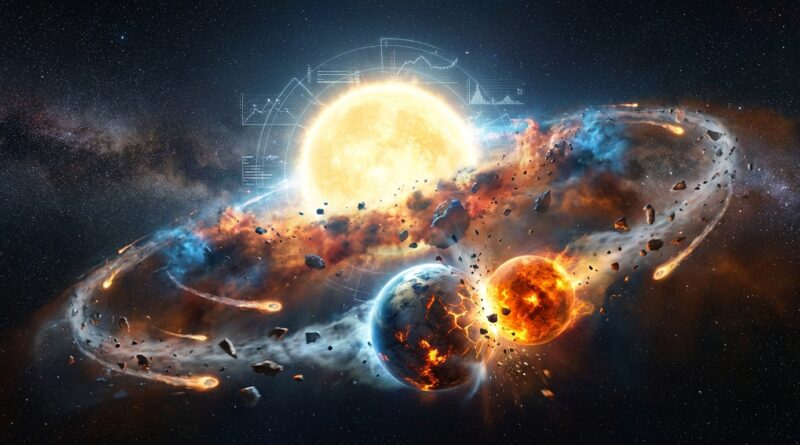
The best way to understand a star that ‘went bonkers’ after a planetary smash‑up 11,000 light‑years away
Most space headlines make this kind of story sound like pure chaos. A star dims. Then it brightens in strange ways. Then everybody says “scientists are baffled,” and you are left wondering what actually happened. Fair frustration. The object now getting all the attention, called Gaia20ehk, is interesting not because astronomers saw two planets smack into each other directly, but because they caught the messy aftermath. The best current reading of the data is that a collision between large planetary bodies created a cloud of debris around a star about 11,000 light-years away. That debris first blocked some of the starlight, then heated up and glowed in infrared light. In plain English, the star did not really “go bonkers” on its own. Something around it did. And that matters, because this may be one of the clearest real-time examples we have of a giant planet-forming or planet-destroying smash-up beyond our solar system.
⚡ In a Hurry? Key Takeaways
- The leading explanation for Gaia20ehk is not a “crazy star,” but debris from a likely planetary collision causing unusual dimming and brightening.
- When reading space news, look for what wavelengths were observed. Visible light tells one part of the story, infrared often reveals hot dust and debris.
- This is rare and exciting, but it is still an interpretation of evidence, not a direct video of planets crashing together.
What actually happened with Gaia20ehk?
The short version is this. Astronomers saw a distant star fade in visible light. That alone could mean several things. Maybe dust drifted in front of it. Maybe the star itself changed. Maybe there was some kind of eruption.
But then the plot thickened. Follow-up observations showed unusual behavior in infrared light, which is the kind of light warm dust gives off. That shifted the story from “the star is acting weird” to “something around the star may have suddenly made a huge amount of hot debris.”
That is why the phrase Gaia20ehk planetary collision unexplained star dimming keeps popping up. The mystery is not just the dimming. It is the sequence. First, light gets blocked. Then dust appears to glow. Put together, that starts to look less like a moody star and more like a cosmic car crash.
Why scientists think planets may have smashed together
Think of it like arriving after a kitchen accident. You did not see the plate fall, but you can see the shards on the floor, the spilled sauce, and the dent in the cabinet. You can make a pretty good guess about what happened.
That is basically what astronomers are doing here.
The clues they are working from
Clue 1: The star dimmed.
A dip in brightness often means some material moved in front of the star from our point of view.
Clue 2: The system gave off extra infrared light.
Infrared is a big clue because dust heated by a nearby star glows strongly in it. If you suddenly see lots of warm dust, something probably made or stirred up that dust.
Clue 3: The timing fits a violent event.
The changes do not look like a slow, ordinary cycle. They look abrupt enough to suggest a major disruption.
Clue 4: The scale seems huge.
To get this much debris and this kind of signal, scientists think the event may have involved planet-sized bodies, not just a few random asteroids bumping into each other.
So did we really witness a planet collision?
Probably the aftermath, yes. The collision itself, not directly.
This is an important distinction, and it is where a lot of headlines get sloppy. Astronomers are not saying they watched two labeled planets with little name tags crash on camera. They are saying the best explanation for the observed dimming plus infrared glow is a giant impact that produced a thick cloud of debris.
If that sounds familiar, it should. One leading idea for how our own Moon formed involves a huge collision early in Earth’s history. So when scientists compare Gaia20ehk to a “Moon-making-style” smash-up, they mean an event in that general family. Large bodies collide. Material gets blasted out. A dusty disk or cloud forms. Over time, that debris can settle, spread, clump, or fall inward.
Why this has astronomers so spooked, in a good way
Because these events are supposed to be brief on cosmic timescales and easy to miss.
Space is huge. Planetary systems evolve over millions or billions of years. Catching a dramatic turning point while it is happening is like walking into a forest and just happening to witness one exact tree fall.
That is why Gaia20ehk matters. It is not just another vague “space mystery.” It may be a rare live look at the kind of violence that shapes solar systems. The same sort of process that can build moons, destroy worlds, and rearrange planetary neighborhoods may have left fingerprints we can actually study in real time.
How astronomers figured this out from light alone
This is the part that often gets lost, and it is honestly the coolest part.
Astronomers usually cannot fly out and inspect distant objects. They read light the way a mechanic listens to an engine. Small changes mean specific things.
Visible light tells you what got blocked
If a star suddenly looks dimmer, something is either covering it, or the star changed its own output.
Infrared tells you where the heat is
If there is extra infrared emission, warm dust is often the culprit. Dust grains absorb starlight and reradiate that energy as heat.
The pattern over time tells you the story
A one-off flicker can be noise. A repeating dip might be an orbiting object. But a sudden dimming followed by behavior that suggests newly heated debris is where the collision idea starts to make sense.
That is why this case feels so different from generic “unexplained star dimming” stories. Here, the data are not random. They form a chain of clues.
Could it be something else?
Yes. Good science always leaves room for that.
Alternative explanations can include unusual dust structures, material falling into the star, or some other kind of instability in the system. Scientists compare models and ask which one best matches all the observations, not just one piece.
Right now, the giant-impact idea is compelling because it explains several things at once. It gives you a reason for the sudden dust. It explains the dimming. It fits the infrared glow. It also lines up with what we think violent young or evolving planetary systems can do.
But “best explanation so far” is not the same as “case closed forever.” That is normal science, not weakness.
What makes this story different from clickbait cosmic mysteries
Usually, vague space stories stop at “scientists don’t know.” That is not very useful.
The better way to read a story like this is to ask three simple questions:
1. What was observed directly?
In this case, changes in the star’s brightness and infrared output.
2. What is inferred from those observations?
That a lot of warm dust appeared around the star after a disruptive event.
3. What is the leading explanation?
A collision between large planetary bodies, or at least a giant impact involving planet-scale material.
Once you separate those steps, the whole story becomes much easier to follow.
Why this matters beyond one weird star
Because it gives us a practical example of how solar systems change.
We often talk about planets as if they are permanent fixtures. They are not. Young systems are messy. Even older systems can go unstable. Orbits shift. Bodies collide. Dust clouds form. Material gets flung out or pulled inward.
Gaia20ehk is a reminder that planets are not just born and parked neatly forever. Sometimes the architecture of a system gets rewritten violently.
And for readers, that is the real value here. You are not just consuming another dramatic headline. You are learning how astronomers turn weird light curves into a detective story about destruction, formation, and change.
How to read the next headline without getting lost
If another article pops up tomorrow saying a star “went bonkers,” use this quick checklist:
Ask what kind of light changed
Visible, infrared, X-ray, radio. Each points to different physics.
Ask whether the star changed, or material around it changed
That one question cuts through a lot of confusion.
Ask whether scientists saw the event itself, or its aftermath
With Gaia20ehk, the aftermath is the key.
Look for the confidence level
“Best explanation,” “leading model,” and “confirmed” are not the same thing.
At a Glance: Comparison
| Feature/Aspect | Details | Verdict |
|---|---|---|
| What was directly observed | A distant star dimmed, and the system later showed strong signs of warm dust in infrared light | Solid observational starting point |
| Leading explanation | A giant impact between large planetary bodies created debris that both blocked and emitted light | Most convincing current model |
| Level of certainty | Strong clue-based inference, but not a direct visual recording of planets colliding | Exciting, but still under study |
Conclusion
The best way to understand Gaia20ehk is to stop picturing a star randomly losing its mind and start picturing a crime scene lit by starlight. The star’s strange behavior is likely collateral evidence. Dust moved in, heat built up, and astronomers read those signals as the aftermath of a giant planetary smash-up. That is why this story has grabbed so much attention. It lets the Anomal community tap into a live cosmic whodunnit instead of recycling old mysteries. A real system 11,000 light-years away may have gone through a Moon-making-style collision, and following how scientists built that case gives you a concrete, useful way to understand how truly rare events are spotted and decoded in real time.