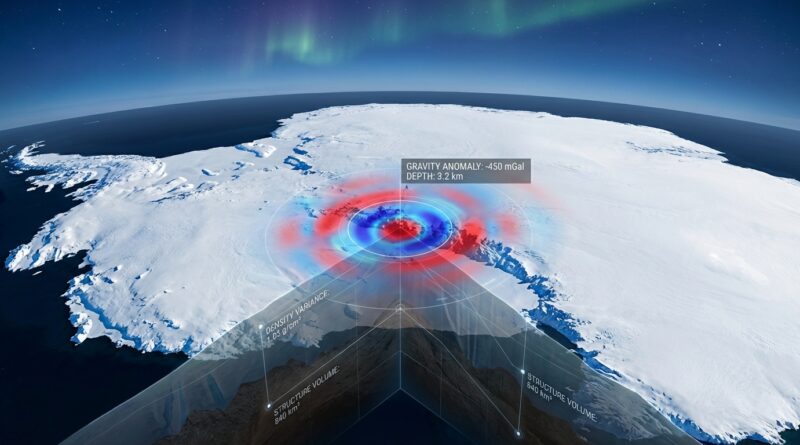
The Antarctic Gravity Anomaly: The Hidden ‘Mass’ Beneath the Ice That Shouldn’t Be There
You are not wrong to feel worn out by Antarctica stories. One post says alien ruins. Another says a hidden map proves the world is lying to you. Most of it falls apart the second you ask for actual data. But there is one real, documented mystery that scientists do take seriously. Parts of Antarctica show gravity signals that do not fit neatly with the amount of ice, the shape of the bedrock, or the usual geologic models. That does not mean anything supernatural is hiding there. It means the planet is messier than our first-pass equations would like. The best-known case sits in East Antarctica, in and around Wilkes Land, where satellite gravity surveys and later follow-up work found a buried structure and unusual mass patterns beneath the ice. Scientists have proposed several explanations, from a giant impact scar to deep mantle and crustal density contrasts. None has closed the case cleanly. That is what makes this a real mystery, not just recycled internet fog.
⚡ In a Hurry? Key Takeaways
- The most credible unexplained antarctic gravity anomaly is tied to East Antarctica, especially Wilkes Land, where gravity data suggests hidden dense structures under thick ice.
- If you want to judge claims yourself, look for sources using satellite gravimetry, bedrock mapping, and peer-reviewed geophysics, not viral images or dramatic arrows on a map.
- This is a scientific puzzle, not proof of a secret civilization or doomsday event. The value is that the data is genuinely odd, and experts still debate the best fit explanation.
The one Antarctica mystery worth your time
If you want one case to keep in your back pocket, start with Wilkes Land.
This region of East Antarctica has shown unusual gravity behavior in multiple datasets, including satellite gravity missions and airborne geophysical surveys. In plain English, when scientists map how strongly mass pulls in that area, some parts do not line up cleanly with what they expect from the known ice thickness and ordinary crust below it.
That matters because gravity is not just about things falling down. It is also a way to “see” hidden mass. Dense rock, deep basins, mantle upwellings, old impact structures, and buried crustal blocks all leave fingerprints in the gravity field.
Antarctica is perfect for this kind of detective work because so much of the bedrock is hidden. You cannot just walk over and inspect it. You have to piece the story together from radar, seismic data, magnetics, and gravity maps.
What scientists actually found
A huge buried structure
One reason Wilkes Land got so much attention is that researchers identified a very large circular feature under the ice, often discussed as a possible impact basin. Some studies linked it with a strong mass concentration, sometimes called a “mascon,” which is the kind of gravity signature you get when something unusually dense is sitting below the surface.
The striking part is not simply that a basin may be there. Earth has impact craters. That alone is not shocking. The puzzle is that the gravity signal and surrounding structure are hard to explain with one simple story that everyone agrees on.
The numbers do not settle down neatly
Normally, geophysicists correct gravity data for obvious things. They adjust for topography, ice thickness, bedrock depth, and known crustal structure. After those corrections, the leftover signal should make more sense.
In this case, some of the leftover signal still looks strange.
That is why the unexplained antarctic gravity anomaly has stuck around in serious discussion. It survives the first round of “you forgot to account for the ice” criticism. The hard part is deciding what the remaining mismatch really means.
Why gravity in Antarctica is so tricky in the first place
Before we get too excited, it helps to understand how easy it is to fool yourself with gravity data.
Gravity maps are not photographs. They are models built from measurements. Those measurements are then corrected, filtered, compared, and interpreted. A small error in ice thickness, bed elevation, or rock density can ripple through the final result.
That means two things can be true at once.
First, the anomaly is real enough to study. Second, the exact cause may still be uncertain because Antarctica is one of the hardest places on Earth to model well.
The leading explanations
1. A giant ancient impact
This is the explanation that gets the most attention. The idea is that a huge asteroid struck the area long ago, creating a vast buried basin and leaving behind a mass pattern that still affects the gravity field.
Why scientists consider it: the circular geometry, the size, and the kind of gravity signature associated with buried structures.
Why they hesitate: age estimates are uncertain, direct rock samples are scarce, and some features can also be explained by tectonics and crustal evolution rather than one dramatic impact.
2. Dense crust or mantle material
A less cinematic but very plausible idea is that the anomaly reflects denser-than-expected rock deep in the crust or upper mantle. That could come from old tectonic collisions, volcanic additions, mantle processes, or ancient continental rearrangements.
This is often how frontier science works. The dramatic explanation gets headlines, but the boring explanation sometimes wins because it fits more of the data.
3. A mix of both
This may be the most realistic option. There could be an ancient impact feature that was later modified by tectonic activity, sediment loading, crustal thinning, or mantle changes. In other words, the gravity field we measure today may be the result of several layers of history piled on top of each other.
What this does not prove
It does not prove a hidden city. It does not prove a military cover-up. It does not prove Antarctica is hollow, engineered, or geologically impossible.
That is worth saying plainly because online myth-making feeds on any phrase like “scientists cannot explain this.” Usually, what that really means is “scientists have several possible explanations, and the current data is not strong enough to choose one with confidence.”
That is still interesting. Honestly, it is more interesting than a made-up secret base story, because it shows what real uncertainty looks like.
How the data is collected
Satellite gravimetry
Missions such as GRACE and GOCE helped map subtle changes in Earth’s gravity field from space. These missions do not directly photograph buried structures, but they are extremely good at detecting where mass is distributed differently than expected.
Airborne surveys
Planes fitted with radar, magnetometers, and gravity instruments can trace the bedrock beneath the ice much more closely than satellites alone. Antarctica’s hidden landscape has become much clearer thanks to these flights.
Seismic and radar context
Gravity data works best when paired with other tools. Radar reveals ice thickness and bed shape. Seismic studies help estimate rock properties deeper down. Put together, they let scientists test whether a gravity bump is caused by missing model detail or by something genuinely unusual.
Why Wilkes Land keeps coming up
Wilkes Land sits in a part of Antarctica where the crustal story is already complicated. East Antarctica looks stable on a map, but deep below the ice it holds old rifts, ancient continental fragments, subglacial basins, and poorly exposed geology. That means gravity oddities there are not easy to dismiss, but they are also not easy to decode.
So when people ask for one rigorously documented case of an unexplained antarctic gravity anomaly, this is usually the best answer. Not because scientists are clueless, but because the evidence is strong enough to be real and messy enough to remain open.
How to separate real mystery from Antarctica clickbait
Look for measurements, not mood
If a claim shows only a blurry image, a red circle, and some capital letters, move on. Real geophysics comes with maps, survey methods, and uncertainty ranges.
Check whether the source admits uncertainty
Good science writing says what is known, what is inferred, and what is still debated. Bad science writing treats every anomaly like final proof of a grand theory.
Ask what has already been corrected for
This is the biggest clue. Serious papers explain whether they corrected for ice load, bedrock topography, crustal thickness, and known density contrasts. If not, the “mystery” may just be bad math.
Why this story is better than the usual conspiracy bait
Because it gives you something solid. You get a place, a method, a real dataset, and a live scientific argument. That is much more useful than endless recycled claims that cannot survive basic fact-checking.
It also gives the Anomal community something rare online. A grounded mystery. You can disagree about the cause without arguing about whether the evidence exists at all.
At a Glance: Comparison
| Feature/Aspect | Details | Verdict |
|---|---|---|
| Core anomaly | Gravity signals in East Antarctica, especially Wilkes Land, suggest hidden dense mass or structure not fully explained by ice and standard geology alone. | Real and worth studying |
| Best current explanations | Possible giant impact basin, unusual crust or mantle density, or a mix of several deep geologic processes. | Unresolved, but not magical |
| Internet claims vs evidence | Social media often jumps from “anomaly” to secret bases or lost civilizations without peer-reviewed support. | Mostly noise. Stick with geophysics. |
Conclusion
If you are tired of vague Antarctica conspiracies, this is the better path. There really are places under the ice where Earth’s gravity field bends in ways current models do not cleanly explain, even after researchers account for normal geology and ice thickness. Wilkes Land stands out because the evidence is strong enough to be serious and strange enough to stay unsettled. That makes it valuable. Instead of another blurry “secret base” photo, you get a real scientific puzzle with actual measurements behind it. For curious readers and the wider Anomal community, that gives you a shared baseline of facts and a much more honest kind of wonder. Sometimes the most interesting story is not that science has all the answers. It is that nature still refuses to fit neatly inside them.