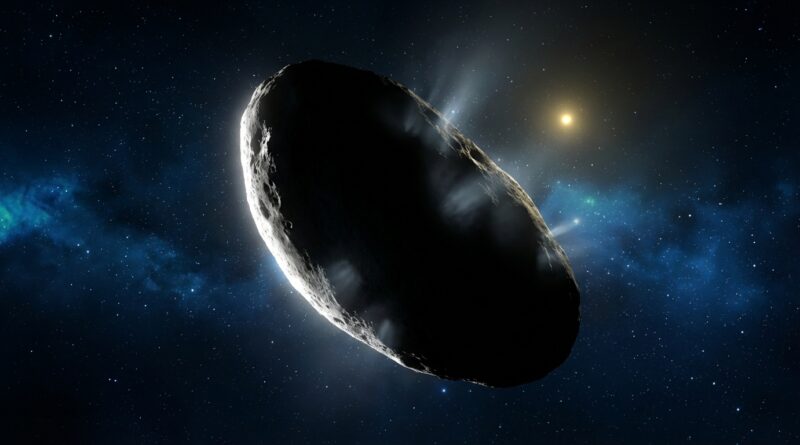
Mystery Object In Deep Space Is Acting Like Our First ‘Alien’ Visitor All Over Again
If you are tired of every strange thing in space getting labeled either “definitely aliens” or “nothing to see here,” you are not alone. That whiplash is back. Astronomers are tracking a mysterious interstellar object with unexplained behavior, and it is stirring up the same uneasy feeling many people had with ‘Oumuamua in 2017. The object appears to come from outside our solar system, but what has researchers paying close attention is how its brightness changes and how its motion does not sit neatly inside the simplest models. That does not mean spacecraft. It also does not mean a boring answer is guaranteed. It means the data is messy, the object is odd, and scientists are doing what good scientists do when nature refuses to cooperate. They keep watching, checking, arguing, and refining their ideas. For the rest of us, this is a rare chance to watch a real scientific mystery unfold in almost real time.
⚡ In a Hurry? Key Takeaways
- This object appears to be interstellar, and its changing brightness and motion are unusual enough that astronomers cannot fully explain them yet.
- If you want to follow the story sensibly, watch for repeat observations, peer-reviewed updates, and whether multiple telescopes confirm the same odd behavior.
- “Unexplained” is not the same as “alien.” The value here is seeing how science handles a real mystery without hype or hand-waving.
Why this has people on edge again
‘Oumuamua left a mark on public imagination because it did two things at once. It looked like a natural object, but it also behaved in ways that were hard to pin down. That opened the door to every possible theory, from odd comet fragments to artificial probes.
This new case feels familiar. The mysterious interstellar object with unexplained behavior is not just passing quietly through. Its light output appears to vary in a way that suggests an unusual shape, spin, surface, or all three. On top of that, some observers say its speed or acceleration does not fit the most comfortable models.
That is exactly the kind of detail that makes scientists sit up straight. Not because it proves anything dramatic, but because space usually rewards patience, and this object is refusing to be simple.
What “interstellar” actually means
In plain English, an interstellar object is something that did not form around our Sun. It is passing through from the wider galaxy. Think of it as cosmic driftwood from another star system.
Astronomers usually identify this by studying its trajectory. If the path is too fast or too steep to have originated inside our own solar system, that is a big clue it came from outside. ‘Oumuamua was the first confirmed example. Then came comet 2I/Borisov, which looked more comfortably comet-like. This new visitor seems to land somewhere in the uncomfortable middle, where the labels are less helpful.
What is strange about this object
Its brightness keeps changing
When an object gets brighter and dimmer, astronomers often read that as a clue about shape and rotation. A potato-shaped rock, for example, reflects light differently as it tumbles. But sometimes the swings are too extreme or too irregular for that easy answer.
If brightness changes do not match a stable spin model, researchers start asking harder questions. Is gas venting off the surface? Is dust being released? Is the object made of layers with very different reflectivity? Could it be breaking apart very slowly?
Its motion may not be fully explained by gravity alone
This is the part people latch onto. If an object seems to speed up or drift more than gravity predicts, astronomers look for non-gravitational forces. The classic natural explanation is outgassing. Warm the surface, release gas, get a tiny push. Comets do this all the time.
The trouble starts when there is little or no obvious comet tail, or when the measured push does not match the kind of gas release scientists expect. That does not make the object artificial. It just means the natural explanation needs more work.
It may not fit neat categories
We like our space objects in tidy boxes. Asteroid. Comet. Ice-rich body. Rocky fragment. But nature is under no obligation to sort itself for us. Some objects may be battered leftovers from violent planetary systems, with strange surfaces and mixed compositions that make them behave in unfamiliar ways.
Why this is not “aliens,” but also not boring
There is a habit online to treat every mystery as a final exam with only two possible answers. Either it is extraterrestrial technology, or scientists are hiding a plain answer. Real life is much less cinematic and much more interesting.
The honest answer right now is this. We do not know enough yet. The most likely explanations are still natural ones. But “natural” covers a lot of ground. It can mean an exotic shard from another planetary system, a volatile-rich body with unusual chemistry, or a shape and spin state we do not often see nearby.
That uncertainty is the story. A mysterious interstellar object with unexplained behavior matters because it tests the limits of our models. It shows where astronomy is strong, and where it still has blind spots.
What astronomers are doing right now
Watching it with multiple telescopes
No single telescope tells the full story. Different observatories can track motion, measure brightness, split light into spectra, and look for faint signs of gas or dust. The more teams checking the same target, the better.
Comparing fresh data to old cases
‘Oumuamua is the obvious comparison, but researchers will also compare this object to comets, dark asteroids, and icy bodies from the outer solar system. The goal is not to force a match. It is to see where this object breaks the pattern.
Trying competing models
This is where the dry papers come in, but it is worth translating. One team may test whether tumbling motion explains the light curve. Another may test whether faint outgassing can explain the acceleration. Another may ask if the surface has unusual thermal properties, meaning sunlight heats and pushes it in ways that are easy to underestimate.
Science often looks messy from the outside because it is supposed to be messy in the middle.
What changed after ‘Oumuamua
The 2017 debate taught astronomers two useful lessons. First, they need faster follow-up when a rare visitor appears. Second, the public can handle uncertainty better than many gatekeepers assume, as long as someone explains it clearly.
That matters here. More sky surveys are now scanning for transient objects, and better software is helping researchers flag unusual paths earlier. So even if this visitor remains frustrating, the overall system for catching the next one is improving.
In other words, this is not just about one object. It is about how prepared we are for the next weird thing the galaxy throws at us.
How to read the headlines without getting fooled
If you want to stay informed without getting yanked around by social media, a few simple rules help.
Watch the verbs
“May,” “suggests,” “could,” and “appears” are not signs of weakness. They are signs that someone is being careful. Be more suspicious of headlines that sound absolutely certain before the data is settled.
Check whether the observation has been repeated
A one-off brightness dip can be noise. A weird speed estimate can come from limited data. Repeated measurements from different teams are where the story gets solid.
Separate anomaly from explanation
An object can be genuinely odd without any one explanation being proven. That is a key distinction. “This is strange” is a data statement. “This is what it is” comes later.
What the most likely explanations look like right now
Based on how these cases usually go, the front-running ideas are still natural.
Unusual outgassing
The object may be releasing gas in a way that is faint, directional, or made of materials that are hard to detect. That could slightly change its motion without producing the kind of dramatic tail people expect.
An extreme shape or chaotic tumble
If the object is long, flat, jagged, or tumbling irregularly, its brightness pattern can look bizarre from Earth. Sometimes geometry really is the culprit.
Odd surface physics
Sunlight does more than illuminate. It heats surfaces. A dark, crusty, or highly reflective surface can change how energy is absorbed and re-radiated, which can create tiny but real forces over time.
None of these are flashy. All of them are interesting.
Why regular people should care
You do not need a PhD to care about a mystery like this. These objects are samples from other star systems delivered to our cosmic doorstep. We cannot yet send probes to distant planetary neighborhoods, but sometimes bits of those neighborhoods come to us.
That means each interstellar visitor is a clue about how planets form elsewhere, what debris gets thrown out, and how different other systems might be from our own. A strange object is not just a curiosity. It is free evidence from another star.
At a Glance: Comparison
| Feature/Aspect | Details | Verdict |
|---|---|---|
| Origin | Its trajectory suggests it likely came from outside our solar system. | Strong reason for scientific interest. |
| Brightness changes | The object appears to brighten and dim in ways that may point to an unusual shape, spin, or surface. | Clearly unusual, but not unprecedented. |
| Speed and motion | Some measurements suggest behavior not fully explained by simple gravity-only models. | Needs more data before any strong claim. |
Conclusion
The smart way to look at this story is to stay curious and stay grounded. Right now the conversation around unexplained objects in space is split between breathless alien headlines and dry technical papers that never leave academia. The useful middle ground is to follow the evidence as it develops. This mysterious interstellar object with unexplained behavior may turn out to have a perfectly natural explanation, but that does not make it dull. It makes it a live test of how well we understand the universe. If you keep an eye on confirmed observations instead of viral guesses, you will be better informed than most of the internet, and ready to talk about this strange visitor with both wonder and common sense.