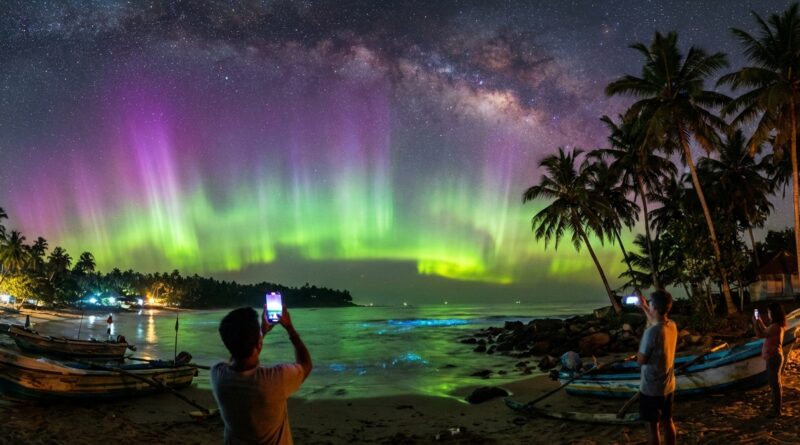
How to Decode the Mystery of Earth’s New ‘Impossible’ aurora spotted where no lights should exist
You are not imagining the confusion. One morning the internet is full of photos showing an aurora far closer to the equator than most people thought possible, and by lunchtime the headlines have already jumped to “impossible,” “mysterious,” and “scientists baffled.” That is frustrating if you just want a straight answer. The good news is that an unexplained low latitude aurora anomaly does not automatically mean the laws of physics broke overnight. It usually means we are watching messy, real science happen in public. Data comes in pieces. Experts disagree at first. Social media fills the gaps with guesses. The useful question is not “is this fake or alien?” It is “what are the most likely natural explanations, what evidence would confirm them, and what should regular people pay attention to if these events become more common?” Once you frame it that way, the mystery gets a lot easier to decode.
⚡ In a Hurry? Key Takeaways
- The most likely answer is not an “impossible” aurora, but a rare low-latitude auroral event, airglow, or a newly recognized aurora-like phenomenon captured under unusual space weather conditions.
- Before sharing dramatic claims, check the location, time, solar storm reports, photo exposure settings, and whether space weather centers logged geomagnetic activity that night.
- Even weird lights can matter in practical ways, because strong geomagnetic events can affect satellites, GPS, radio systems, and power grids long before they become a safety issue on the ground.
Why this feels so strange
Most of us grow up with a simple rule. Auroras belong near the poles. If bright ribbons suddenly show up much farther south or north than expected, it feels wrong.
That instinct is fair. Auroras are usually tied to charged particles from the Sun getting funneled by Earth’s magnetic field toward high latitudes. So when something glows in the “wrong” part of the sky, there are only a few broad possibilities.
Possibility 1: It really is an aurora, just an unusually low-latitude one
This can happen during strong geomagnetic storms. When the Sun throws a big burst of plasma and magnetic energy at Earth, the auroral oval can expand. That pushes visible auroras farther from the poles than normal.
It is rare. It is dramatic. It is not impossible.
Possibility 2: It is not a classic aurora at all
Some sky glows look aurora-like but come from different processes. A famous example is STEVE, a narrow purple-white arc linked to fast flows of charged particles and heating in the upper atmosphere. There is also ordinary airglow, which is a faint natural glow from chemical reactions high in the atmosphere. Cameras, especially phones in night mode, can make these effects look much brighter and stranger than they appeared to the naked eye.
Possibility 3: The pictures are real, but the label is wrong
This is common online. A real sky photo gets posted with the wrong date, wrong place, or wrong explanation. Suddenly a normal event becomes an “anomaly.” That does not mean people are lying. It often means the internet moves faster than verification.
What scientists actually mean when they sound uncertain
Headlines love the phrase “scientists are confused.” In practice, that usually means something much less dramatic.
It means scientists are sorting through competing explanations. They may be asking:
- Was there a geomagnetic storm at the same time?
- Did satellites measure unusual particle activity?
- Were the colors and shapes consistent with known auroras?
- Did the glow appear where cameras were pointed, or somewhere else entirely?
- Was the image enhanced by long exposure, night mode, or post-processing?
That is normal science. First comes observation. Then argument. Then better data. Then a clearer answer.
How to decode an unexplained low latitude aurora anomaly without getting fooled
Check the space weather first
If there was a recent solar flare, coronal mass ejection, or strong geomagnetic storm, low-latitude auroras move from “wild claim” to “plausible event.” Look for reports from NOAA’s Space Weather Prediction Center, NASA updates, or observatory notices.
If there was no meaningful space weather activity, then the glow may be something else.
Look at the color and shape
Classic auroras often show green, red, or purple curtains, arcs, and moving structures. STEVE tends to appear as a more narrow band, often purple or mauve, sometimes with green “picket fence” features. Airglow is usually broader and more diffuse.
This is not foolproof, but it helps.
Ask whether the photo was stronger than the human-eye view
Modern phones are little miracle machines. They stack exposures, brighten shadows, and pull color out of near darkness. A sky that looked like a faint haze to the eye can look like a neon river in the final image.
That does not make the photo fake. It just means the image may be showing more than a person standing there would have noticed in real time.
Check whether multiple observers saw it
One viral image proves very little. Ten observers across a wide area, with matching timestamps and directions, is much stronger evidence. Bonus points if all-sky cameras, weather cameras, or amateur astronomy networks caught it too.
Separate “unusual” from “unknown”
This is the big one. Nature does unusual things all the time. “I have not seen this before” is not the same as “nobody can explain this.” A low-latitude display can be rare and still fit within known atmospheric and geomagnetic physics.
So was it really impossible?
No, “impossible” is almost certainly the wrong word.
What is more likely is one of these:
- A strong geomagnetic event expanded auroral visibility farther toward the equator than usual.
- A less familiar phenomenon, such as STEVE or a related subauroral glow, was mistaken for a classic aurora.
- The event was real, but the online retelling exaggerated how far out of place it was.
The interesting part is not that physics failed. The interesting part is that our sky-monitoring tools, phone cameras, satellites, and citizen observers now catch edge-case events much more often than they used to. That makes the world feel weirder, even when the cause is natural.
Why regular readers should care beyond the pretty photos
This is not just skywatcher trivia.
If a low-latitude auroral event is tied to strong geomagnetic activity, it can be a visible clue that Earth’s magnetic environment is under stress. That matters because the same space weather can affect:
- Satellites and onboard electronics
- GPS accuracy
- Radio communication
- Airline route planning near the poles
- Power-grid stability in severe cases
So yes, the sky is beautiful. But it is also a dashboard light.
A simple reality-check toolkit for the next viral sky event
Use this checklist anytime social media erupts over strange lights:
1. Find the time and place
No location, no timestamp, no trust. If those basics are missing, be cautious.
2. Check official space weather sources
Look for geomagnetic storm scales, aurora forecasts, and solar event reports from reliable agencies.
3. Compare multiple photos
If every image looks wildly different, editing may be driving the story more than the sky itself.
4. Read past the headline
Sometimes the body of the report is far more careful than the title. “Impossible” often turns into “uncommon but under study” by paragraph three.
5. Watch for expert wording
Phrases like “consistent with,” “preliminary,” and “requires more data” are signs that people are being honest, not evasive.
6. Keep your wonder, but keep your standards too
You do not have to choose between curiosity and skepticism. The smartest readers use both.
At a Glance: Comparison
| Feature/Aspect | Details | Verdict |
|---|---|---|
| Classic low-latitude aurora | Usually linked to strong geomagnetic storms that expand auroral visibility farther from the poles than normal. | Rare, but fully plausible. |
| Aurora-like phenomenon such as STEVE or airglow | Can look bizarre in photos, especially with long exposure or phone night mode, and may be mislabeled as a standard aurora. | Very possible and often underreported. |
| Truly “impossible” unknown event | Would require strong evidence that known atmospheric, optical, and geomagnetic explanations do not fit the data. | Least likely. Needs much better proof. |
Conclusion
A sudden glow in the wrong part of the sky is exactly the kind of thing that makes people swing between awe and panic. That is understandable. But this is also a great example of how frontier science really works in public. We see the photos first, then the questions, then the arguments, then the better explanations. For readers, that is useful. It gives you a grounded way to think about geomagnetic anomalies, satellite and power-grid vulnerability, and the difference between “weird but natural” and something truly unexplained. The next time social media lights up over a strange sky, you will not need to pick between blind belief and eye-rolling dismissal. You can ask better questions, look for better evidence, and stay curious without getting carried away. That is how you build a smarter high-strangeness community, and a calmer one too.