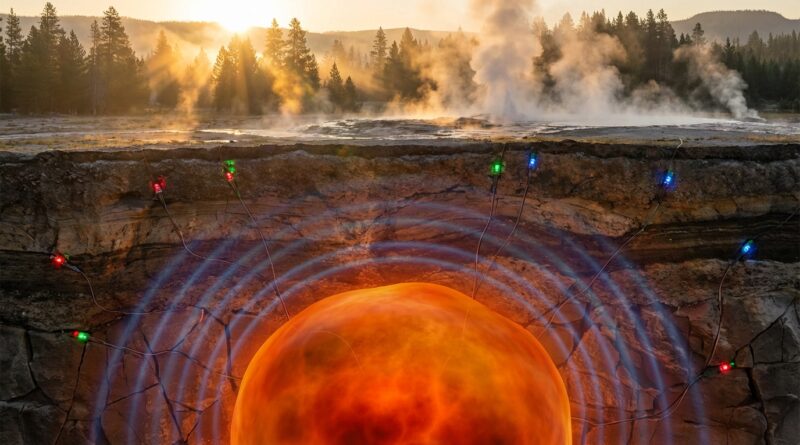
The Yellowstone ‘Heartbeat’: Mysterious Deep Pulse Beneath America’s Supervolcano Baffles Scientists
If you feel whiplash every time Yellowstone shows up in the news, you are not alone. One week it is framed like the end of the world. The next, you are told nothing interesting is happening at all. That is why this new finding matters. Researchers have picked up a strange deep “heartbeat” under Yellowstone, a rhythmic pulse in the magma system that does not neatly fit either story. It is not proof that an eruption is around the corner. It is also not something scientists can just shrug off as background noise. Right now, the honest answer is more interesting and more uncomfortable. Yellowstone appears to be doing something real, measurable, and still unexplained. For anyone tired of recycled supervolcano panic, that is actually good news. We finally have a mystery built on data, not hype, and it gives us a better way to watch what this restless place is doing in real time.
⚡ In a Hurry? Key Takeaways
- The Yellowstone mysterious deep pulse anomaly 2026 looks like a real rhythmic signal deep in the volcanic system, but scientists do not yet know the exact cause.
- If you follow Yellowstone news, stick to seismic, ground deformation, and gas data from scientific monitoring instead of doomsday social posts.
- This is a science story, not a public danger alert. The pulse is worth watching, but it is not the same thing as an eruption warning.
What scientists think they found
The new study points to a repeating deep signal below Yellowstone’s better-known upper features. Think of it less like a movie-style magma chamber “waking up” and more like a slow, periodic throb picked up by instruments that listen for motion underground.
That matters because Yellowstone is not a giant underground tank of glowing liquid rock waiting to pop. It is a layered, messy system of hot rock, partially molten material, fluids, faults, and pressure changes. A rhythmic pulse suggests something in that system may be moving, flexing, or transmitting energy on a schedule.
The schedule is the weird part. Nature often has rhythms, but when one shows up deep under a supervolcano, scientists want to know what is setting the beat.
Why this does not fit the usual Yellowstone script
Most Yellowstone coverage falls into two lazy buckets.
Bucket one says everything is a sign of doom. Bucket two says Yellowstone is stable, monitored, and basically dull.
This pulse sits right in the middle. It seems to be real enough to study, but not dramatic enough to wave as proof of imminent disaster. That makes it harder to package, which is exactly why it is worth paying attention to.
Science is often like that. The most important findings are not always the loudest ones. Sometimes they are the things that do not make sense yet.
What could be causing the pulse?
At this stage, there are a few plausible ideas, and none of them has fully won.
1. Deep magma movement
One option is that molten or partially molten material deeper in the system is shifting in a periodic way. That does not automatically mean rising magma headed for the surface. It could simply mean the deeper plumbing is more active and dynamic than older models suggested.
2. Tectonic forcing
This is one of the more interesting possibilities. Yellowstone sits in a region shaped by both volcanism and broader crustal stresses. The pulse may be linked to tectonic forces squeezing, stretching, or flexing rock in ways that ripple into the volcanic system.
3. Fluids under pressure
Hot water, gases, and superheated fluids can move through cracks and porous rock. In volcanic systems, those fluids matter a lot. A repeating pressure cycle in deep fluids could create a signal that looks heartbeat-like without requiring fresh magma to be surging upward.
4. A mix of causes
This is often the least exciting answer and the most realistic one. Yellowstone is a complicated natural machine. The pulse may come from several things happening together, not one neat cause.
What the data can tell us, and what it cannot
Here is the part that often gets lost online. Instruments can show that a pattern exists before scientists can explain it. That is not weakness. That is how careful science works.
Researchers use seismic readings, GPS ground movement, satellite measurements, and sometimes gas and heat data to piece together what is happening underground. If multiple tools point toward the same repeating pattern, confidence grows that the signal is real.
But a real signal is not the same as a solved signal.
That gap is where a lot of bad headlines rush in. “Unexplained” does not mean “catastrophic.” It means unexplained.
So, should anyone be worried right now?
In practical terms, no. There is a big difference between “scientists found something odd” and “the hazard level has changed.” Yellowstone is one of the most heavily monitored volcanic regions on Earth. If this pulse were paired with sharp jumps in earthquake swarms, rapid uplift, major gas changes, or other red flags, that would change the conversation.
So far, the value here is not panic. It is insight.
This kind of anomaly gives researchers a chance to test models against fresh evidence. It may even help improve future forecasting by showing how deep Yellowstone’s plumbing behaves before any surface changes happen.
Why the “heartbeat” label is helpful, and a little risky
Calling it a heartbeat makes the idea easy to picture. You instantly understand that scientists mean a recurring pulse, not a one-off blip.
But labels can also mislead. Yellowstone is not literally alive, and the signal does not mean the volcano has entered some dramatic new phase. It is a metaphor for a repeating pattern in geophysical data.
That said, it is a good reminder that Earth is not static under our feet. Even famous places we think we know can still surprise us.
What this means for the Anomal community
This is exactly the kind of story people in the Anomal space tend to crave and rarely get. Not another recycled apocalypse thumbnail. Not another sterile “nothing to see here” update. A genuine puzzle.
The yellowstone mysterious deep pulse anomaly 2026 gives you permission to stay curious without falling for nonsense. You can take the weird seriously and still stay grounded in measurements, maps, and instrument data.
That balance matters. It keeps the wonder. It cuts the noise.
How to follow this story without getting fooled
If you want to track where this goes next, watch for three things.
Look for independent confirmation
If other teams, other instruments, or later datasets see the same pulse, confidence rises fast.
Watch for correlated changes
Does the pulse line up with earthquake patterns, ground uplift, hydrothermal shifts, or gas output? That is how a strange signal starts becoming a useful clue.
Ignore all-or-nothing headlines
If a headline says this proves Yellowstone will erupt soon, skip it. If another says it is meaningless because no eruption is underway, skip that too. Both are oversimplifying a complicated system.
At a Glance: Comparison
| Feature/Aspect | Details | Verdict |
|---|---|---|
| What was detected | A repeating deep pulse or rhythmic signal beneath Yellowstone’s volcanic system | Interesting and likely real, but still under study |
| Likely meaning | Could reflect magma motion, tectonic stress, fluid cycling, or a mix of all three | No single explanation yet |
| Risk to the public now | No clear sign this pulse alone points to an imminent eruption or emergency | Watch closely, do not panic |
Conclusion
Yellowstone’s newly reported deep pulse is compelling because it gives us something rare. A live scientific mystery with real data behind it. Not a tired doomsday rerun, and not a hand-wave saying everything is boring. For the Anomal community, that is the sweet spot. We get to watch a strange, possibly tectonics-driven signal unfold in public, one reading at a time, while keeping both feet on the ground. If future instruments confirm the pattern and tie it to deeper changes, this could become an important clue about how supervolcanic systems actually behave. Until then, the best response is simple. Stay curious, stay skeptical, and enjoy the fact that Earth still has secrets left to show us.