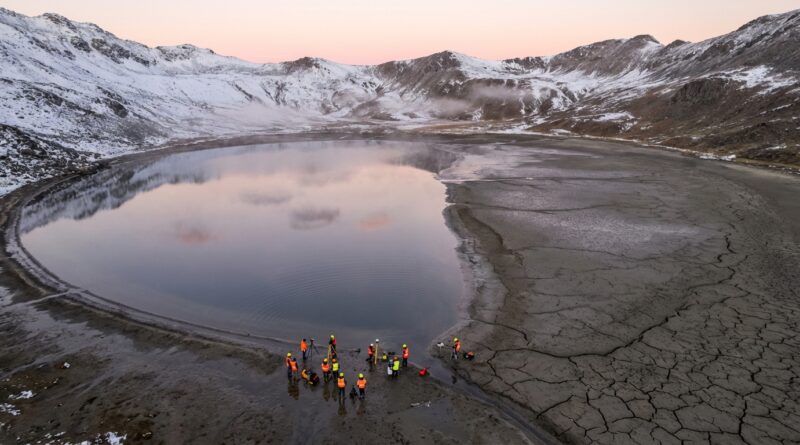
The Vanishing Lake That Reappeared Overnight: Scientists Baffled By A ‘Living’ Body Of Water
You know the feeling. Another day, another headline about strange lights, secret hearings, and something odd far above our heads. Fun, sure. But it can start to feel slippery, like there is nothing solid to grab onto. That is why this story hits differently. A real lake, on a real map, appears to vanish and then return overnight, and the people studying it are not shrugging it off as rumor. They have measurements, eyewitness accounts, water-level records, soil clues, and still no clean answer. That makes this a rare kind of mystery. It is close to home, grounded in actual field science, and weird enough to keep even cautious experts up at night. If you have been wanting a mysterious vanishing reappearing lake unexplained phenomenon that does not depend on blurry footage or space speculation, this is the kind of case worth your time.
⚡ In a Hurry? Key Takeaways
- The lake’s disappearance and rapid return appear to be real, documented events, not just local folklore or social media exaggeration.
- Start with the simplest explanations first, like underground drainage, pressure changes, sinkholes, or blocked inflow, then test each one against what was actually measured.
- This is fascinating, but also a reminder that unstable ground, sudden flooding, and hidden subsurface channels can make these sites risky to visit casually.
Why this case stands out
Most strange stories lose steam the moment you ask for evidence. This one gets stronger.
Reports from the last 24 hours point to a lake that dropped or disappeared so fast that locals were stunned, only to refill again on a timeline that does not sit neatly with normal evaporation, standard runoff, or routine seasonal change. Scientists looking at the event are not saying “magic.” They are saying something much more interesting. The known explanations do not fully fit the timing.
That is what makes this worth reading. A mysterious vanishing reappearing lake unexplained phenomenon is one thing. A documented one is another.
What scientists have actually measured
Water level changes
The first thing hydrologists look for is boring but important. How fast did the water move, and over what area?
If a lake vanishes slowly over days or weeks, the answer is often straightforward. Drought. Irrigation use. Heat. A damaged barrier. But when the change happens overnight, the math gets harder. Water has to go somewhere. Either it drains below ground, escapes through a hidden channel, spreads across land, or the original observation was incomplete.
That means scientists are checking gauge readings, shoreline marks, exposed sediment bands, and time-stamped photos. Even simple details matter, like whether fish were stranded, whether mud stayed wet, and whether nearby springs changed flow at the same time.
Ground and rock clues
Geologists tend to ask a different question. What sits under the lake?
If the basin lies over limestone, lava tubes, fractured bedrock, or old sinkhole terrain, a sudden drain is easier to imagine. Water can slip into underground voids fast if a plug gives way. The problem is the return. Refilling overnight suggests either a powerful unseen source, a temporary blockage, pressure from connected groundwater, or a very unusual link to another water body.
That is where the case gets sticky. A good explanation has to account for both halves of the event, not just the disappearance.
Local observations
Locals are often the first sensors in a story like this. They notice sounds, smells, ground vibration, dead fish, cloudy water, bubbling, or changes in nearby streams.
Those details can sound small, but they help rule things in or out. Bubbling may hint at gas release or pressure changes. Fresh sediment can point to collapse. A nearby creek suddenly slowing down or speeding up may suggest the lake is connected to a hidden channel.
The leading explanations, and where they fall short
1. A sinkhole or underground drain opened
This is the most obvious theory. In karst landscapes especially, lakes can drain into subterranean passages when sediment plugs break.
Why it fits: It explains a rapid drop.
Why it may not fit fully: It does not easily explain a rapid return unless the underground system backed up, rerouted, or re-pressurized quickly.
2. A blocked inflow or outlet shifted suddenly
Natural debris jams, beaver activity, landslip, or sediment movement can change how water enters or leaves a basin.
Why it fits: It can cause abrupt changes without anything supernatural.
Why it may not fit fully: Scientists would expect visible signs nearby, and the timing of the refill still has to match available water volume.
3. Groundwater pressure pulsed through a hidden connection
This is one of the more intriguing ideas. Some lakes are tied to aquifers in ways that are poorly mapped. Pressure changes can move water fast through fractures and underground cavities.
Why it fits: It can explain both disappearance and return better than a simple sinkhole story.
Why it may not fit fully: It still needs strong supporting data, like pressure records, dye tracing, or linked changes in nearby wells and springs.
4. Misread observations or exaggerated timing
This is always worth considering. Sometimes “overnight” really means “sometime since yesterday morning,” and that difference matters.
Why it fits: Human memory is imperfect, and viral stories often compress timelines.
Why it may not fit fully: If multiple measurements, photos, and local reports line up, this explanation gets weaker fast.
How to think about it like an investigator
You do not need a geology degree to sort good theories from flimsy ones. Use a simple checklist.
Ask where the water went
Any serious explanation must account for volume. If a large basin emptied quickly, the missing water should leave signs somewhere, below ground, downstream, or across nearby land.
Ask how it came back
This is the question many easy theories dodge. Refilling is not just the reverse of draining. It needs a source, a path, and enough speed to match the reports.
Ask what changed nearby
Did wells rise or fall? Did springs cloud up? Did animals behave differently? Did stream flow change? A lake is rarely isolated from the rest of its landscape.
Ask what evidence is time-stamped
Videos, weather records, gauge data, satellite snapshots, and sensor logs are more useful than dramatic retellings after the fact.
Why this is more than just a weird headline
Cases like this are a good reset for anyone burned out on endless sky mysteries. Here, the puzzle sits in dirt, stone, and water. You can test ideas. You can compare timelines. You can ask experts better questions.
That is also why communities built around strange events can be useful when they stay grounded. The best conversations are not just “wow, spooky.” They are “does this theory explain both the drain and the refill?”
And if you are lucky enough to follow updates in near real time, you get something rare. A living mystery, with new data still coming in.
What to watch next
If scientists release more findings, these are the details that matter most:
- Whether dye tests show the lake connects to springs, caves, or nearby streams.
- Whether seismic or ground-penetrating surveys found fresh collapse zones under the basin.
- Whether rainfall records can be ruled out as too small to explain the refill.
- Whether nearby wells or aquifer monitors changed at the same time.
- Whether satellite or drone images confirm the before-and-after timeline.
If you ever visit a site like this, keep your distance from fresh banks and exposed mud flats. Sudden water loss can leave unstable ground. Sudden return can be worse.
At a Glance: Comparison
| Feature/Aspect | Details | Verdict |
|---|---|---|
| Disappearance | Reported as rapid enough to shock locals and trigger scientific review of drainage and subsurface causes. | Likely real, but the exact timing still matters. |
| Reappearance | The refill is the harder part to explain and puts pressure on simple sinkhole theories. | Still genuinely unexplained. |
| Best current explanation | A hidden groundwater connection or temporary underground drainage path is the leading natural idea. | Plausible, but not proven. |
Conclusion
This is exactly the kind of case that keeps curiosity healthy. It is weird, but not untouchable. Strange, but measurable. Today’s pick gives the community something rare: a fresh Earth-bound anomaly that is both rigorously documented and still unexplained, offering a break from purely cosmic puzzles while keeping the scientific stakes high. By unpacking what hydrologists, geologists and locals have actually measured in the last 24 hours, the story lets readers think like investigators, spot weak explanations, and build better ones together in the comments. That is how Anomal stays useful. Not by chasing every flashy claim, but by taking real-world high strangeness seriously when the evidence says it deserves a closer look.