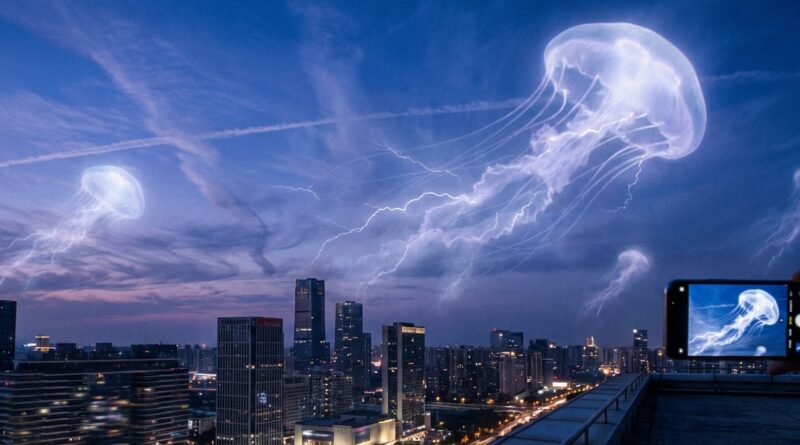
The Sky ‘Creatures’ You Never See: Inside The Growing Mystery Of Invisible Atmospheric Life
You are not imagining the frustration here. People keep filming strange, jellyfish-like shapes in the sky, then getting told it must be a bug, a smudge, a balloon, or bad compression. Sometimes that is true. But not always in a neat, satisfying way. A growing pile of clips shows forms that seem to pulse, stretch, drift, or even react to air currents in ways that do not fit the usual list of explanations. That has pushed some people toward a stranger question. What if a few of these sightings are not machines at all, but something closer to invisible sky creatures, atmospheric plasma life, or another unexplained phenomenon we do not have a clean label for yet? Before we jump to aliens or laugh it off, it helps to slow down, sort the camera tricks from the genuinely odd cases, and ask a more grounded question. What can our eyes and phones actually see up there, and what might they be missing?
⚡ In a Hurry? Key Takeaways
- Most “sky creature” clips can be explained by focus issues, insects, balloons, fabric, birds, or compression, but a small number stay genuinely hard to classify.
- If you catch one on camera, record the exact time, location, weather, direction, and keep the original file. That matters more than zooming in.
- There is no proof yet of invisible atmospheric life, but some ideas, including plasma-based behavior in the upper atmosphere, are worth testing rather than mocking.
Why this idea keeps coming back
If you spend any time in UAP forums, skycam feeds, or local Facebook groups, you see the same pattern. Someone posts a clip of a translucent shape above the clouds. It looks alive for a second. The comments split instantly.
One side says bug on the lens. The other says living entity in the atmosphere. Both can be too quick.
The truth is more annoying and more interesting. Cameras are bad at showing scale, distance, and depth in the sky. At the same time, the atmosphere is full of poorly understood electrical, optical, and fluid effects. That means two things can be true at once. Many clips are mistakes. A few may be showing something we do not yet understand very well.
What people are actually seeing
The “sky jellyfish” pattern
The reports tend to sound surprisingly similar. Witnesses describe a semi-clear form with tendrils, a pulsing center, or a drifting body that seems too structured to be a cloud and too soft-edged to be a craft. In video, these forms often appear to ripple or rotate slowly.
Some are bright and reflective. Others are dark against cloud cover. A few seem to vanish when the camera angle changes, which is one reason the phrase “invisible sky creatures” keeps showing up in search traffic.
Why phones make this harder
Your phone is doing a lot of guessing. It sharpens edges, smooths noise, adjusts exposure, and compresses detail. That is great for holiday photos. It is terrible for proving what a tiny object in the sky really is.
A spider web strand close to the lens can look enormous. A bug crossing near the camera can appear like a giant translucent organism at a distance. Digital zoom can turn a blurry blob into something that looks weirdly biological.
The ordinary explanations that solve a lot of cases
Let’s be fair to the skeptical side. There are several repeat offenders.
1. Insects and spiders near the camera
This is the big one, especially with security cams and outdoor doorbells. A close insect can become a glowing, jelly-like shape because the lens is focused on the background, not the bug. Add infrared light at night and the result can look downright alien.
2. Balloons, plastic, and drifting debris
Mylar balloons, shredded plastic sheeting, and loose insulation can twist into very strange forms in upper winds. They can seem to pulse or “swim” because they are rotating and catching sunlight unevenly.
3. Birds, seed clusters, and spider silk
Flocks and debris can merge into one shape on low-quality footage. So can airborne silk from mass spider ballooning events. Nature can look bizarre when viewed at the wrong distance.
4. Compression artifacts and autofocus hunting
When a camera struggles to lock focus, edges smear and reform. A plain object can appear to grow tentacles or shimmer as the software tries to make sense of low detail.
Why a few cases still bother people
Even after you strip out the easy explanations, some footage remains awkward. Not proven. Not magical. Just awkward.
These are the clips where the object appears at significant altitude, is tracked over time, is seen by more than one witness, or is captured by more than one camera. A handful seem to interact with cloud layers or electrical weather in ways that do not fit a party balloon or nearby insect.
That does not mean “living sky animal” wins by default. It means the case deserves better notes, better imaging, and less chest-thumping from both camps.
The strange science people point to
Could plasma act in life-like ways?
This is where the idea gets interesting without needing to get silly. Plasma is an ionized gas. It shows up in lightning, auroras, the sun, and some upper-atmosphere events. Under certain conditions, plasma can self-organize into filaments, glowing knots, and moving structures. That does not make it alive. But it can look weirdly life-like.
Some researchers and fringe theorists have asked whether long-lived plasma structures in the atmosphere could mimic a few traits we associate with living systems, such as maintaining form briefly, reacting to fields, or exchanging energy with their environment.
That is not mainstream proof of atmospheric organisms. It is a serious question about whether our old categories, machine, weather, life, might be too rigid for some rare phenomena.
The “plasmoid” angle
There are already real things in nature that blur lines. Ball lightning is one example. It is reported often, documented unevenly, and still not fully pinned down. If rare electrical structures can persist longer than expected, then it is not crazy to ask whether some unexplained sky forms are electrical rather than mechanical.
The leap from “electrical structure” to “plasma life” is huge, though. We should be honest about that. Fascinating does not equal proven.
What cameras can and cannot tell you
What a clip can do well
A good video can show motion pattern, duration, brightness changes, relation to clouds, and whether the object appears affected by wind. It can also help rule out some obvious local causes.
What a clip usually cannot do
A single clip usually cannot tell you true size, exact distance, material, or whether the object is near the lens or miles away. That is the trap. A lot of arguments online are really just people fighting over missing depth information.
If you want a useful case file, the original footage matters. So does metadata. So do witness notes taken right away, before memory starts editing the event.
How to document a sighting without fooling yourself
If you think you have filmed an unexplained phenomenon, do these simple things.
Keep the original file
Do not upload only a compressed social clip. Save the raw video first.
Record the basics immediately
Write down the time, date, location, weather, wind, cloud cover, direction you were facing, and how long you watched it.
Film wider before zooming
Start with a wide shot that includes buildings, trees, or the horizon. That gives scale and helps others reconstruct the scene.
Try for a second angle
If someone else is with you, have them record too. Two phones from two positions can answer a lot of questions later.
Check local flight and weather data
Look for known balloons, aircraft paths, drone activity, launches, and unusual weather conditions. You are not “debunking yourself.” You are doing the groundwork that makes the remaining mystery stronger.
How to think about this without falling into two bad habits
Bad habit one: Everything weird is proof
It is not. The sky is a brutal place for perception. Many dramatic videos collapse under boring but solid explanations.
Bad habit two: Everything weird is stupid
That is not serious skepticism either. If multiple people keep reporting similar jellyfish-like forms, the right move is to compare patterns, not sneer and move on.
The best approach is plain and almost old-fashioned. Treat witnesses with respect. Treat footage as evidence with limits. Treat your own favorite theory as temporary.
So are there really invisible sky creatures?
Right now, there is no accepted proof that invisible sky creatures or atmospheric plasma life exist in the way people imagine. No lab confirmation. No captured specimen. No consensus model.
But there is enough odd material to justify careful attention. The unexplained phenomenon here is not just the object in the sky. It is also how often our tools fail to describe what is happening above us in clean, reliable terms.
That alone is worth your time. Because once you strip away hoaxes and camera mistakes, you are left with a smaller set of cases that may point to unfamiliar atmospheric physics, unusual biological material, rare electrical events, or something else we have not sorted properly yet.
At a Glance: Comparison
| Feature/Aspect | Details | Verdict |
|---|---|---|
| Common explanation | Nearby insects, spider webs, balloons, drifting plastic, autofocus errors, and video compression create many “living sky” effects. | Most cases likely solved here |
| Hard-to-explain cases | Multi-witness sightings, long-duration tracking, altitude clues, or motion that does not fit obvious debris remain open questions. | Interesting, but not proof |
| Plasma life idea | Some plasma structures can self-organize and look life-like, but there is no accepted evidence that they are living organisms. | Serious fringe hypothesis |
Conclusion
What makes this topic stick is that it hits a nerve many readers already feel. They are buried in UAP clips, but short on calm, careful analysis that treats sightings like data instead of content. Looking at possible invisible sky creatures, atmospheric plasma life, and other unexplained phenomenon gives people a better way to compare cases, understand what cameras are really doing, and test unusual ideas without getting swallowed by hype. If you have seen something odd, the useful move is not to declare victory for your side. It is to document it well, share it clearly, and stay open to being wrong for the right reasons. In a moment when everyone is staring at hardware in the sky, asking whether the atmosphere itself might host stranger, softer, almost hidden forms feels fresh, unsettling, and just hopeful enough to keep watching.