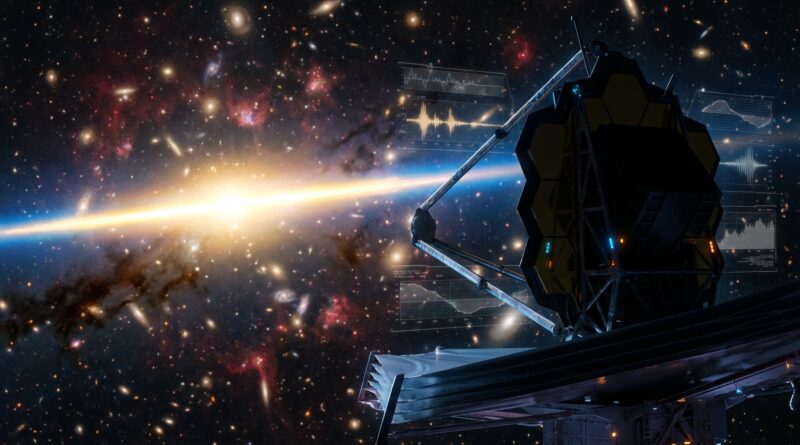
The Seven-Hour Cosmic Flash James Webb Can’t Explain
If you feel like every big “space mystery” gets neatly explained a week later, you are not wrong. A lot of odd signals really do turn out to be space junk, instrument glitches, or familiar objects wearing a strange disguise. That is why this seven-hour cosmic flash has people paying attention. It does not fit the usual boxes. It was bright for far too long to behave like a normal gamma-ray burst, and it does not line up cleanly with a standard supernova either. Even with the James Webb Space Telescope and a pile of follow-up work, astronomers are still arguing about what they actually saw. That makes this one rare. The mysterious James Webb seven hour cosmic explosion is not a solved case dressed up as a teaser. It is a live scientific puzzle. Better yet, it is one you can actually follow in public, through telescope alerts, open data, and fresh preprints as researchers test one idea after another.
⚡ In a Hurry? Key Takeaways
- This event is unusual because it stayed bright for about seven hours, much longer than most known high-energy cosmic bursts.
- If you want to track it yourself, start with the public preprint databases and observatory alerts, then compare how the leading explanations change over time.
- No, this does not mean aliens or the end of physics. It does mean scientists have a real unsolved case that is worth watching closely.
What actually happened?
Astronomers spotted a powerful outburst in space that lit up for roughly seven hours. That duration is a huge part of the mystery. In astronomy terms, a few seconds, minutes, or days can each point to very different causes. Seven hours sits in an awkward middle ground for a bright high-energy event. It is too long for many ordinary gamma-ray bursts, but not an easy fit for the standard playbook of exploding stars either.
James Webb did not necessarily “discover” every part of the event on its own. That is often how these stories get simplified. Usually, multiple telescopes notice different pieces of the same event. One may catch the initial flash. Another may find the afterglow. Webb often comes in as the super-detailed follow-up tool, helping scientists study the host galaxy, the chemistry, and the environment around the event. That deeper look is exactly why Webb matters here. It can show what kind of cosmic neighborhood produced the flash, and whether that neighborhood supports any of the main theories.
Why scientists are stuck
Most cosmic explosions leave fingerprints. A normal gamma-ray burst has a certain timing pattern and energy profile. A supernova has a different brightening and fading curve. A tidal disruption event, where a black hole tears apart a star, also tends to follow a more familiar script.
This one seems to borrow bits from several categories without matching any of them cleanly.
Too long for the usual suspects
Classic long gamma-ray bursts are already called “long,” but they are usually nowhere near seven hours of strong emission. That is the first red flag. If you try to force this event into that category, you quickly run into trouble.
Too odd for a routine supernova
Supernovae can be brilliant, but they generally evolve on longer timescales in visible and infrared light. Their rise and fall, and the spectral clues they leave behind, often point to known kinds of stellar death. Here, the timing and brightness pattern appear off enough that researchers are cautious about using that label.
Maybe not a simple black hole meal either
One idea is that a black hole was feeding, possibly tearing at a star. That sounds dramatic because it is. But even black-hole feeding events usually have recognizable signatures. If this was one, it may have happened under very strange conditions.
The leading explanations, in plain English
This is where the story gets fun. Scientists are not just shrugging. They are putting real models on the table and trying to break them.
1. A star being destroyed in an unusual way
One possibility is some kind of stellar death event that happened inside a thick cocoon of material. Picture a star exploding, but wrapped in dense gas and dust that changes how the light escapes. That could stretch or reshape the signal, making it look weird from Earth.
The appeal of this idea is that stars do explode in messy environments. The problem is whether that mess can reproduce all the details of a seven-hour bright flash without creating other signals we would expect to see.
2. A black hole tearing apart a star
This is called a tidal disruption event. Gravity wins, the star loses. Material from the star spirals inward, heats up, and can produce a bright flare. In some cases, jets of matter blast outward at nearly light speed.
That could explain a dramatic outburst. But again, the timing matters. Researchers have to ask whether the flare rose and faded in a way that makes sense for this process, and whether the host galaxy contains the kind of black hole that fits the event.
3. A magnetar or neutron star doing something extreme
A magnetar is a super-dense dead star with a magnetic field so strong it makes normal magnets look like fridge decorations. Magnetars can produce bursts of high-energy radiation. In theory, a very unusual magnetar-related event could create something strange and bright.
The challenge is scale. Can such an object stay that bright for that long and still match the observations? That is an active debate.
4. Something more exotic
This is the category people jump to first, but scientists usually save for last. Could it point to a rare kind of black hole physics, a failed star collapse, or some process we have not properly modeled yet? Possibly. But “exotic” is not a free pass. It still has to explain the data better than the boring options.
Where James Webb changes the story
Webb is not just there to take pretty pictures. It is useful because it can study faint infrared light with incredible sensitivity. That matters when you are trying to figure out the cosmic address of an event.
Webb can help answer questions like these:
- What kind of galaxy did the flash come from?
- Was it in a star-forming region packed with young massive stars?
- Was it near the center of a galaxy, where a large black hole might live?
- Is there dust hiding part of the story?
Those details can knock out bad theories fast. If the event came from a place with intense star formation, one class of explanation gets stronger. If it came from a quiet galactic core, another class starts looking better.
Why this mystery feels different from the usual hype cycle
A lot of viral space stories are basically solved before they hit your feed. The headline says “astronomers baffled,” but the paper itself says “we are 90 percent sure this is a known thing.” That is not what is happening here.
Here, the uncertainty is real. Researchers are still comparing models, testing follow-up observations, and arguing in preprints. That is healthy science. It also means the public gets to watch the process before the neat documentary voice arrives to tidy everything up.
That is the best part of the mysterious James Webb seven hour cosmic explosion. It gives space fans something authentic to track, not just consume.
How to follow the case without a PhD
You do not need a wall of equations to keep up. You just need a few habits.
Read the abstract first, not the headline
When a new preprint drops, start with the abstract and conclusion. Ask one question: what do the authors actually claim, and how certain are they? Scientists are usually more careful than social media posts about their work.
Watch for the host galaxy updates
Some of the biggest clues may come from where the event happened, not just from the flash itself. Webb and other observatories can slowly build that context.
Separate “possible” from “preferred”
If a paper says “this could be explained by X,” that is not the same as “we think X is the best answer.” This is where a lot of online summaries go wrong.
Follow public sources
Look at arXiv preprints, observatory release pages, and researchers posting conference slides or summaries. If two teams disagree, that is not confusion. That is the process working in public.
What this does not mean
It does not mean physics is broken.
It does not mean James Webb found proof of aliens.
It does not even mean the final answer will be wildly exotic. Sometimes a mystery stays weird for months and then resolves into a rare but ordinary event. That could still happen.
But even if that is where this ends, it is still valuable. Watching scientists narrow the options is how real understanding gets built.
Why people are excited anyway
Because the weird ones are where astronomy grows. Every major category we now treat as normal was once a nuisance in the data. Pulsars. Quasars. Fast radio bursts. At first, they looked like mistakes or one-off oddities. Then the evidence piled up.
This event may end up being the first clean example of a new subclass, or just the most dramatic member of an old class we did not fully understand. Either result would matter.
At a Glance: Comparison
| Feature/Aspect | Details | Verdict |
|---|---|---|
| Duration | About seven hours of bright emission, much longer than typical gamma-ray bursts | Main reason the event stands out |
| Best-fit explanation | Still disputed, with ideas ranging from unusual stellar death to black hole feeding | Genuinely unsolved for now |
| Why James Webb matters | Helps identify the host environment, dust, chemistry, and location within the galaxy | Crucial for ruling theories in or out |
Conclusion
The nice thing about this story is that it does not ask you to pretend every weird dot in the sky is revolutionary. Most are not. This one might be. Right now, the mysterious James Webb seven hour cosmic explosion is a fresh, real puzzle. It looks nothing like an ordinary gamma-ray burst or a straightforward supernova, and it is pushing astrophysicists to test ideas that range from a star being swallowed under strange conditions to more exotic black hole behavior. If you have been craving a space mystery that has not already been wrapped up with a bow, this is a good one to follow. Keep an eye on the open data, the new preprints, and the host-galaxy updates. You do not have to sit on the sidelines. You can watch the scientific process happen in real time, and that is often more interesting than the final answer.