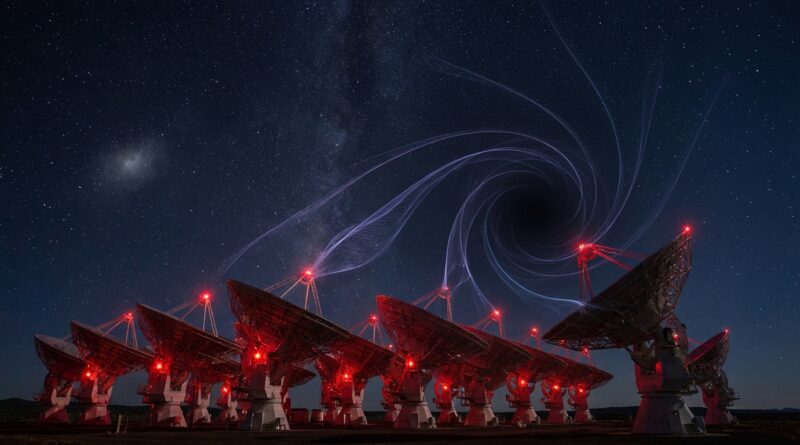
The Radio Signal That Shouldn’t Exist: Astronomers Baffled By Repeating Burst From An ‘Empty’ Patch Of Space
Most people are worn out by the usual routine. Another blurry light. Another dramatic caption. Another clip that falls apart the second anyone asks for data. That is why this mysterious repeating radio burst from empty region of space feels different. It is not a shaky phone video. It is a measured signal, picked up by real instruments, repeating in a way that grabs astronomers’ attention and refuses to sit neatly inside the usual boxes. Even better, the patch of sky it seems to come from is not some obviously busy hotspot packed with known objects. On paper, it looks oddly plain. That is the part that has researchers scratching their heads. A radio source that repeats is already interesting. A repeating source tied to an apparently empty area is the kind of thing that makes careful scientists say, yes, this is strange, and no, we do not have a clean answer yet.
⚡ In a Hurry? Key Takeaways
- This is a real astronomical puzzle, not a social media UFO clip. The signal is repeatable, recorded by professional instruments, and still unexplained.
- If you want to follow it responsibly, watch for telescope follow-up papers, sky survey updates, and whether other observatories confirm the same location and timing.
- The safest takeaway is simple. “Unexplained” does not mean aliens, but it does mean the data is strong enough that scientists think it is worth serious attention.
What actually happened?
Astronomers detected a repeating radio burst that appears to come from a part of the sky with no obvious source. That is the headline version. The more useful version is this. Radio telescopes can pick up short, bright flashes at specific frequencies, and some of these bursts repeat. Usually, researchers try to match them to something physical, like a neutron star, a magnetar, a distant galaxy, or another known type of energetic object.
In this case, the signal seems to point back to a region that does not make that job easy. There is no neat, satisfying “there it is” object sitting in plain view. No obvious culprit. That does not mean the source is truly nowhere. Space is messy, distance is tricky, and some objects are hard to see in visible light. But it does mean the normal detective work is not producing a quick answer.
Why scientists care about a repeating signal
One weird flash can be a glitch. Two flashes start a conversation. A repeating pattern changes everything.
Repeat behavior gives astronomers something they can test. They can compare timestamps, frequencies, intensity, polarization, and sky position. They can ask other observatories to look at the same spot. They can check old archives to see if the source was whispering before anyone noticed. That is why a mysterious repeating radio burst from empty region of space is much more valuable than a one-off oddity.
Repeatability is the difference between noise and a real anomaly
If a signal comes back, researchers can try to rule out boring explanations. Was it local interference from Earth? Was it a satellite? Was it a processing error? Did weather or instrument noise fake the pattern? The more independent detections pile up, the harder it is to dismiss.
This is also why the story matters beyond astronomy fans. It is a clean example of how science handles the unknown. Not with certainty too early. Not with wild claims too early. Just patient checking.
What “empty patch of space” really means
This phrase sounds dramatic, but it needs a little translation. Empty does not mean truly blank. It usually means astronomers do not yet see an obvious source there in the wavelengths they have checked, or nothing known fits the behavior well enough.
Think of it like hearing a repeating beeping sound in your neighborhood but not being able to spot the house it is coming from. The source exists. You just have not pinned it down.
Possible reasons it looks empty
The object could be extremely faint. It could be very far away. Dust could hide it. It could show up in radio but not in visible light. Or the source might belong to a class of objects we do not fully understand yet.
That last option is the one that gets people excited. Carefully excited, if they are doing it right.
What could be causing it?
Right now, there are a few broad buckets scientists usually consider.
1. A known object behaving in a less familiar way
Neutron stars and magnetars are common suspects in strange radio stories. These are dense, extreme remnants of dead stars. They can produce intense bursts and odd periodic behavior. Sometimes the surprise is not the object itself, but the exact rhythm and strength of the signal.
2. A hidden source in a distant galaxy
Some repeating radio bursts come from far outside the Milky Way. If the host galaxy is faint or the localization is still not precise enough, the source can seem detached from anything visible at first.
3. A new or poorly understood astrophysical process
This is the most interesting possibility, and also the one that needs the most caution. Science finds new things by first noticing what does not fit. But “does not fit yet” is not proof of a revolutionary discovery. It is a starting point.
4. Something closer to home that has not been ruled out yet
A good team always checks for interference, instrument effects, and terrestrial contamination. That can sound boring, but it is important. The history of odd signals includes both amazing discoveries and very human mistakes.
Why this feels different from typical UFO chatter
Because the evidence is structured. There are timestamps. Frequency measurements. Telescope logs. Follow-up campaigns. Independent teams can review methods and compare notes.
That is the big dividing line. A lot of viral anomaly content asks you to trust a reaction. This asks you to inspect a record.
For readers who are tired of choosing between mockery and blind belief, this is the sweet spot. You do not have to pretend there is already an answer. You also do not have to pretend every unexplained thing is nonsense. You can sit in the middle and watch the evidence build.
How regular readers can follow the story without getting lost
You do not need a PhD to keep up. You just need a few habits.
Check whether multiple observatories confirm it
If more than one telescope sees the same source, confidence goes up fast. Independent confirmation is gold.
Watch for localization updates
The more precisely astronomers pin down the source, the easier it is to match it with a real object or rule candidates out.
Look for peer-reviewed papers, not just dramatic summaries
A splashy headline can leave out caveats. The actual research usually tells you what is solid, what is tentative, and what remains unknown.
Pay attention to what scientists say they do not know
This is a useful trick in any anomaly story. The most trustworthy researchers are often the ones who speak carefully and leave room for doubt.
Why this matters to the anomalous-phenomena community
Because this is the kind of case that can reset the conversation. Instead of arguing over recycled clips and overconfident claims, people can gather around live evidence. They can compare observations, track updates, and learn how real investigation works.
That is healthy. It gives curious readers a way to practice discernment. Not cynicism. Not gullibility. Discernment.
It also creates a better culture. One where “strange” means something testable, not just something exciting.
At a Glance: Comparison
| Feature/Aspect | Details | Verdict |
|---|---|---|
| Evidence quality | Instrument-recorded radio detections with repeat behavior, suitable for follow-up by other observatories. | Strong enough to take seriously. |
| Source identification | Appears linked to a region with no obvious visible counterpart or easy textbook explanation. | Still unresolved. |
| Public takeaway | A real scientific mystery with data people can track, rather than a rumor driven by shaky footage. | Worth following with curiosity and patience. |
Conclusion
This is why the story matters right now. The anomalous-phenomena world is split between spectacle and skepticism, and both sides are tired. A rigorously documented, still-unexplained repeating radio source gives readers something rare. A mystery with receipts. Something you can actually track, question, and compare against new data as it arrives. That is far more useful than stale conspiracies or low-effort viral clips. It gives newer readers a chance to learn how genuine anomalies are handled, and it gives long-time watchers a shared project rooted in evidence. We are not just swapping spooky stories. We are learning how to map the strange, one verified signal at a time.