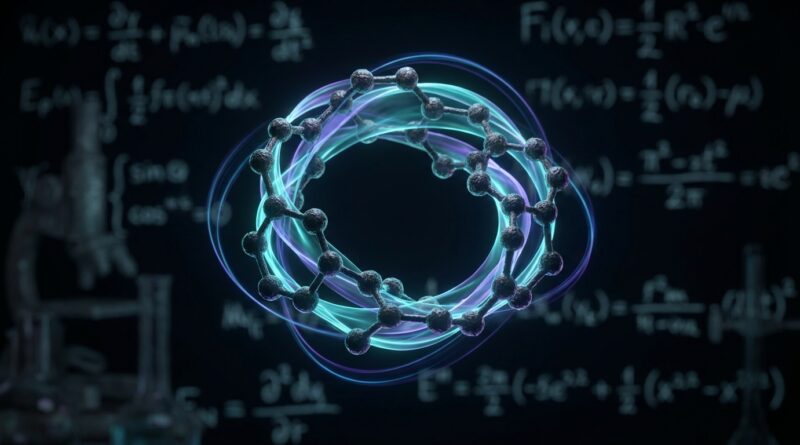
The Molecule That Breaks Reality: Chemists Discover a ‘Half‑Möbius’ World Where Electrons Refuse To Behave
You can be forgiven for rolling your eyes at stories that promise reality-breaking science and then deliver a lot of hype with very little substance. Most of us have seen enough “mysteries” that fall apart the second you ask for real evidence. That is why this one matters. Chemists have now reported a peer reviewed molecule with a strange “half-Möbius” character, a shape and electronic behavior that sounds made up but was measured in a lab. The short version is simple. The molecule’s structure and the way its electrons move do not fit the neat, flat expectations many people have for ring-shaped molecules. Instead, it twists into something closer to the famous Möbius strip, but only partway, creating a weird in-between state where electrons follow rules that feel almost wrong at first glance. It is not magic. It is not internet folklore. It is careful chemistry, and it may point to a whole class of materials with unusual quantum behavior.
⚡ In a Hurry? Key Takeaways
- This half mobius molecule unexplained phenomenon is real science, not a rumor. Researchers report a molecule whose twist changes how its electrons behave.
- If the jargon gets heavy, focus on the core idea. Shape controls electron flow, and this shape is unusually twisted in a way chemists did not expect to see so clearly.
- The value here is rigor. This is a peer reviewed result that could matter for future quantum materials, molecular electronics, and our basic picture of what molecules can do.
What exactly is a half-Möbius molecule?
Start with the ordinary Möbius strip. Take a strip of paper, give it one twist, then join the ends. You get a surface with only one side. It is a classic bit of odd geometry.
Now shrink that idea down to the molecular level. Chemists have been interested for years in whether a molecule, especially a ring-shaped one, can take on a Möbius-like twist. That matters because electrons in these rings do not just sit still. They spread out, interact, and follow the geometry of the structure they live in.
A “half-Möbius” molecule is not literally a paper strip cut in half. It means the molecule seems to show only part of the full Möbius-style topological behavior. Think of it as a molecule living in the awkward middle ground between a normal ring and a fully twisted Möbius system. That halfway state is exactly what makes it interesting.
Why scientists are excited
In everyday chemistry, we often picture molecules as tidy little arrangements of atoms. Real molecules are fussier than that. They bend, rotate, and sometimes settle into shapes that change their electronic properties in a big way.
What makes this discovery special is not just the shape. It is the combination of shape and electron behavior. The electrons in this molecular system appear to follow a pattern linked to that unusual twist. That means the geometry is not just decoration. It is actively changing the rules of the game.
This is where the half mobius molecule unexplained phenomenon starts to sound less like a headline trick and more like a real boundary-pushing result. Topology, which is the branch of math that studies properties that survive twisting and stretching, is already a huge deal in modern physics. Seeing a fresh version of that idea inside a single molecule is a big moment.
Why “electrons refuse to behave” is not just clickbait
That phrase sounds dramatic, but there is a solid idea underneath it.
Electrons in ring-shaped molecules often follow established patterns. Chemists use these patterns to predict stability, magnetic response, and reactivity. One of the best known tools here is aromaticity, the idea that certain electron arrangements make a ring especially stable.
But in Möbius-like systems, the usual rules can flip. A twisted path can produce a different kind of aromatic behavior than a flat ring would. So when scientists say the electrons are not behaving normally, they mean the molecule’s topology may be pushing the electrons into a regime that standard flat-ring intuition does not handle well.
That is a serious claim. It has consequences for how we think about molecular stability and how we might design future materials on purpose.
How researchers likely proved it
No one gets to publish a claim like this by saying, “Trust us, it looks weird.” Chemists have to build a case from several kinds of evidence.
Structural measurements
First, they need to show the molecule really does adopt the twisted shape. That often means X-ray crystallography, which lets scientists map where the atoms sit in a crystal. If the twist is there, this technique can make it visible.
Spectroscopy
Next comes spectroscopy, such as NMR and UV-visible measurements. These help show how electrons are distributed and how the molecule responds to magnetic or light-based probes.
Computational modeling
Then there is theory. Computer calculations can test whether the observed structure should create the odd electron behavior the team claims. In modern chemistry, experiment and computation usually work together.
So while the headline sounds wild, the path to that headline is usually very methodical.
Why this feels bigger than one weird molecule
One strange molecule would already be fun. But the reason people in advanced chemistry and materials science care is that a result like this can open a new design space.
If chemists can control partial Möbius twisting, they may be able to tune electronic properties in ways that normal molecular rings cannot. That could matter for:
- molecular electronics
- organic conductors
- quantum information materials
- responsive sensors
- magnetically unusual compounds
In plain English, a weird twist could become a useful tool.
What this does not mean
Let’s keep our feet on the ground.
This does not mean scientists found a portal, broke physics, or proved reality is a simulation. It also does not mean every claim about impossible geometry in matter is suddenly true.
What it does mean is better, honestly. It means the real world is still capable of surprising us in ways that survive peer review. That is rarer and more valuable than a flashy claim that disappears a week later.
Why Anomal readers should care
This story sits in a sweet spot your average science brief often misses. It is strange enough to scratch that “how is this even allowed?” itch, but grounded enough that you do not have to suspend disbelief.
If you are into non-Euclidean geometry, topological oddities, or materials that seem to bend the normal script, this is exactly the kind of finding worth watching. It links abstract math, quantum behavior, and hands-on lab work in one package.
That is why the half mobius molecule unexplained phenomenon has real staying power. It gives you something fresh. Not recycled ghost stories in a lab coat. Not another reheated UFO debate. A genuine experimental result, new enough that even big outlets are still figuring out how to explain it.
At a Glance: Comparison
| Feature/Aspect | Details | Verdict |
|---|---|---|
| What was discovered | A peer reviewed molecule showing a partial Möbius-like twist linked to unusual electron behavior | Genuinely novel and worth attention |
| Why it feels strange | The molecule sits between normal ring geometry and a fully twisted Möbius system, which can alter aromatic and electronic rules | Weird, but scientifically grounded |
| What it could lead to | Better understanding of topology in chemistry, plus possible uses in advanced materials and molecular electronics | Early stage, but potentially important |
Conclusion
This is the kind of science story that earns your attention. It is a genuinely new, peer reviewed discovery sitting right on the line between hard science and the almost impossible. A half-Möbius molecule connects non-Euclidean geometry, quantum weirdness, and reality-bending materials to a real experiment that happened now, not to a legend somebody keeps recycling. That gives the Anomal community something rare. Fresh mystery with receipts. If this research holds up and expands, you will likely see versions of it everywhere soon. For now, the smart move is to understand it early, clearly, and without the usual hype fog. Sometimes the strangest thing in the universe is not out in deep space. Sometimes it is hiding inside one molecule, quietly telling us matter is still stranger than we thought.