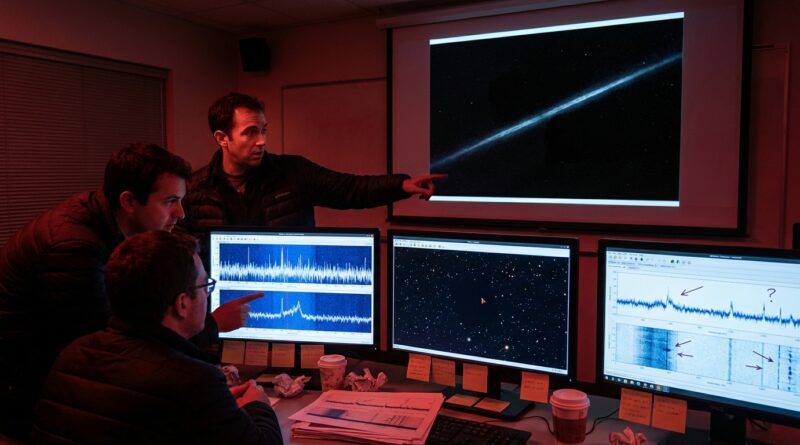
The ‘Ghost Radio’ Signal That Shouldn’t Exist: Astronomers Catch A Perfect Cosmic Beat From Nowhere
If you are tired of every odd speck in the sky getting sold as proof of aliens, you are not alone. Most “space mystery” stories are either recycled from years ago or built on blurry clips that fall apart the second someone checks the facts. That is why this one stands out. Astronomers have picked up a mysterious repeating radio signal from deep space that is so clean and so perfectly timed it looks almost like a beacon. The problem is, when they look back at the same patch of sky, there is no obvious source sitting there. No bright star behaving badly. No known pulsar. No easy explanation. That does not mean little green men. It means something real, current, and weird is happening, and scientists are doing the hard work of figuring out whether this is a rare cosmic object, an Earth-side interference problem, or something we have not classified yet.
⚡ In a Hurry? Key Takeaways
- This mysterious repeating radio signal from deep space is real enough to trigger follow-up checks, but it still has no confirmed source.
- If you want to follow it properly, watch for repeat detections from multiple observatories, not just one dramatic screenshot.
- The smartest approach is skepticism with curiosity. Most anomalies end up explained, but the good ones teach us how science works in real time.
Why this signal has astronomers paying attention
Radio astronomy is noisy. Very noisy. Earth is constantly blasting out signals from satellites, radar, aircraft systems, phones, and electronics. So when researchers spot something oddly precise, their first job is not celebration. It is elimination.
What makes this case unusual is the rhythm. Reports describe a pulse pattern that appears razor-regular, more like a controlled transmission than the messy natural bursts we often see from active cosmic sources. Natural objects can absolutely create repeating signals. Pulsars do it all the time. But in this case, the patch of sky does not seem to host an obvious object that fits the pattern.
That is where the story gets fun. Not because it proves anything exotic, but because it passes the first test of a good anomaly. It is specific, measurable, and weird enough to be checked.
What it could be, before anyone jumps to aliens
1. A strange kind of neutron star or pulsar
This is still one of the safest bets. Space has a long history of producing objects that look impossible until we find more of them. A neutron star with an unusual spin rate, magnetic field, or environment could create a repeating radio pattern that does not match the textbook examples.
2. A fast radio burst source acting in a new way
Fast radio bursts, or FRBs, are brief, powerful radio flashes from outside our galaxy. Some repeat. Most do not. If this signal belongs to that family, it may be showing us a version we have not seen before, perhaps one that repeats with much tighter timing.
3. A local interference source fooling the instruments
This is the boring answer, but boring answers win a lot. Sometimes a signal only looks cosmic because it slips through filters or bounces in a strange way. A hidden satellite path, a ground transmitter, or hardware behavior inside the observing system can mimic something from deep space.
4. A source too faint to see clearly in other surveys
There may be an object there, just not one that shows up cleanly in visible light, X-rays, or older sky maps. That is why astronomers compare data across many wavelengths and archives before declaring a mystery truly source-free.
How scientists separate a real anomaly from a glitch
This part matters more than the headline. A mysterious repeating radio signal from deep space becomes interesting only after it survives a series of boring checks.
First, researchers ask whether the signal appears more than once. A one-off event can be anything, including a technical hiccup. A repeating pattern is harder to dismiss.
Second, they check whether other telescopes can see it. Independent confirmation is the gold standard. If one dish sees it and another does not, that does not kill the story, but it raises questions.
Third, they test whether the signal drifts in frequency the way a cosmic source should as it travels through space. Radio waves moving through interstellar material often show a telltale delay pattern called dispersion. That helps astronomers tell space signals from local junk.
Fourth, they search old data. Sometimes the “new” mystery was quietly sitting in archives for years, missed because nobody was looking for that exact pattern.
If you want a smart guide to following cases like this without getting lost in hype, The best way to track a ‘ghost’ radio signal that keeps vanishing without a trace is worth a look. It gets into the practical side of watching these stories unfold.
Why the “no obvious source” part is such a big deal
Normally, when a strange radio signal appears, astronomers try to match it to something visible or already cataloged. A known pulsar. A magnetar. A galaxy with a busy core. Even if the match is imperfect, there is usually a suspect.
Here, the problem is that the sky location seems annoyingly empty or at least unhelpful. That does not mean the signal comes from nowhere in the literal sense. It means the usual suspects are missing.
Think of it like hearing a metronome ticking in the next apartment, but when you knock on the door there is no drummer, no speaker, no clock, nothing obvious making the beat. You would not assume magic. You would assume there is a hidden explanation. But you would keep listening.
What readers should watch for next
Repeat detections
The single biggest update to look for is whether the signal comes back on schedule, off schedule, or not at all. A truly repeating source gives astronomers something to predict and test.
Multi-observatory confirmation
If more than one telescope, especially in different places, picks up the same pattern, confidence shoots up fast. That is how a curiosity starts becoming a serious scientific case.
Catalog matches and archival finds
A later paper might reveal a faint object in old survey data that was overlooked. That would not make the story less interesting. It would make it better, because it would give the mystery a home address.
Retractions or instrument notes
Do not ignore the boring updates. If a team later says the signal was linked to local interference or a processing issue, that is still useful. Good anomaly hunting means accepting the answer even when it kills the thrill.
How you can follow the case without falling for nonsense
Start with the source of the claim. Was it mentioned in an observatory alert, a preprint, a conference talk, or just on social media?
Then check whether anyone else has independently discussed the detection. Amateur radio forums, astronomy communities, and sky survey trackers can be surprisingly helpful, as long as you treat them as leads, not proof.
Also watch the language. “Candidate,” “unconfirmed,” and “under investigation” are honest words. “Scientists baffled” is often where the clickbait starts.
If you enjoy doing some detective work yourself, you can monitor public sky surveys, observatory notices, and follow-up reports instead of waiting for viral accounts to distort the story. That way you are tracking an actual live mystery, not a recycled legend dressed up as breaking news.
At a Glance: Comparison
| Feature/Aspect | Details | Verdict |
|---|---|---|
| Signal pattern | Exceptionally regular radio pulses, reportedly closer to a beacon-like rhythm than a random burst | Interesting enough for follow-up, but not proof of anything exotic |
| Source location | Patch of sky with no obvious confirmed source currently tied to the pulses | Main reason the case remains open and worth watching |
| Best next step | Wait for repeat detections, independent observatory checks, and deeper survey analysis | This is where a real discovery separates itself from a glitch |
Conclusion
This is the kind of story anomaly fans actually need more of. Not another dusty “maybe UFO” claim from ten years ago, but one clean, current mystery that scientists are still actively trying to explain. Following a mysterious repeating radio signal from deep space like this gives readers a better feel for how discovery really happens. Slowly. Carefully. Often with false starts. It also helps everyone get better at spotting the difference between a real developing case and the next “Wow! signal 2.0” post making the rounds online. If you keep an eye on follow-up observations, public sky data, and credible updates, you are not just consuming the mystery. You are helping build a smarter community around it. That is a lot more useful than doom-scrolling through bad rumors.