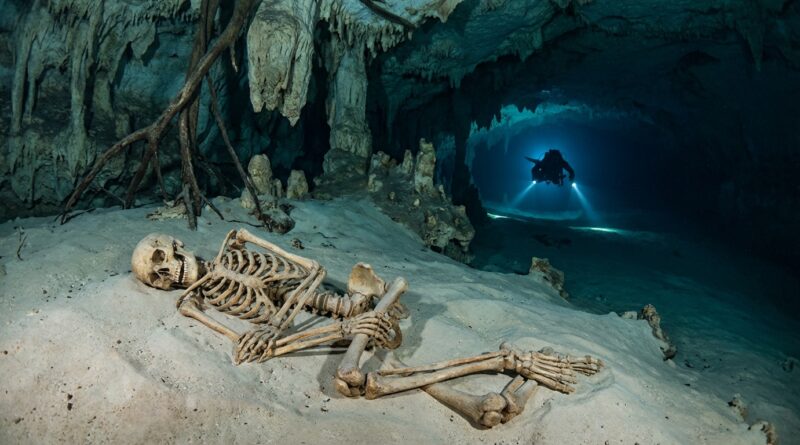
The 8,000-Year-Old Skeleton In A Mexican Underwater Cave That Shouldn’t Exist
It is hard not to feel a little whiplash with a find like this. Human burials make sense in graveyards, deserts, or old settlement sites. They are not supposed to show up deep inside a black underwater cave in Mexico, 80 feet below the surface, in a tunnel that would have been dry thousands of years ago. Yet that is exactly why the mysterious 8000 year old underwater cave skeleton yucatan discovery has scientists so riveted. Divers exploring a flooded cave system on the Yucatán Peninsula found human remains laid on what appears to be a sand dune, far from daylight and far from any easy explanation. The basic facts are strange enough. The bigger shock is what they suggest. If the body was placed there on purpose, then people 8,000 years ago were moving through these cave systems with intent, memory, and possibly ritual meaning. That could change how we think about early people in the Americas, and about caves as sacred spaces rather than simple shelters.
⚡ In a Hurry? Key Takeaways
- The skeleton appears to be about 8,000 years old and was found deep inside a flooded Yucatán cave that was dry when the body was likely placed there.
- The most useful way to read this story is to separate the confirmed facts from the theories. Burial, ritual deposit, and pilgrimage are all possibilities, but none is settled yet.
- This matters beyond the eerie factor. The find could reshape ideas about how early Americans used caves, honored the dead, and moved through harsh prehistoric landscapes.
Why this skeleton is such a big deal
Let’s start with the part that makes archaeologists sit up straight. This was not a random bone washed into a sinkhole. According to the announcement, the remains were found deep in a flooded cave maze, resting on a sand rise, in a place that would have been accessible only when sea levels were much lower.
That matters because the Yucatán looked very different 8,000 years ago. Many of the cave systems now filled with water were once dry passages. People and animals could walk into them. Later, after the Ice Age ended and seas rose, groundwater flooded the tunnels and sealed them off.
So the puzzle is not, “How did someone get a skeleton underwater?” The better question is, “Why was a person taken so far into a dark cave before the cave flooded thousands of years later?”
What experts seem to agree on so far
Even with a fresh discovery, a few points already look solid.
The cave was once dry
This is the backbone of the whole story. No one is arguing that prehistoric people were scuba diving. The tunnel would have been dry land when the remains were placed there.
The placement may have been intentional
The reported position on a sand dune or raised patch inside the cave suggests some care. That does not prove a formal burial in the modern sense, but it does push the discovery away from the idea of someone simply collapsing at the entrance.
The site is old enough to matter a lot
An 8,000-year-old date places the remains in a crucial period after the last Ice Age, when environments, coastlines, and human lifeways were changing fast. Any burial or ritual behavior from that time can tell us a great deal.
Why the location is the real mystery
There is eerie, and then there is “deep inside a pitch-black cave with no natural light” eerie. If the remains were intentionally placed there, that means people entered a dangerous underground space carrying knowledge, light sources, and a reason.
Think about the effort involved. This was not a quick stop. A trip deep into a cave system takes planning. You need torches or firebrands. You need to know the route. You need enough confidence to return. That suggests these caves may have been familiar places, not just scary holes in the ground people avoided.
And that opens the door to the most interesting possibility. These caves may have had social or spiritual meaning long before later Mesoamerican cultures attached sacred ideas to cenotes and the underworld.
The main theories, in plain English
This is where it helps to stay calm. A strange site tends to attract wild claims. The real science is slower and more careful.
1. An intentional burial
This is the cleanest explanation if the body was deliberately laid in a specific spot. A burial does not need a coffin or grave marker to count as intentional. It can simply mean a body was placed somewhere with purpose.
If true, that would make the cave part of a funerary landscape. In simple terms, the dead were taken somewhere chosen, not dumped.
2. A ritual deposit
This is slightly different. In a ritual deposit, the cave itself may have mattered more than the body’s practical disposal. The act of leaving a person in that place could have been symbolic, spiritual, or tied to beliefs about the underworld, ancestors, or sacred geography.
3. A pilgrimage or ceremonial journey
This is the most dramatic theory, but not impossible. If communities knew these caves well, a journey inward could have been part of a rite. The darkness, remoteness, and difficulty may have been the point.
4. A tragic death that later looked ceremonial
Scientists also have to consider the boring answer. Someone could have entered the cave and died there, and natural processes or later disturbance could make the scene look more deliberate than it really was. That is why archaeologists will want detailed mapping, sediment study, bone analysis, and dating work before going all in on any story.
What scientists will look at next
This is the part many readers miss, and it is where the real value is. A discovery like this is not solved by one dramatic dive photo. It gets solved piece by piece.
Bone position and surrounding sediment
If the bones stayed roughly where the body was first placed, that supports intentional placement. If they were shifted by water flow, collapse, or animal activity, the story gets murkier.
Signs of treatment on the body
Researchers will look for cut marks, wrapping evidence, burning, trauma, or anything else that hints at how the person died and what happened afterward.
Dating from multiple sources
Good archaeology does not lean on one date if it can avoid it. Scientists may compare dates from the bone, nearby organic remains, and cave sediments to narrow down the timeline.
Objects nearby
Tools, charcoal, offerings, or worked stone would strengthen the case for purposeful human activity. Even the lack of such items tells a story.
Why the Yucatán keeps producing these jaw-dropping finds
The Yucatán is one of those places where geology and history keep colliding in weird ways. Its limestone bedrock is full of caves, sinkholes, and flooded passages. Because many were sealed after sea levels rose, they can preserve bones and traces of ancient activity in ways open-air sites often cannot.
That is one reason the region has become so important for studying the earliest people in the Americas. These caves can hold snapshots from a vanished landscape, almost like time capsules, except much darker and much harder to reach.
So, does this rewrite history?
Not overnight. That is the honest answer.
But it could shift the conversation in a real way. If the evidence supports an intentional deposition, then archaeologists will have to take more seriously the idea that early people on the Yucatán were doing complex, meaningful things in cave spaces much earlier than many assumed.
It would also add weight to a bigger point. Early Americans were not just surviving. They were making choices about memory, death, place, and belief. That is a far richer picture than the old stereotype of people simply following game across a landscape.
How to read stories like this without getting fooled
If you like mystery but hate hype, here is the best approach.
Look for the difference between “found” and “explained”
The find is real. The final meaning is still up for debate. Those are two very different things.
Watch for words like “may,” “suggests,” and “appears”
Those are not signs of weakness. They are signs that researchers are being careful.
Be suspicious of instant certainty
When a brand-new discovery gets turned into a complete story within hours, that usually means someone is guessing faster than the evidence allows.
At a Glance: Comparison
| Feature/Aspect | Details | Verdict |
|---|---|---|
| Age and setting | Roughly 8,000 years old, inside a Yucatán cave now flooded but dry when the remains were likely placed there. | Strongly unusual and scientifically important. |
| Intentional placement | The body appears to have been laid on a sand rise deep in the cave, which hints at deliberate placement. | Plausible, but needs more evidence. |
| Historical impact | Could change ideas about early ritual behavior, cave use, and how the first Americans understood sacred landscapes. | Potentially major if confirmed. |
Conclusion
This is exactly the kind of discovery that sticks in your head. It has hard data, genuine eeriness, and real stakes. An ancient person, placed deep inside a cave that is now reachable only by expert divers, forces us to ask better questions about the first Americans and the worlds they knew. Maybe this was a formal burial. Maybe it was a ritual journey. Maybe it points to cave systems that were mapped, remembered, and mythologized far earlier than expected. The debate is just starting, and that is the exciting part. Good science does not rush to explain a true anomaly away. It tests, compares, and keeps digging. For readers, that makes this more than a spooky headline. It is a live case study in how history gets revised, one strange and fascinating piece of evidence at a time.