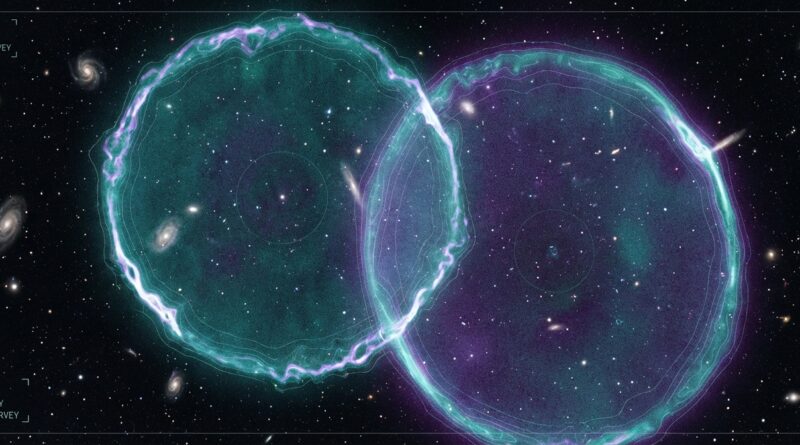
Strange Rings Of Radio Light In Deep Space: The New Cosmic Mystery No One Can Explain
If you are worn out by every strange thing in the sky being turned into lazy UFO bait, you are not alone. A lot of readers want a real mystery, not another headline pretending every unexplained signal means aliens. Odd Radio Circles, often shortened to ORCs, are exactly the kind of puzzle people have been asking for. They are huge, faint rings in deep space that show up in radio observations, not normal visible-light photos. They are so big that many are far wider than the Milky Way, and astronomers still do not agree on what makes them. Now the mystery has gotten even better. Researchers have reported a rare pair of overlapping mysterious radio rings in space, giving scientists a new clue and the rest of us a front-row seat to a live unsolved case. This is one of those rare moments when “we don’t know yet” is the most honest and exciting answer.
⚡ In a Hurry? Key Takeaways
- Odd Radio Circles are giant, faint rings seen only in radio light, and the newly reported overlapping pair makes the mystery even harder to explain.
- If you want to follow this story like a pro, compare radio images with visible-light galaxy maps and keep an eye on citizen-science projects that help spot new ORCs.
- The value here is simple: this is a real scientific mystery with public data, competing ideas, and no agreed answer yet.
What are Odd Radio Circles, exactly?
Think of them as ghost rings in the sky. They are not planets, not normal nebulae, and not the usual round galaxies you see in telescope posters.
Odd Radio Circles are enormous circular structures found in radio astronomy surveys. They are usually very faint. You do not see them in ordinary visible-light images. Instead, radio telescopes pick up the energy they give off at radio wavelengths.
That alone makes them strange. Most famous deep-space objects can be checked in several kinds of light, like visible, infrared, or X-ray. ORCs tend to stand apart because the ring itself is often only obvious in radio data.
They were first noticed only in the last few years, which tells you something important. This is not an old mystery dragged back out for clicks. It is a fresh one, made possible by better radio surveys and sharper software tools.
Why the overlapping discovery matters
Finding one ORC is already unusual. Finding a pair of odd radio circles overlapping is the kind of thing that makes astronomers stop and rethink their working theories.
Why? Because a single ring could maybe be explained by one dramatic event. Two rings interacting, crossing, or appearing as a linked pair can hint at a more complicated story. Maybe the environment around them matters. Maybe nearby galaxies matter. Maybe these are not one-off cosmic explosions at all.
This is where the search term really comes into focus. The story is not just about odd radio circles. It is about overlapping mysterious radio rings in space that may help researchers sort out whether these things come from shock waves, old galaxy outbursts, collisions, or something nobody has modeled correctly yet.
What scientists think might be causing them
1. Giant shock waves from old galactic activity
One leading idea is that ORCs are the leftovers of a violent event in or around a galaxy. Picture a massive burst of energy expanding outward, like a ripple from a stone dropped in a pond. Except the pond is intergalactic gas, and the ripple is bigger than galaxies.
This could happen if a supermassive black hole at a galaxy’s center had an active phase long ago and blasted matter outward. As that material slammed into surrounding gas, it might create the ring-like radio glow we now detect.
2. A huge stellar “traffic jam” of supernova activity
Another idea is less about one central black hole and more about a period of intense star formation. If a galaxy went through a starburst phase, many massive stars could have exploded as supernovae over time. Their combined outflows might build a vast shell or bubble that lights up in radio wavelengths.
This is a neat idea because it uses known physics. No magic required. The problem is scale. ORCs are so large that scientists have to ask whether normal starburst activity can really make something this big and this cleanly ring-shaped.
3. Merger or interaction effects between galaxies
Galaxies do not live quiet lives. They tug on each other, merge, stretch, and sometimes stir up huge waves in the gas around them. The newly noticed overlapping odd radio circles could support the idea that interactions between nearby galaxies help shape these rings.
If two galaxies have had energetic outbursts or are moving through a shared environment, the radio structures could overlap the way smoke rings might cross paths in slow motion.
4. Something we have not nailed down yet
This may be the most important possibility. Scientists could be looking at a class of object that does not fit nicely into existing boxes. That does not mean “aliens did it.” It means the data may be pointing to a process that is rare, short-lived, or difficult to model.
Good science is full of these moments. First you spot the odd thing. Then you argue. Then you collect better data. Then, slowly, the picture sharpens.
Why they only show up in radio light
This part sounds technical, but it is actually simple. Different telescopes detect different kinds of energy. Your eyes see visible light. Radio telescopes detect much longer wavelengths.
If an object is made of charged particles moving through magnetic fields, it can produce radio emission even when there is not much visible light coming from it. So an ORC might be like a giant shell of energetic particles and magnetic structure that glows for radio telescopes but barely registers in a normal sky photo.
That is why ORCs can feel so eerie. In one image, there is almost nothing there. In the radio map, there is a huge ring floating in deep space.
How big are these things?
Absurdly big.
Some odd radio circles are tens of times larger than the Milky Way. That is one reason they grab attention so fast. We are not talking about a tidy little cloud sitting near one star. We are talking about structures on a scale that pushes into the giant architecture of galaxies and the space between them.
When astronomers say these rings are enormous, they really mean enormous. It is part of what makes the mystery so compelling. Any explanation has to account for that size, their shape, and their preference for appearing in radio data.
What the new overlapping ORCs might tell us
The overlapping case gives researchers something precious. Constraints.
In plain English, it gives them more specifics to test. If two rings overlap, astronomers can ask:
- Are both rings centered on galaxies?
- Do they have similar radio brightness?
- Are they likely at the same distance, or is the overlap just a line-of-sight accident?
- Do their edges suggest collision, expansion, or separate origins?
- Is there hot gas, X-ray emission, or galaxy interaction nearby?
That is how mysteries become science. Not by yelling “what if,” but by narrowing down what is physically possible.
Why this story is better than the usual cosmic clickbait
Because the mystery is real, and the uncertainty is honest.
No one needs to oversell this. Astronomers themselves admit they do not yet have an agreed explanation. That is not weakness. That is the fun part. You are watching the scientific process while it is still moving.
And unlike a lot of sensational space stories, this one invites readers in. You can look at the same style of survey images scientists use. You can learn what radio maps show. You can follow how one theory gains ground and another starts to wobble.
Can regular people help find more ORCs?
Yes, and this is one of the best parts.
Modern astronomy creates more survey data than professional teams can inspect by eye. That opens the door for citizen science. Volunteers often help classify galaxies, spot unusual shapes, and flag strange objects for follow-up.
If you want to participate in the hunt for odd radio circles overlapping mysterious radio rings in space, here is a simple way to start:
Learn the look
Spend time looking at known ORC images from radio surveys. Train your eye to notice faint circular edges, partial rings, and diffuse glow around galaxies.
Follow major radio survey projects
Projects tied to instruments like ASKAP, MeerKAT, and eventually the Square Kilometre Array are producing the kind of wide-field data where ORCs turn up.
Join citizen-science communities
When astronomy platforms ask the public to classify odd shapes or radio sources, jump in. Even if the task is not labeled “find ORCs,” weird rings often emerge from exactly that kind of pattern-spotting work.
Compare wavelengths
A useful habit is checking whether the radio ring has a visible-light galaxy near its center. That does not solve the mystery, but it helps you think the way astronomers do.
What to watch for next
The next chapter will probably come from better multi-wavelength follow-up. Astronomers will want sharper radio imaging, distance measurements, and checks in X-ray, optical, and infrared data.
If a central galaxy keeps showing up in these systems, that will strengthen some explanations. If overlapping ORCs turn out to be common in galaxy groups or merger environments, that points in another direction. If none of the current models fit well, then the field may need a new one.
That is the beauty of a live mystery. The answer is not frozen yet.
At a Glance: Comparison
| Feature/Aspect | Details | Verdict |
|---|---|---|
| What ORCs are | Huge, faint ring-like structures seen mainly in radio wavelengths, often linked to distant galaxies. | Real astronomical objects, not a hoax or recycled UFO story. |
| Why the overlapping pair matters | Two rings appearing together gives astronomers more clues about environment, origin, and whether current theories hold up. | One of the best new pieces of evidence in the ORC mystery. |
| What readers can do | Follow radio-survey news, learn to read radio images, and join citizen-science classification projects. | You can actually take part instead of just reading headlines. |
Conclusion
Odd Radio Circles are the kind of mystery space fans keep asking for. They are giant, ghostly rings that only show up in radio light, they can be tens of times bigger than the Milky Way, and nobody has a final explanation yet. That alone makes them worth watching. The newly reported overlapping pair raises the stakes even more, because it gives scientists a rare natural test case for their competing ideas. Better still, this is not a sealed-off expert-only puzzle. Readers can understand the main theories, look at the same kinds of data behind the headlines, and even join citizen-science efforts that may help spot the next one. For anyone tired of recycled alien chatter, this is the real thing. A hard-science mystery, unfolding right now.