NASA Scientist Says ‘Something’ May Be Watching Our Skies: Inside The Mystery Flashes Of The Nuclear Age
If you feel like the UFO conversation is all static and no facts, you are not imagining it. Most people are stuck sorting through blurry clips, breathless social posts, and official statements that say a lot without saying much. That is why this new look at the mysterious nuclear age sky flashes matters. It is not another random video. It is a fresh read of old astronomical photographic plates from the years before Sputnik, some of which were brushed off as dust, scratches, or camera glitches. Now, researchers say certain bright flashes and odd tracks may cluster around the same period as early nuclear tests and major UFO report waves. More importantly, a respected former NASA scientist has publicly said some of these cases may deserve consideration as possible artificial objects. That does not prove non-human intelligence. But it does move the story out of pure conspiracy territory and into something far more useful. A real evidence question.
⚡ In a Hurry? Key Takeaways
- The direct answer is this. A new review suggests some mysterious nuclear age sky flashes may be worth serious study, but there is no proof yet of non-human intelligence.
- If you want signal over hype, focus on what can be checked: dates, plate archives, test timelines, and whether independent teams can repeat the analysis.
- The value here is not a final alien verdict. It is a better way to separate old photographic noise from patterns that may point to something engineered.
Why this story is getting attention
The phrase mysterious nuclear age sky flashes non human intelligence study sounds like internet bait at first glance. Fair enough. We have all seen stories that promise everything and deliver nothing.
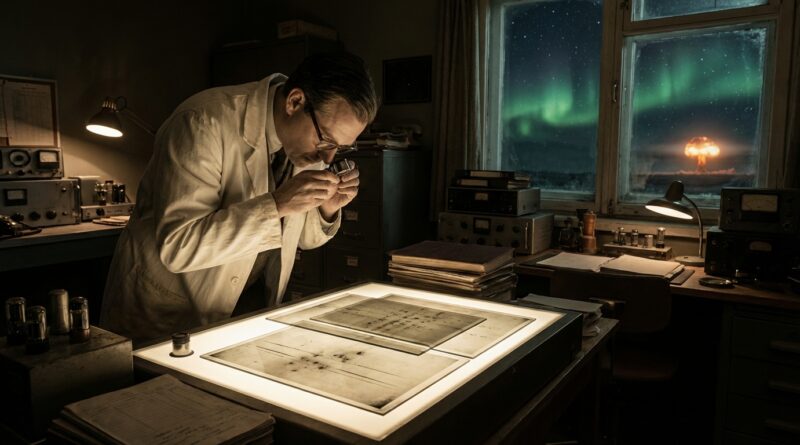
What makes this one different is the source material. We are talking about pre-Sputnik photographic plates, old-school sky records made before the modern space age changed how we observe Earth and orbit. These plates captured the sky in a way that can now be reviewed with better tools and, just as important, with fresh questions.
The new argument is simple enough to follow. Some bright flashes and strange tracks in those records may not be random defects. They appear to show timing patterns that overlap with early nuclear testing periods and, according to supporters of the idea, with spikes in UFO reports.
That overlap is what has people paying attention. Not because coincidence is impossible, but because coincidence is exactly the thing researchers now need to test properly.
What the former NASA scientist is actually saying
This is where it helps to slow down and keep your footing. A scientist saying “this deserves investigation” is not the same as saying “we found alien craft.” Those are very different statements.
The importance of a respected ex-NASA researcher speaking up is tonal as much as scientific. It tells other serious people that looking at odd data will not automatically end their credibility. In UFO history, that has often been the biggest barrier. Not lack of mystery, but fear of being laughed out of the room.
The key claim seems to be that at least some anomalous tracks could be artificial objects rather than simple plate contamination or instrument error. Could be. That is the whole point. It is a hypothesis that can be tested, challenged, and maybe knocked down. That is healthier than treating every odd dot in the sky as either proof of aliens or obvious nonsense.
Why the nuclear angle changes the conversation
Nuclear history has been tied to UFO stories for decades. Missile sites, test ranges, and weapons facilities show up again and again in witness accounts, military rumors, and government files. Usually, that is where the conversation slides into folklore.
Here, the nuclear angle matters because it gives researchers something concrete to compare against. Dates. Locations. Plate exposures. Known tests. Known atmospheric conditions. If bright sky events cluster around those windows more than chance would predict, that is worth knowing. If they do not, that is useful too.
This is how you pull a weird subject out of the swamp. You stop asking, “Do you believe?” and start asking, “What does the record show?”
What researchers would need to prove
For this idea to hold up, a few things have to happen.
First, the old plate anomalies need independent review by more than one team. Second, the methods for spotting and grouping these flashes need to be public and repeatable. Third, researchers have to rule out boring explanations like dust, scratches, chemical damage, light leaks, exposure errors, and ordinary astronomical objects.
That may sound less exciting than talk of watchers in our skies. But this is the part that matters. If the case survives boring scrutiny, then it gets interesting fast.
What ordinary readers should take from it
You do not need to become a plate archive expert to understand why this matters. The useful takeaway is that evidence can age well. Old data dismissed decades ago can become meaningful when people ask better questions and use better tools.
That is true in science, and honestly, it is true in everyday tech too. We have all had that moment where a device log, an old backup, or a tiny setting we ignored suddenly explains a problem. The data was there. We just did not know how to read it yet.
That is why this story has traction. It bridges serious science and a topic most institutions have treated like a career hazard. For readers who are tired of meme-level UFO chatter, this is a chance to watch a real test take shape.
The big caution: pattern does not equal proof
It is very easy to overread stories like this. Human brains love patterns. We connect dots fast, sometimes too fast. A timing overlap between sky flashes, nuclear tests, and UFO waves is intriguing, but it is not a verdict.
There are several possible explanations. The anomalies could be physical defects on the plates. They could be misunderstood natural phenomena. They could be artifacts of how the archive was stored or digitized. They could also represent something genuinely unusual. Right now, several doors are still open.
The good news is that this is exactly the kind of mystery that should be argued with records, not vibes.
How to read claims like this without getting fooled
Here is a simple filter.
Ask whether the claim includes original source material. Ask whether dates and methods are shared. Ask whether critics are addressing the data itself instead of mocking the topic. And ask whether supporters are willing to be wrong if better analysis points elsewhere.
If all you get is dramatic language and no trail back to the evidence, back away slowly.
Why this could matter beyond UFO culture
Even if the final answer turns out to be mundane, the process still matters. Rechecking old scientific archives can reveal blind spots in how institutions handled strange data. Sometimes “noise” really is noise. Sometimes it is a weak signal buried under bad assumptions.
That lesson reaches well beyond UFO talk. It touches astronomy, defense history, data preservation, and even public trust. People lose faith when every strange event is either hyped into fantasy or buried under official shrugging.
A careful study of these mysterious nuclear age sky flashes offers a third option. Take the anomaly seriously without turning it into religion.
At a Glance: Comparison
| Feature/Aspect | Details | Verdict |
|---|---|---|
| Source material | Pre-Sputnik photographic plates re-examined with modern interest and methods | More substantial than social media clips |
| Main claim | Some bright flashes and tracks may align with early nuclear tests and UFO report waves | Intriguing, but not proof |
| Scientific strength | Gets a boost from a respected former NASA scientist calling for serious investigation | Worth watching if independent review follows |
Conclusion
This story lands because it connects two worlds that usually avoid each other. Serious space science and the taboo subject of UFOs. That alone does not make the claim true. But it does make it harder to dismiss with a lazy joke. A fresh look at old sky plates, once written off as dust and glitches, now seems to show patterns that line up a little too neatly with the nuclear age and waves of UFO interest. Add a respected ex-NASA voice saying some anomalous tracks could be artificial, and the conversation shifts from internet spectacle to a real evidence problem. For anyone in the Anomal community, that is the best possible outcome. Less meme-chasing, more method. We may not be close to a final answer. But we may finally be getting better at telling the difference between random noise in old data and something in our skies that deserves a hard, honest look.