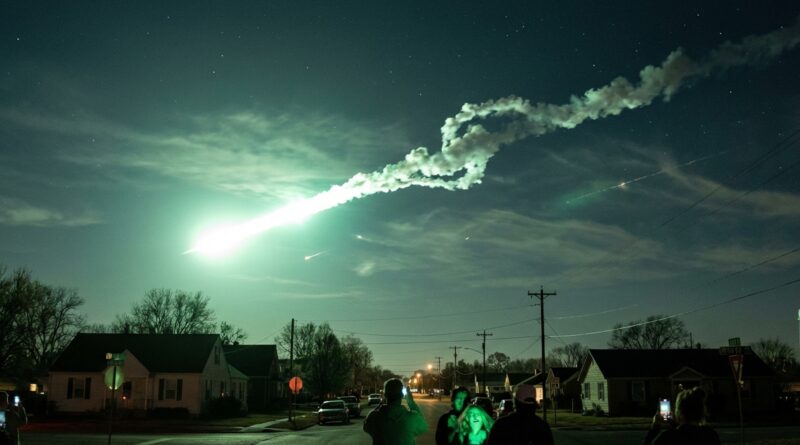
Mysterious Fireballs Are Surging Over Earth: Why 2026’s Sky Is Acting So Strange
If it feels like the sky has been acting weird lately, you are not imagining it. People in Germany, Texas, and plenty of places in between have reported brilliant fireballs in early 2026, some bright enough to light up neighborhoods, rattle windows, and spark instant UFO talk online. That gets frustrating fast, because every clip seems to split people into two camps. One says it was “obviously just a meteor.” The other says something stranger is going on. The truth sits in the messy middle. Yes, Earth regularly gets hit by bits of space rock. But even seasoned meteor watchers have admitted this year feels unusually busy, especially for dramatic, headline-grabbing fireballs. And a few reports, especially the ones describing sudden brightness changes or odd path shifts, do not fit neatly into the usual script. So let’s sort out what a real meteor surge looks like, what might explain the weirdest cases, and how to judge the next viral sky video without getting played by bad assumptions.
⚡ In a Hurry? Key Takeaways
- Yes, there appears to be a real spike in dramatic fireball reports in early 2026, but not every sighting points to something exotic.
- To judge a sighting, check time, direction, duration, sound delay, and whether multiple witnesses or camera angles agree.
- Never go meteor hunting at a fresh fall site without caution. Hot debris, private land, and false reports are all common problems.
Why the 2026 fireball wave has people on edge
Most years bring a steady trickle of meteor reports. That part is normal. What feels different in 2026 is the concentration of unusually bright events, the number of videos, and the fact that several reports include sonic booms, fragmentation, and long glowing trails seen across huge distances.
That matters because a fireball is not just any shooting star. It is a meteor bright enough to stand out dramatically, often brighter than Venus. Some become bolides, which can explode in the atmosphere and produce shock waves. When people hear a boom minutes later, that is often a clue the object was real, fast, and deep enough into the atmosphere to make a serious show.
The Germany and Texas events got so much attention because they checked several of those boxes at once. Bright light. Wide-area visibility. Sound reports. And enough witness accounts to push the story beyond one shaky phone video.
What could cause a real increase in fireballs?
1. Earth may be passing through denser debris
The simplest answer is often the right starting point. Earth moves through a messy orbital environment. If our planet intersects a richer stream of debris, you can get a cluster of stronger-than-usual meteor activity. That does not mean alien craft. It means timing and orbital mechanics.
Not all debris streams behave like famous meteor showers with neat dates on a calendar. Some are patchy. Some are leftovers from older comet trails. Some may be tied to asteroid fragmentation that has not been fully mapped yet.
2. More cameras mean more reports
This is also true. Doorbell cams, dash cams, security systems, and all-sky observatories catch things that would have gone unnoticed twenty years ago. A fireball over a rural area used to become a local story. Now it becomes twenty clips on social media by sunrise.
But this only explains part of the jump. Better cameras increase detection. They do not fully explain why some recent events have been so bright and physically intense.
3. Some “fireballs” are not meteors at all
Reentering space junk can look spectacular. So can rocket stages, old satellites, and hardware burning up in the atmosphere. These tend to move more slowly across the sky, often with a fragmented, train-like appearance. They can look bizarre enough to trigger instant speculation.
That said, not every strange sighting can be waved away as space junk. Some 2026 reports appear too fast, too bright, or too steep in angle for the usual reentry explanation.
Why some witness reports sound “impossible”
This is where things get interesting, and where people often talk past each other.
Witnesses sometimes describe fireballs making turns, stopping, speeding up, or changing direction mid-flight. On paper, that sounds impossible for a meteor. In practice, a few things can create that impression without requiring science fiction.
Perspective tricks
A bright object crossing the sky at high speed can seem to shift direction if the observer is moving, if clouds break unevenly, or if the object fragments and one bright piece outshines the rest. Human depth perception is not great against a dark sky with no fixed reference points.
Fragmentation and flare-ups
Meteors often break apart. When they do, one fragment may brighten suddenly while another fades. To a witness, that can look like a sharp turn or a sudden acceleration. It is really a change in which fragment your eye is tracking.
Low-angle entry paths
An object skimming the atmosphere at a shallow angle can seem to travel in a long, odd path. If it breaks in stages, that path can look unnatural, especially on wide-angle phone video that distorts motion near the edges.
Still, there are cases where the footage and witness descriptions remain awkward fits for the standard explanation. That is worth saying plainly. “Probably a meteor” is not the same as “case closed.”
What made the Germany and Texas sightings stand out?
While exact details vary by report, both cases drew attention for the same basic reasons.
Germany
Witnesses described an intense light, a fast-moving fireball, and in some areas delayed booms or rumbling. Reports from multiple locations suggested a wide visible path, which usually points to a high-altitude atmospheric event rather than something local like a transformer explosion or aircraft issue.
Texas
The Texas event got extra traction because of the brightness and the social media aftermath. Several accounts described a blinding streak followed by explosive sound. Those details are consistent with a bolide, but some witnesses also reported odd visual changes that helped fuel the “not just a rock” debate.
That phrase, by the way, is where people get stuck. “Not just a rock” can mean many things. A fragile cometary fragment. A metal-rich meteoroid. Space debris. Multiple objects entering close together. Or yes, something not yet explained well. You do not have to jump straight to the wildest answer to admit a report is unusual.
How to tell a meteor from reentering space junk
If you want to make sense of future mysterious fireball sightings 2026 is producing, start with a few basic clues.
Speed
Meteors are usually very fast. Reentering debris often appears slower and more prolonged.
Trail shape
Space junk often breaks into a long string of glowing pieces, almost like a parade of embers. Meteors can fragment too, but the look is often more explosive and sudden.
Duration
A classic bright meteor may last a few seconds. Reentries can stay visible much longer.
Sound timing
If people hear a boom well after the flash, that can support a real atmospheric event. Light arrives instantly. Sound does not. A delayed boom can help estimate distance.
Direction and official tracking
Rocket bodies and satellites are often tracked. If a known reentry happened at the same time and place, that is a big clue. If no tracked object matches, the mystery gets more interesting.
How to analyze a fireball sighting like a calm adult, not a panicked comment section
You do not need a PhD for this. You just need a checklist.
Write down the exact time
Even being off by five minutes can ruin comparisons with radar, seismic data, or satellite tracking.
Note where you were facing
North, south, east, west. If possible, estimate height above the horizon.
Estimate duration honestly
People are terrible at this under stress. Count it out afterward if you have video.
Listen for delayed sound
If there was a boom, how long after the flash did it happen? That is useful.
Save the original video
Do not just post a compressed social clip. Original files keep metadata and image detail.
Compare with other witnesses
If three people from different towns saw the same path, that is far better evidence than one dramatic post.
This is the kind of basic fieldwork that turns skywatching from doom-scrolling into real observation. It is also how communities separate good mysteries from recycled nonsense.
What experts still do not know
Here is the honest part. Experts can explain a lot, but not everything quickly. Atmospheric entry is chaotic. Composition matters. Entry angle matters. Weather matters. Camera lenses distort. Witness memory drifts. And sometimes there just is not enough data.
That uncertainty is not weakness. It is how real investigation works. Good analysts do not force every case into one neat bin. Some events become confirmed meteors. Some become likely debris. Some remain unresolved because the evidence is thin or contradictory.
That is exactly why these cases hold people’s attention. The mystery is real, even when the final answer turns out to be ordinary.
Should you worry?
Probably not in the end-of-the-world sense. Most fireballs burn up high in the atmosphere. Even when fragments survive, the risk to any one person is tiny.
But there are practical reasons to pay attention. Strong bolides can create shock waves, start small local searches for meteorites, and briefly confuse emergency services. In rare cases, debris can reach the ground. So curiosity is fine. Panic is not useful.
What to do if you think a meteorite landed nearby
First, do not rush toward the area assuming you will find a smoking alien part. Meteorite hunts are messy. Reports are often wrong. Land ownership matters. And fresh fragments may be sharp or contaminated by whatever they hit.
Do this instead.
- Mark the time and direction of the sighting.
- Check whether others in your area reported the same event.
- Look for official notices from astronomy networks, local observatories, or weather services.
- If you find a suspicious rock, photograph it where it sits before touching it.
- Use gloves and document location carefully.
Why open-minded beats gullible
The internet is very good at two bad habits. Explaining everything away too fast, or turning every bright streak into proof of visitors. Neither approach helps.
The smart middle ground is simple. Start with the likely explanation. Keep the weird details on the table. Update your view when better data arrives.
That is especially important this year. The rise in reports appears real enough to deserve attention, and a few cases do not sit comfortably inside the “nothing to see here” box. But weird is not the same as extraterrestrial. Not yet, anyway.
At a Glance: Comparison
| Feature/Aspect | Details | Verdict |
|---|---|---|
| Typical meteor fireball | Very fast, bright, often lasts a few seconds, may fragment and produce delayed boom | Best fit for many 2026 sightings |
| Reentering space debris | Usually slower-looking, longer-lasting, often appears as multiple glowing pieces in a line | Explains some events, but not all |
| Truly unexplained cases | Conflicting data, odd brightness changes, unclear trajectory, no known reentry match | Worth watching, but still unproven |
Conclusion
The big picture is this. Early 2026 really does seem to be serving up more dramatic fireball events than usual, and that alone is enough to keep both scientists and the Anomal crowd paying attention. The Germany and Texas sightings helped push the story into public view because they were bright, loud, widely seen, and just strange enough to resist easy cleanup by the usual talking points. A grounded, open-minded approach lets us do two useful things at once. We can understand what a normal meteor surge looks like, and we can keep a sharp eye on the cases that still do not fit. That is where this gets fun. Instead of passively scrolling past blurry clips and hot takes, readers can start collecting better evidence, asking smarter questions, and tracking patterns together in real time. That is real value. It turns confusion into investigation, keeps curiosity honest, and makes Anomal exactly the right place for a shared mystery that is still unfolding above our heads.