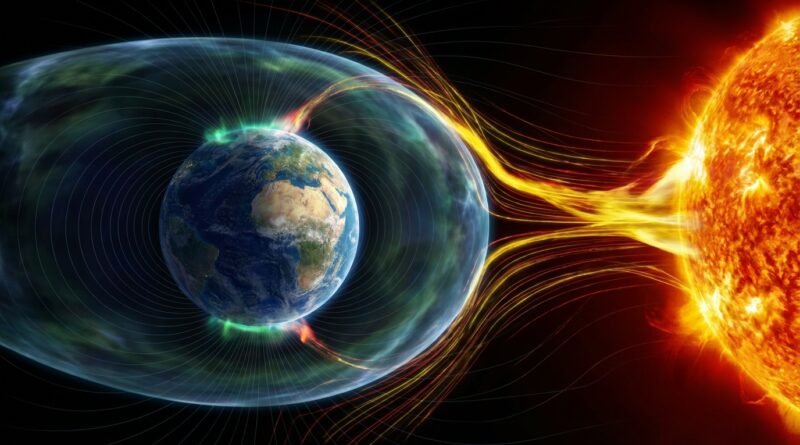
Earth’s New ‘Invisible Wall’ In Space: The Magnetic Mystery Shielding Our Planet
You have probably seen the same frustrating headline more than once. The Sun spits out a huge flare, experts warn about possible chaos, and then. Nothing. Other times a storm that looked routine suddenly lights up skies, messes with radio signals, or rattles power grid operators. It can feel like space weather is half science and half guessing. The truth is less spooky and more interesting. Earth really does sit inside a kind of magnetic bubble, and scientists are now digging into signs that this protection may act more like a shifting, uneven wall than the neat textbook version most of us learned.
That does not mean a brand-new sci-fi shield has appeared around Earth overnight. It means researchers are getting better at spotting magnetic structures in near-Earth space that can deflect, absorb, or redirect charged solar particles in ways we still do not fully understand. If you want to understand the mysterious magnetic shield protecting Earth from solar storms without needing a physics degree, start here.
⚡ In a Hurry? Key Takeaways
- Earth is protected by its magnetosphere, but scientists are finding that its magnetic boundaries can behave in strange, uneven ways that help explain why some solar blasts hit harder than others.
- You can track this yourself using NOAA space weather alerts, aurora forecasts, solar wind dashboards, and magnetometer data instead of relying on vague viral headlines.
- This is not a reason to panic. It is a reason to pay attention, especially if you care about auroras, ham radio, GPS reliability, or power grid impacts.
What is this “invisible wall” people are talking about?
The short answer is Earth’s magnetosphere. That is the giant magnetic region created by our planet’s core. It stretches far into space and acts like a protective zone against the constant stream of charged particles blowing out from the Sun.
But here is the part that often gets lost. This shield is not a smooth glass dome. It is messy. It flexes, wrinkles, compresses, and reconnects. When a coronal mass ejection, also called a CME, races toward Earth, the way that solar material is magnetically aligned can matter just as much as its speed.
So when people describe a mysterious magnetic shield protecting Earth from solar storms, they are usually reacting to a real scientific puzzle. Why do some violent outbursts glance off or underperform, while others punch through more effectively? The answer seems to involve magnetic orientation, pressure, density, and local structures in near-Earth space.
Why some solar storms “miss” even when they seem aimed at us
This is the part that makes headlines sound confusing. A solar eruption can be huge and still produce mild effects at Earth. That happens for a few common reasons.
The eruption was never centered on Earth
Sometimes the blast looks Earth-directed in early images, but later data shows we only caught the edge. Think of it like standing near the edge of a splash instead of getting hit by the full wave.
The magnetic alignment was wrong for a strong impact
This is a big one. If the incoming magnetic field lines do not connect well with Earth’s field, energy transfer is weaker. If they line up in a more hostile way, especially with a southward magnetic orientation called Bz south, Earth’s protective bubble is easier to disturb.
Space between the Sun and Earth is not empty
Solar wind streams, leftover plasma, and magnetic structures from earlier eruptions can change what happens to the next storm behind them. In some cases, they may blunt it. In others, they can make things worse.
Earth’s own shield is dynamic
The magnetopause, bow shock, radiation belts, and plasma sheet are always changing. So the barrier facing the Sun today is not exactly the barrier that was there yesterday.
So what is the “new” mystery?
The new part is not that Earth has a magnetic shield. Scientists have known that for a long time. The mystery is how many subtle layers and strange behaviors we are still finding inside that shield and at its edges.
Modern satellites can measure magnetic reconnection, particle flows, boundary ripples, and shock interactions with much better detail than older missions could. That is showing us that near-Earth space is more complex than the old simple diagrams suggest.
In plain English, Earth’s space shield may have blind spots, strong spots, and temporary magnetic traffic jams. That helps explain why forecasting solar storm effects is still hard, even with excellent solar images and models.
What this means for normal people on the ground
If you are not a scientist, this still matters. Space weather can affect everyday systems you probably use without thinking about them.
GPS and navigation
Strong geomagnetic activity can mess with signal accuracy, especially for aviation, marine use, farming equipment, and surveying.
Radio communication
Ham radio operators know this well. The ionosphere can help or hurt long-distance radio depending on what the Sun is doing. A magnetic disturbance can suddenly change propagation.
Aurora chasing
This is the fun part. A storm that couples strongly with Earth’s magnetic field can push auroras much farther south than usual.
Power and infrastructure
In big events, power grid operators and satellite managers pay close attention. Most storms are manageable, but the risk is real enough that the field is taken seriously.
How to track it yourself without getting fooled by hype
You do not need a PhD to follow this story. You just need a few reliable habits.
1. Watch NOAA’s Space Weather Prediction Center
Start with official alerts and forecasts. Look for G-scale geomagnetic storm ratings, solar radiation storm notices, and CME arrival estimates.
2. Check the Bz reading
If you want one nerdy metric that is worth learning, this is it. A sustained southward Bz often means better coupling with Earth’s magnetic field and a greater chance of stronger geomagnetic effects.
3. Look at solar wind speed and density together
Fast wind alone is not the whole story. Density spikes and pressure jumps can also matter. A moderate storm with the right setup can outperform a bigger one with the wrong setup.
4. Use aurora apps carefully
Aurora forecasts are helpful, but they are not guarantees. Treat them like weather apps. Good for trends, not perfect promises.
5. Follow magnetometer data
If you are really curious, local and regional magnetometer readings can show when Earth’s magnetic field is getting stirred up. This is especially useful for amateur radio users and aurora watchers.
Why scientists are still cautious
Because “we found a new invisible wall around Earth” is catchy, but it can be misleading. What researchers usually mean is that they are seeing new evidence of how Earth’s magnetic environment behaves under stress.
Science often works like that. The shield is real. The mystery is in the details. Which magnetic structures matter most. When they form. How temporary they are. And whether they can be used to improve forecasting before a storm reaches us.
That is a lot more useful than pretending everything is already solved.
What sky-watchers and ham radio users should do next
If this topic grabs you, now is a good time to build a simple watch list.
- Bookmark NOAA SWPC forecasts.
- Check real-time solar wind data from DSCOVR or similar dashboards.
- Save one trusted aurora forecast map.
- Track local magnetometer readings if available.
- Keep notes when forecasts and real-world results do not match.
That last one matters. Community pattern spotting can be surprisingly useful. If enough people notice that a certain kind of event underperforms or overperforms, it helps everyone ask better questions.
At a Glance: Comparison
| Feature/Aspect | Details | Verdict |
|---|---|---|
| Main “shield” | Earth’s magnetosphere deflects and redirects charged solar particles. | Real and important, but not simple or uniform. |
| Why storms vary | Magnetic orientation, solar wind density, speed, and existing space conditions all change the outcome. | This is why forecasts can still surprise people. |
| Best thing readers can do | Use trusted space weather tools and watch trends over time instead of reacting to dramatic headlines. | Smart, practical, and useful for aurora fans and radio hobbyists. |
Conclusion
The biggest takeaway is simple. Earth is not sitting naked in front of the Sun. We are wrapped in a complicated magnetic defense system, and scientists are still learning how its shifting weak points and strong points shape every solar storm that comes our way. That helps the community today because it turns a fresh, cutting-edge mystery in heliophysics into something you can actually track and debate on your own, instead of just soaking up spooky headlines about geomagnetic chaos. If you are a sky-watcher, a ham radio user, an aurora chaser, or just someone who likes knowing what is really going on, this gives you practical tools and a better mental model. You do not have to wait years for a final explanation. You can start watching the mystery unfold in real time.