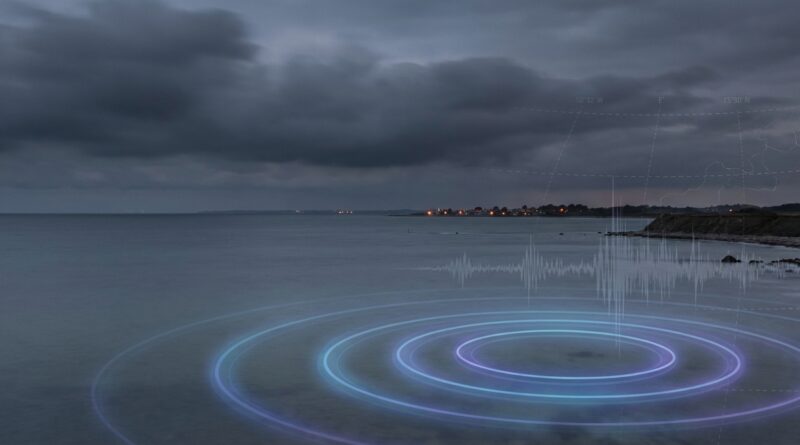
Denmark’s Invisible Shockwaves: The Mystery Tremors No One Can See Or Trace
Something shook Denmark, and that is the frustrating part. People looking at the data can see the tremors clearly, but the usual explanations are missing. No confirmed earthquake. No obvious explosion. No easy pin on a map. Over the last day, seismic stations picked up short, sharp jolts that seem to have come in from offshore, then faded out before anyone could trace a clean source. That makes this more than just another odd blip on a chart. It is a live mystery with real instruments, real waveforms, and a lot of unanswered questions. If you have ever rolled your eyes at vague “strange event” stories, this one is different because the sensors really did light up. The hard part is figuring out what they actually captured. Was it acoustic energy coupling into the ground, a marine source, weather-related pressure waves, or something much rarer?
⚡ In a Hurry? Key Takeaways
- Denmark’s mystery tremors look real on seismic networks, but they do not match a normal local earthquake signature.
- If you want to follow the case, compare timing across multiple stations and look for whether the signal arrives like a ground quake or more like an acoustic wave from offshore.
- This is interesting, not proof of anything supernatural. The smartest move is to separate what instruments show from guesses spreading online.
What happened, in plain English
The search term here says it well: Denmark mystery tremors acoustic waves from unknown source. That is the heart of it.
Seismic sensors in and around Denmark picked up pulses that felt earthquake-like on the graphs. But when geologists started doing the usual checks, the event did not sit neatly in the earthquake box. A normal quake usually leaves a more familiar pattern. You expect certain wave arrivals, a likely epicenter, and a source you can triangulate with growing confidence.
Instead, these signals seem to have raced in from somewhere out at sea. They were sharp, unusual, and hard to pin down. That matters because seismic stations do not only hear earthquakes. They can also pick up blasts, sonic booms, landslides, quarry activity, and even strong atmospheric pressure waves if the conditions are right.
Why experts are scratching their heads
Think of a seismic network like a neighborhood of doorbell cameras. One camera catches motion. That is interesting, but not enough. Ten cameras catching the same thing from different angles tells a story. Here, the “cameras” saw something, but the angles are not lining up into a clean answer yet.
No confirmed earthquake source
If this were a small offshore quake, researchers would usually be able to estimate where it started. Even if the answer was rough at first, the pattern would tighten as more stations reported in. That does not seem to be happening cleanly here.
No obvious blast explanation
Explosions can also leave distinct fingerprints. They often look different from natural earthquakes because the energy release is more abrupt and shallow. If there were a known industrial blast, military event, or accident, that would quickly jump to the top of the list. So far, there is no widely accepted match.
The signals may involve air-to-ground coupling
This is where things get interesting for non-specialists. A strong acoustic event in the atmosphere or over the sea can sometimes couple into the ground and show up on seismic instruments. In simple terms, the ground can “hear” the air under the right conditions. That could explain why the tremors looked quake-like without being a classic earthquake.
How to read this mystery like an investigator
You do not need a geology degree to follow along. You just need a few basics and a little patience.
1. Look at multiple stations, not one scary screenshot
A single waveform posted on social media can be dramatic and misleading. What matters is whether nearby and distant stations recorded the same pulse, and in what order. If the timing spreads outward neatly from one point, that supports a physical source. If the pattern is messy or selective, the explanation may be more complicated.
2. Watch the arrival times
Earthquakes usually send out different wave types at different speeds. If the signal lacks the expected separation, or if it appears more like a fast-traveling pressure disturbance, that pushes people toward an acoustic or mixed-source explanation.
3. Check whether the source “moves” offshore
One clue in reports like this is directionality. If several stations suggest energy coming from sea routes or coastal directions rather than from a fixed underground point, that is a sign the source might not be tectonic at all.
4. Ignore instant certainty
This is the internet’s least favorite rule, but it is the most useful one. Fast certainty is usually wrong in cases like this. The best explanations tend to get boring before they get solid. That is normal science, not a cover-up.
Most plausible explanations so far
No single answer has won yet, but a few candidates make more sense than others.
Atmospheric acoustic waves
A pressure wave from a distant source over water can travel efficiently and interact with the ground near coastlines or at sensor locations. This would fit the “felt like a quake, acted unlike a quake” problem pretty well.
Marine or offshore industrial activity
Ships, offshore construction, controlled detonations, or sonar-related operations can create odd signatures. That does not mean one of these happened here. It just means investigators will check them because offshore sources are part of the real-world shortlist.
Meteorological effects
Sudden pressure jumps, rare atmospheric conditions, or ocean-atmosphere interactions can do weird things to sensor networks. Weather is not usually dramatic enough to fool a seismic network this way, but “usually” is doing a lot of work in a mystery like this.
A small unusual seismic event
It is still possible this was a real geophysical event with an awkward signature. Earth does not always read the textbook before it moves.
What probably does not fit well
At the moment, a few popular online theories look weak.
“It must be a hidden major earthquake”
Large quakes are hard to hide from regional and global networks. If this were a standard quake of meaningful size, the data trail would likely be clearer by now.
“The sensors are broken”
One bad sensor happens. Several stations seeing related signals is different. Instrument errors can distort details, but they are less likely to create a whole coordinated event out of thin air.
“This proves something paranormal”
No. It proves there is an anomaly worth studying. That is enough. Jumping straight from strange to supernatural skips the interesting part, which is learning how experts narrow things down.
Why this case is so compelling
Most weird stories arrive after the fact, wrapped in rumor and half-memory. This one is different because it is being captured in real time by instruments. That makes it catnip for the Anomal community.
You are not just reading a spooky headline. You can follow the clues. You can compare station traces. You can watch how serious observers test ideas and throw weak ones out. That is much more satisfying than doom-scrolling through recycled mystery posts.
And that is the real value here. Cases like this teach people how evidence works. Not in a classroom way. In a live, messy, unfolding way.
What to watch next
If you are tracking this story, keep an eye on four things.
Official seismic updates
Regional geology and seismology groups may revise early readings as more data comes in. First takes are often rough.
Offshore incident reports
If a maritime, industrial, or military source is involved, details may surface later than the sensor data did.
Waveform comparisons
The more side-by-side comparisons that appear from different stations, the easier it becomes to tell whether this was seismic, acoustic, or a mix of both.
Repeat events
If it happens again, the mystery gets easier to test. Repeated patterns are gold. One-offs are much harder.
At a Glance: Comparison
| Feature/Aspect | Details | Verdict |
|---|---|---|
| Classic earthquake fit | Tremors were recorded, but the source location and expected wave pattern do not appear clean or settled. | Possible, but not the leading simple answer. |
| Acoustic or pressure-wave source | Offshore directionality and odd signal behavior make air-to-ground coupling a credible idea. | One of the stronger explanations right now. |
| Online rumor theories | Claims are moving faster than confirmed data, and many skip basic source-checking. | Treat with caution until evidence catches up. |
Conclusion
Denmark’s invisible shockwaves are the rare kind of mystery that rewards paying attention. The data says something happened. The hard part is naming it correctly. For the Anomal community, that is the fun of it. This is a modern, instrument-captured event sitting right on the border between geophysics and the genuinely strange. If you follow it carefully, you get more than a weird headline. You learn how to read tremor waveforms, compare sensor arrays, and sort hoaxes from plausible but unsettling explanations. That turns you from a passive reader into part of the hunt, and honestly, that is a lot more interesting than pretending the answer is already obvious.