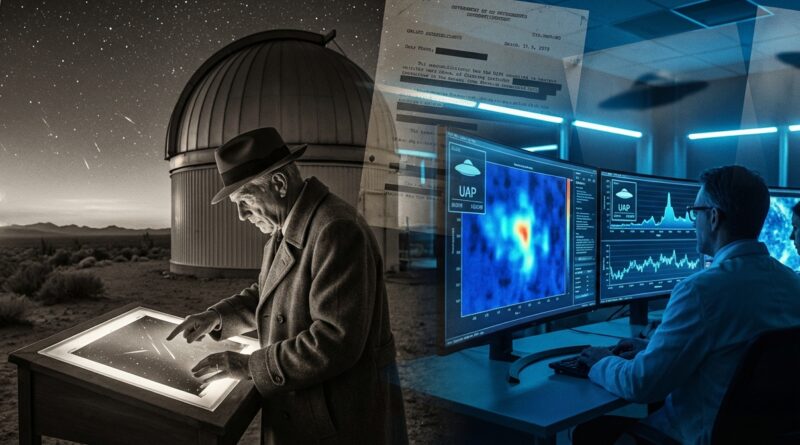
Cold War Ghost Lights: New Study Links 1950s Sky Flashes To Nuclear Tests And Modern UAP Mysteries
If you follow UFO news, you already know the problem. Most of the conversation is built on blurry clips, secondhand stories, and posts that spread fast but prove very little. That gets old. Fast. What makes this new research so interesting is that it does the opposite. Instead of asking you to trust a shaky phone video, it goes back to old astronomical records and asks a simple question: did strange sky flashes show up in the data long before social media, and did they appear around moments of extreme human activity like nuclear tests? According to the study, the answer may be yes. Researchers re-checked decades-old photographic plates and found short-lived flashes in the sky that seem to cluster around Cold War nuclear detonations and periods that also saw waves of UAP reports. That does not prove alien visitors. But it does give serious skywatchers something they rarely get, which is measurable, historical evidence that something odd may have been happening overhead.
⚡ In a Hurry? Key Takeaways
- The new research suggests mysterious cold war sky flashes linked to nuclear tests and uap study patterns may be real enough to show up in archival astronomical data.
- If you discuss UAPs, use this study as a better starting point than viral clips. It is based on old sky plates, timing patterns, and statistical analysis.
- This is intriguing evidence, not final proof. The safest takeaway is that some sky events deserve more serious tracking, not wild conclusions.
Why this study matters more than the usual UFO headline
Most UAP stories fall apart for the same reasons. The footage is poor. The timing is vague. Nobody can check the original source. This study matters because it starts with something much harder to fake, which is archival astronomy.
The researchers looked at historical photographic plates, the glass or film records astronomers used to capture the night sky before modern digital sensors took over. These old plates are useful because they freeze a moment in time. If a brief light really appeared, and if it was bright enough, there is at least a chance it left a mark.
That gives us a very different kind of evidence. Not perfect evidence. But better.
What the researchers reportedly found
The basic claim is simple. When the team re-analyzed old plates, they found brief sky flashes that did not fit neatly into the usual buckets like known stars, ordinary photographic defects, or easily explained atmospheric effects. More interestingly, these flashes seemed to cluster around periods of nuclear weapons testing in the 1950s and around eras that produced spikes in UAP reporting.
That combination is what gives the study its punch.
A single weird flash could be dust, a scratch, a processing issue, or a camera problem. A pattern is different. Once events start grouping around certain dates and historical conditions, you have something worth paying attention to.
Why nuclear tests are part of the story
Cold War nuclear detonations were not just political events. They were giant physical disturbances. They dumped energy into the atmosphere, created electromagnetic effects, and in some cases produced optical phenomena that were visible far from the blast site. So one possible explanation is the boring one, which is that these flashes were indirect effects of weapons testing.
But the study appears to raise a more provocative possibility. If the flashes line up not only with tests, but also with periods of unusual aerial reports, maybe nuclear activity was not just causing strange sky effects. Maybe it was also correlating with whatever else people thought they were seeing.
Correlation is not proof. But it is not nothing.
This is the part where it helps to stay calm. A correlation does not mean one thing caused the other. People often skip that step because the exciting answer is more fun.
There are several possibilities:
- The flashes were physical side effects of nuclear testing and have nothing to do with UAPs.
- The flashes were real but came from natural or human-made causes that are still poorly cataloged.
- The UAP report waves and the flash clusters shared a common trigger, such as increased sky watching during tense military periods.
- Something genuinely anomalous was present, and the data is finally catching up.
The smart move is to keep all four on the table until more work is done.
How old photographic plates can still teach us new tricks
This is one of my favorite parts of the story, because it reminds people that “new discovery” does not always mean “new telescope.” Sometimes it means someone had the patience to re-check old material with better tools.
Think of it like scanning an old family photo at much higher quality. Suddenly you notice details nobody saw the first time. In astronomy, modern image analysis can pull patterns out of data that earlier researchers either missed or had no way to test properly.
That is a big reason this study is getting attention. It is not based on rumor. It is based on revisiting preserved records and asking sharper questions.
What counts as a “flash” in this context?
These are not hours-long glowing objects parked over a city. The reported events are short-lived bursts, the kind of thing that may appear briefly and then vanish. That matters because brief events are easy for human observers to miss and easy for casual witnesses to describe badly.
It also means historical plates are one of the few ways to catch them at all. A camera does not get bored, distracted, or excited. It just records what hit it.
Why UAP researchers should pay attention
If you are tired of debates that go nowhere, this gives you something concrete to point to. Not a grand answer. A better question.
Instead of arguing over whether one modern clip is fake, you can ask:
- Do unexplained sky events leave traces in archival scientific data?
- Do those events cluster around major human technological milestones, especially weapons testing?
- Can independent teams reproduce the same pattern using different archives?
Those are useful questions because they can be tested.
And that is the real value here. The mysterious cold war sky flashes linked to nuclear tests and uap study angle gives the UAP community a path away from endless opinion and toward evidence that other researchers can actually check.
What skeptics will say, and where they may be right
Skeptics are going to ask about plate defects, light leaks, timing errors, selection bias, and whether the researchers looked harder at dates they already expected to be interesting. Those are fair questions.
Old data is messy. Photographic plates can be damaged. Logs can be incomplete. Correlations can look stronger than they are if the sample is small or if too many variables are tested.
So if you are sharing this study, do not oversell it. Say what it is.
It is fresh, peer-reviewed work pointing to a statistical pattern in historical sky records. That is strong enough to be interesting. It is not strong enough to settle the UAP question by itself.
What this could mean if the pattern holds up
If future teams confirm the findings, the implications get uncomfortable in a hurry.
One possibility is that nuclear testing produced sky effects we still do not fully understand. That alone would be historically important.
Another possibility is the one that will get all the attention. If unexplained aerial activity really does bunch up around humanity’s most dangerous weapons work, then people will naturally ask whether something was reacting to us, monitoring us, or simply becoming easier to notice under those conditions.
That is where the study stops being just a Cold War curiosity and turns into a much bigger question.
How to use this study in real conversations
If you want to talk about this without sounding like you have lost the plot, keep it simple.
Use careful wording
Say the study found a pattern of short-lived sky flashes in archival data, with apparent clustering around nuclear testing periods and UAP report waves. That is accurate and hard to dismiss as hype.
Separate evidence from interpretation
The evidence is the flash pattern. The interpretation is what caused it. Those are not the same thing.
Ask for replication
The best next step is for other researchers to check other astronomical archives, military records, and atmospheric data sets. If the pattern appears again, the story gets stronger.
What skywatchers and researchers can do next
You do not need a classified lab to take a useful lesson from this. If brief aerial events matter, then timing and recordkeeping matter too.
- Log exact dates, times, direction, and weather when you observe something odd.
- Check whether your sighting lines up with known launches, tests, meteor activity, or atmospheric events.
- Favor multiple sensors when possible, such as visual observation plus camera plus radar data if available.
- Keep an eye on historical databases, not just current social media feeds.
That last point is easy to miss. Sometimes the most interesting UAP clues are not new. They are old, sitting in storage until someone bothers to run the numbers.
At a Glance: Comparison
| Feature/Aspect | Details | Verdict |
|---|---|---|
| Type of evidence | Historical astronomical photographic plates re-analyzed with modern methods | Stronger than anecdotal sightings, but still needs replication |
| Main pattern | Short-lived sky flashes appear to cluster around 1950s nuclear tests and UAP reporting waves | Interesting and testable, not yet definitive |
| What it proves | Suggests unexplained sky events may show up in cold historical data | Does not prove alien craft, but does justify more serious study |
Conclusion
This is why the study matters. It gives the UAP community something rare, which is fresh, peer-reviewed evidence rooted in old records instead of modern hype. By showing how astronomers re-examined decades-old plates and found short-lived bursts that seem to cluster around nuclear detonations and waves of UAP reports, it gives readers specifics they can actually use in debates, investigations, and their own skywatching. Just as important, it opens a darker question that is hard to shake. If these flashes really do track with humanity’s most dangerous weapons tests, what does that say about who or what might have been watching, and why the pattern only became visible once someone finally took the time to check the data properly? Even if the answer turns out to be less dramatic than many hope, this is still a step forward. It moves the conversation from folklore toward evidence, and that is always worth paying attention to.